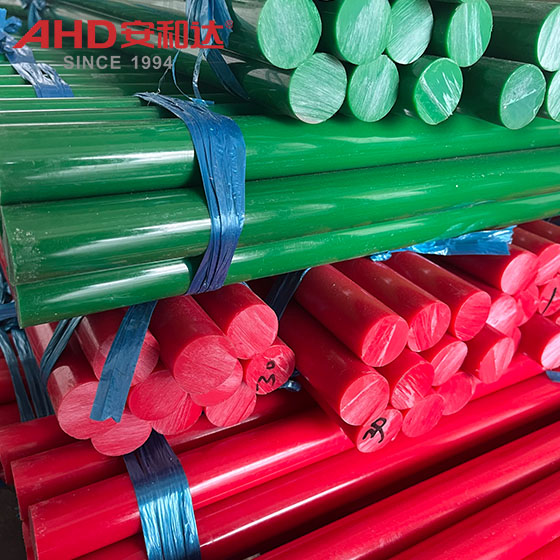
The processing technology of POM sheets (Delrin Sheet) and bars mainly revolves around their thermoplastic and machinability characteristics, encompassing three core categories: machining, thermoforming, and welding, to meet varying precision and shape requirements.
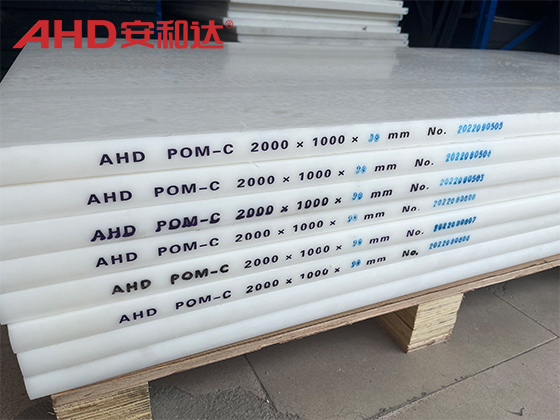
AHD Polyoxymethylene Sheet
I. Machining Processes (Most Commonly Used)
Machining is the most mainstream processing method for POM sheets and bars, enabling rapid manufacturing of high-precision POM Part and suitable for mass production or customized production.
Cutting: Using lathes, milling machines, planers, and other equipment, POM sheets and bars are turned, milled, and planed to produce regular or complex-shaped parts such as shafts, gears, and nuts. Care must be taken to control the cutting speed during machining to avoid overheating due to friction, which could lead to material melting or deformation.
Drilling and Tapping: Holes are drilled in the POM sheets and bars using a drilling machine, or internal threads are tapped using a tap. Due to the good toughness of POM material, an appropriate tap size must be selected to ensure clear threads that are not easily chipped.
Sawing: POM sheets and bars are cut to the required length or sheet size using circular saws, band saws, and other equipment. During sawing, the saw blade must be kept sharp to reduce burrs. Edge smoothness can be further improved through subsequent grinding.
Milling and Engraving: Using a CNC milling machine or engraving machine, grooves, recesses, or complex patterns are milled into the surface of the POM Sheet (Polyacetal Sheet). This is suitable for products with precise appearance and structure requirements, such as electronic components and instrument housings.
II. Thermoforming Process (Suitable for Complex Shapes)
Thermoforming utilizes the thermoplasticity of POM material, softening it through heating and then shaping it. This is suitable for manufacturing irregular or curved parts.
Hot Press Forming: The POM board is heated to its softening temperature (approximately 150-180℃), placed in a mold, pressure is applied, and after cooling, it is demolded to obtain the desired shape. This process is suitable for mass production of parts with curved or uneven structures, such as automotive interior parts and appliance housings.
Hot Bending Forming: The POM board is partially or entirely heated until softened, then bent into a specific angle (e.g., 90°, 135°) using a mold or fixture. After cooling, the shape is fixed. Commonly used in the manufacture of display racks, equipment covers, and other products requiring curved structures. During processing, it is crucial to control the uniformity of heating to avoid localized overheating and deformation.
III. Welding Processes (for assembly)
When POM sheets and rods need to be assembled into large or complex structures, welding can be used to ensure a strong and sealed joint.
Hot Air Welding: A hot air gun is used to heat the POM welding rod and the POM sheet to be welded to a molten state. Pressure is applied to fuse the welding rod and the sheet together, and a weld is formed after cooling. This process is simple to operate and suitable for sheet splicing, pipe connections, etc., achieving a weld strength of 70%-80% of the base material.
Ultrasonic Welding: Utilizing the heat generated by ultrasonic vibrations, the welding surfaces of the POM sheets and rods melt and bond rapidly. The welding time is short (usually within a few seconds) and no additional welding rods are required. Suitable for welding precision parts, such as electronic component housings and medical device components, ensuring a deformation-free and burr-free weld.
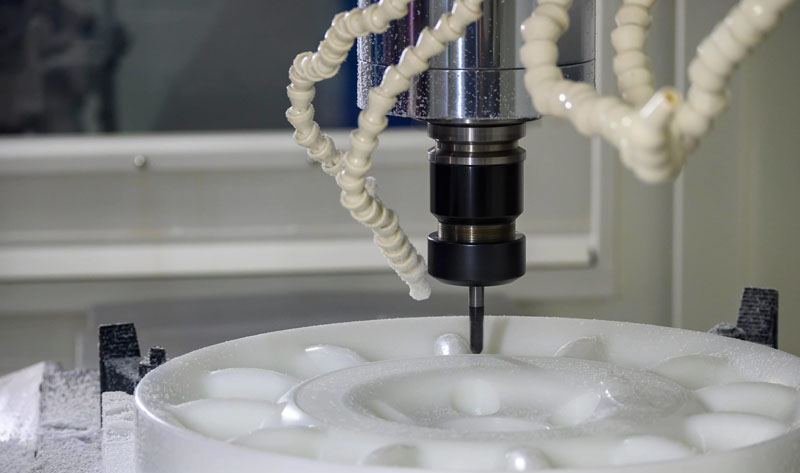
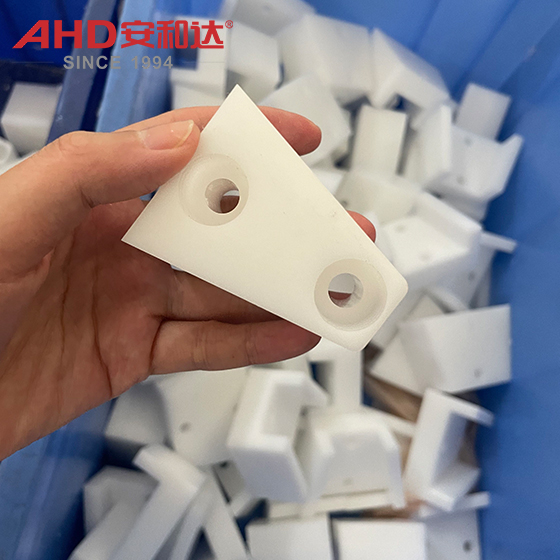
POM boards, through machining or CNC machining, can be manufactured into a variety of products, ranging from precision parts to structural components, with their core strengths revolving around ease of machining and high wear resistance.
I. Precision Transmission and Structural Parts
These POM Machined Part require extremely high dimensional accuracy and wear resistance, which CNC machining's high precision fully meets.
Gears: Machined into spur gears, helical gears, bevel gears, etc., used in the transmission systems of automotive windshield wipers, printers, and smart home devices, these POM Processed Parts can withstand high-frequency friction and are not easily worn.
Shafts and Sleeves: Manufactured into motor shafts, bearing sleeves, guide shafts, etc. CNC turning processes can ensure that the dimensional tolerances of the outer and inner diameters are controlled within ±0.01mm, adapting to the operational requirements of precision equipment.
Cams and Linkages: Used in cam mechanisms and link assemblies in automated machinery, CNC milling achieves complex surface machining, ensuring precise motion trajectories.
II. Electronic and Electrical Components
This field requires consideration of insulation, dimensional stability, and antistatic properties; machining can flexibly adapt to different specifications.
Insulating Brackets and Partitions: These are machined into insulating brackets and circuit board partitions inside electronic devices to prevent short circuits and withstand the localized high temperatures during operation.
Connectors and Terminal Blocks: CNC machining allows for precise milling of slots and holes on POM boards to create connector housings and terminal block bases, ensuring smooth insertion and removal and stable contact.
Semiconductor Fixtures: Such as wafer carrier trays and chip testing fixtures, these are precisely machined using CNC engraving to create positioning holes. Custom anti-static properties can also be added to prevent damage to semiconductor components.
III. Medical and Laboratory Equipment Components
These components have stringent requirements for material safety and processing precision. Machining must meet the dual requirements of sterility and wear resistance.
Surgical Instrument Accessories: These are machined into the jaws of surgical forceps and the handle connectors of scalpels, meeting medical-grade hygiene standards and withstanding ethylene oxide sterilization.
Laboratory Clamps and Containers: These are used to manufacture test tube racks, reagent bottle clamps, and reaction vessel liners. Surfaces can be machined to a mirror smooth finish to reduce impurities and facilitate cleaning.
IV. Industrial and Civil Structural Components
These components emphasize structural support and wear resistance. Machining (such as sawing and milling) allows for rapid standardization or customization.
Guide Rails and Sliders: Machined into linear guide rails and sliders for use in automated production lines and conveyor equipment. Their self-lubricating properties reduce equipment operating noise.
Equipment Housings and Covers: Machined using CNC milling and drilling into housings and control panel covers for small equipment. Heat dissipation holes and button holes can be milled as needed, combining protection and practicality.
Wear-Resistant Gaskets and Seals: Machined into round and square gaskets or seals for pipe connections and valve sealing. They are compression-resistant and resistant to aging, extending service life compared to traditional rubber gaskets.
POM Sheet and POM Rod in Colors