

HDPE (high-density polyethylene) hollow tubes and POM (polyoxymethylene) hollow tubes are two widely used plastic tube materials. Based on their different material properties, they differ significantly in performance and application scenarios. The following comparison focuses on their material basis, core characteristics, advantages and disadvantages, and application scenarios:

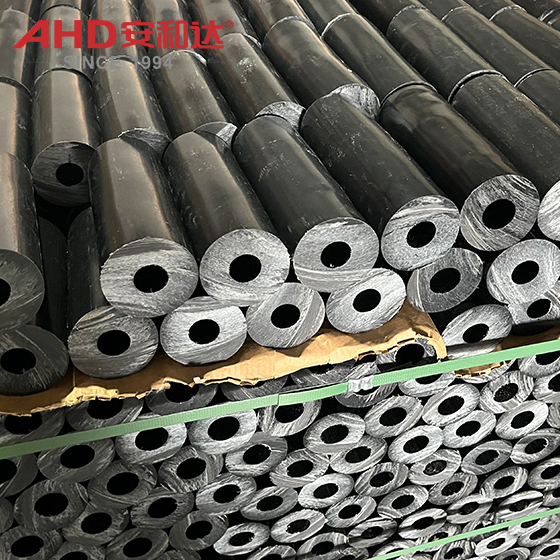
AHD Hollow POM Rod
I. Materials Fundamentals
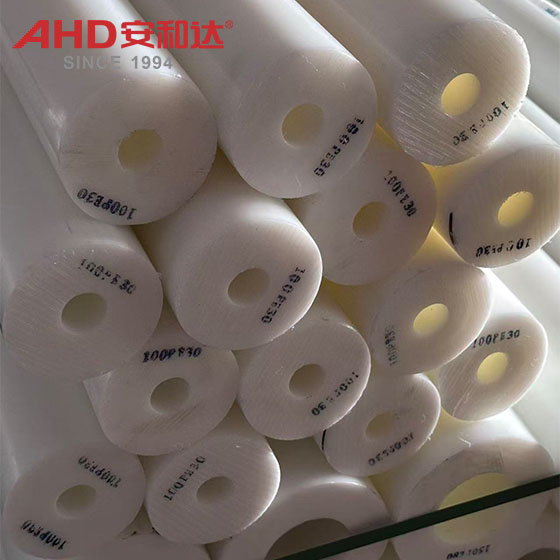
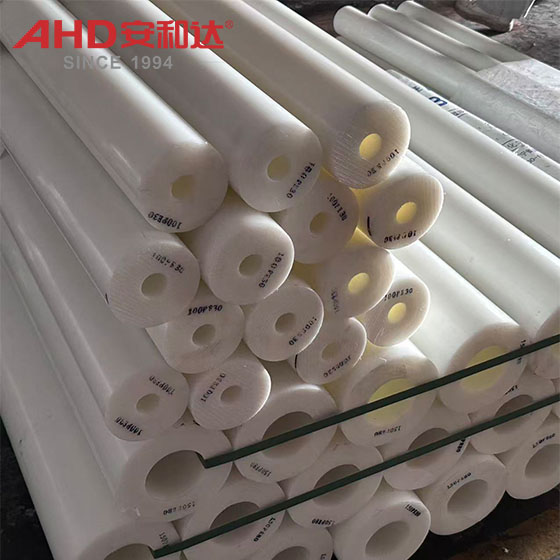
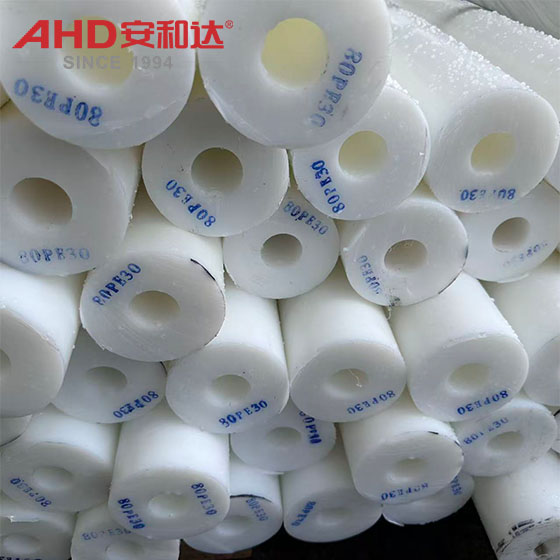 AHD Hollow HDPE Rod

| Item | Hollow HDPE Tube | Hollow POM Tube |
| Chemical Structure: | HDPE is a high-density polyethylene (PE) variety, with a main chain of linear ethylene monomer polymerization (-CH₂-CH₂-), very few branches, and a crystallinity of approximately 70%-80%. | POM is divided into homopolymer (-CH₂O- repeating units, crystallinity ≈75%) and copolymer (containing a small amount of ethylene oxide units, crystallinity ≈70%), with a main chain containing a large number of ether bonds. |
| Material Type: | Thermoplastic General-Purpose Plastic (Polyolefins) | Thermoplastic Engineering Plastic (High-Performance Crystalline Plastics) |
| Physical State: | White granules, odorless and no obvious odor | White or milky white granules, no obvious odor |
II. Comparison of Core Characteristics
1. Mechanical Properties
HDPE: Lower tensile strength (approximately 20-30 MPa), but high elongation at break, excellent impact resistance (especially at low temperatures, maintaining toughness even at -40℃), moderate rigidity and hardness (Rockwell hardness R60-70).
POM: High tensile strength (60-70 MPa), high flexural modulus (2.5-3.5 GPa), outstanding rigidity, hardness, and creep resistance; excellent fatigue resistance (can withstand millions of cycles of load), but relatively brittle (notched impact strength only 5-10 kJ/m²).
2. Thermal Properties
HDPE: Melting point approximately 120-135℃, long-term service temperature -50℃~90℃ (short-term resistance to 100℃), easily softens at high temperatures (Vicat softening point approximately 125℃).
POM: Homopolymer POM has a melting point of approximately 175℃, while copolymer POM has a melting point of approximately 165℃; long-term service temperature is -40℃ to 100℃ (short-term temperature can reach 123℃). Its thermal stability is better than HDPE, but it is prone to decomposition at high temperatures (releasing formaldehyde gas above 240℃).
3. Chemical Resistance
HDPE: Resistant to most inorganic acids, alkalis, and salt solutions (such as sulfuric acid, hydrochloric acid, and sodium hydroxide), but easily corroded by strong oxidizing agents (such as concentrated nitric acid); oil resistance is moderate (swelling occurs with prolonged contact with lubricating oil).
POM: Poor resistance to organic solvents (such as hydrocarbons and alcohols) and greases (easily swells or stress cracks), but good resistance to weak acids and weak alkalis; better resistance to strong oxidizing agents (such as chromic acid) than HDPE.
4. Weather Resistance and Aging
HDPE: Strong resistance to UV aging (requires the addition of antioxidants such as carbon black); slow performance degradation with long-term outdoor use; excellent low-temperature resistance.
POM: Poor weather resistance; UV radiation accelerates its oxidative degradation (surface powdering and embrittlement), requiring the addition of light stabilizers; low hygroscopicity (equilibrium water absorption < 0.2%), but dimensional stability is still slightly inferior to HDPE in humid environments.
5. Processing Performance
HDPE: Good melt flowability, can be processed using ordinary extruders, low shrinkage (1.2%-2.0%), suitable for large-diameter tubes production.
POM: High melt viscosity, temperature-sensitive (must be strictly controlled between 180-220℃ to avoid decomposition); high shrinkage (1.5%-3.5%), requires precision mold design, suitable for small-diameter, high-precision tubes.
6. Other Properties
HDPE: Excellent electrical insulation (volume resistivity > 10¹⁶ Ω·cm), non-toxic (meets food contact standards), recyclable.
POM: Low coefficient of friction (good self-lubricating properties), outstanding wear resistance, but slightly lower electrical insulation than HDPE.
III. Advantages and Disadvantages
HDPE Hollow Rod
Advantages:
① Low cost;
② Low temperature and impact resistant, suitable for cold regions;
③ Resistant to chemical corrosion (non-strong oxidizing environments), good weather resistance;
④ Simple processing, capable of producing large-diameter tubes;
⑤ Non-toxic and environmentally friendly, suitable for drinking water transportation.
Disadvantages:
① Lower rigidity and load-bearing capacity;
② Easily softens at high temperatures (performance deteriorates with long-term use above 80℃);
③ Low surface hardness, easily scratched by sharp objects.
POM Hollow Rod
Advantages:
① High strength and rigidity, capable of withstanding high pressure and heavy loads;
② Fatigue and wear resistant (suitable for dynamic friction scenarios);
③ Good dimensional stability (low water absorption) and precision;
④ Excellent self-lubricating properties.
Disadvantages:
① High cost (both raw material and processing costs are higher than HDPE);
② Poor weather resistance (prone to aging outdoors);
③ High brittleness (notch sensitive, prone to stress cracking);
④ Weak resistance to strong acids, alkalis, and oils.
IV. Application Scenarios
HDPE Hollow Tubes: Primarily used for low-pressure fluid transportation and outdoor infrastructure, such as municipal drainage/sewage tubes, gas pipelines (requiring a flame-retardant layer), agricultural irrigation tubes, cable sheathing pipes, and drinking water pipes.
POM Hollow Tubes: Primarily used in precision applications requiring high mechanical performance, such as piping for mechanical hydraulic/pneumatic systems, automotive fuel lines (resistant to fuel permeation), industrial robot drive guide pipes, and high-wear-resistant material conveying pipes (such as ore slurries).
V. How to Choose?
Choose HDPE: If the requirement is low cost, low temperature resistance, large diameter, outdoor weather resistance, or transportation of non-corrosive media (such as water, sewage).
Choose POM: If the requirement is high rigidity, fatigue resistance, wear resistance, precision dimensions, or dynamic friction applications (such as mechanical transmission, high-pressure oil circuits).
Both are highly complementary; the choice should be made comprehensively based on specific operating conditions (pressure, temperature, medium, lifespan, cost).