

Advanced engineering plastics are characterized by high strength, high heat resistance, and chemical corrosion resistance. Some varieties can be made transparent through formulation adjustments or process optimization, primarily for applications with higher performance requirements (such as high-temperature applications, precision optics, and medical implants). Common transparent sheets among engineering plastics include the following categories:
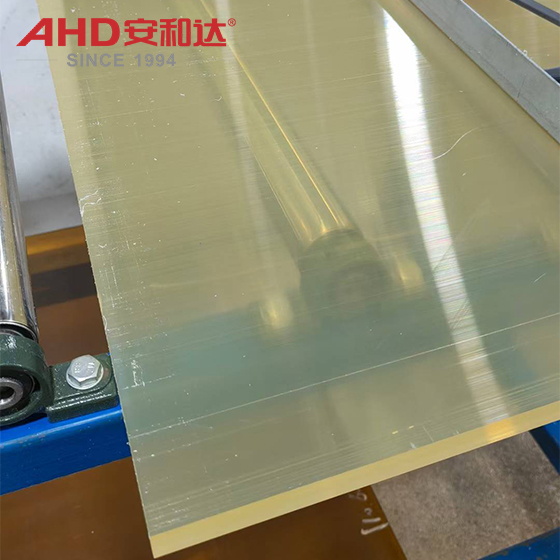
Ⅰ. Polysulfones (PSU/PPSU/PESU)
Polysulfones are a class of high-performance engineering plastics containing sulfone groups (-SO₂-), including common polysulfone (PSU), polyethersulfone (PESU), and polyphenylene sulfone (PPSU), all available in transparent or translucent grades (light transmittance 80%-90%).
Core Characteristics
High Temperature Resistance: Long-term operating temperature 120-180℃ (PPSU up to 180℃, PESU 160℃, PSU 150℃), far exceeding that of general-purpose plastics (e.g., PS ≤ 60℃).
High Strength and Rigidity: Tensile strength 60-80MPa, flexural modulus 2500-2700MPa, excellent creep resistance (no deformation at high temperatures).
Chemical Resistance: Resistant to acids, alkalis, oils, and most organic solvents (except highly polar solvents such as concentrated nitric acid), resistant to steam sterilization (a key advantage in the medical field).
Transparency: 80%-90% light transmittance, but the surface is easily scratched (requires coating protection), and may slightly yellow with long-term use (PPSU has the best weather resistance).
Typical Applications
Medical Devices: Surgical instrument trays, dental tools, artificial dialyzer housings (can be repeatedly sterilized at high temperatures).
Food Contact: Transparent parts for coffee machines/microwave ovens, baby bottles (PPSU, FDA certified non-toxic).
Electronics and Appliances: LED lamp holders, high-frequency circuit boards, high-temperature resistant insulation boards.
Aerospace: Transparent panels for aircraft interiors, instrument panel protective covers.
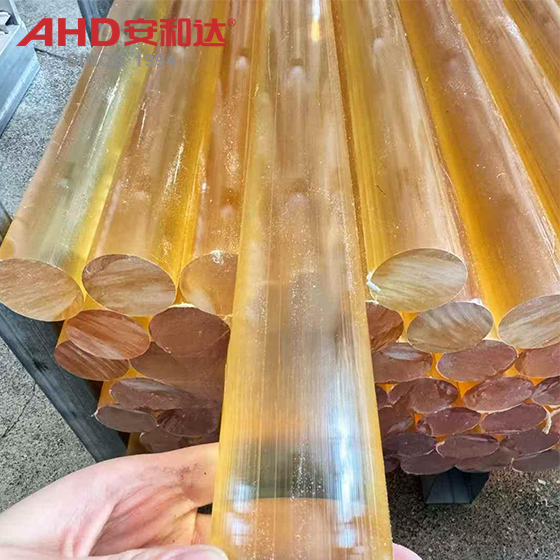
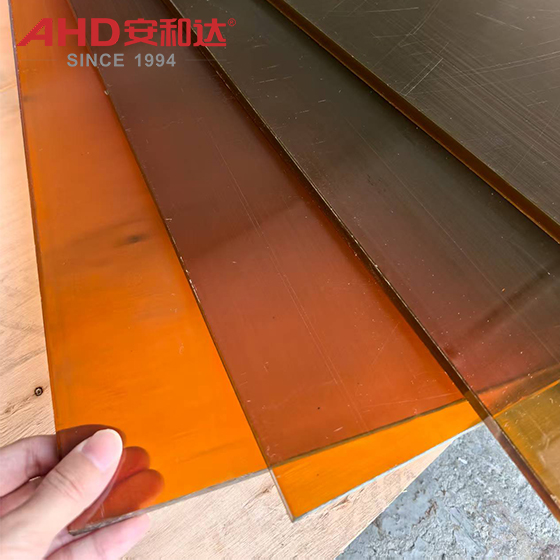 AHD Polyetherimide Sheet (PEI Sheet)
Ⅱ. Polyetherimide (PEI, Ultem)
Polyetherimide is a special engineering plastic containing imide rings and ether bonds. Although it comes in transparent grades (amber-colored translucent), due to color limitations, it is more often used for high-temperature structural components.
Core Characteristics
Light Transmittance: Approximately 50%-70% (translucent, not fully transparent), but with outstanding high-temperature resistance (long-term use 170℃, short-term 200℃).
High Strength and Flame Retardancy: Tensile strength 100-110MPa, flame retardant rating UL94 V-0 (no flame retardant required).
Radiation Resistance: Resistant to gamma rays and X-rays, suitable for nuclear industry or medical radiation environments.
Typical Applications
Aerospace Electronics: Transparent heat insulation panels (translucent, high-temperature resistant).
Semiconductors: Wafer carrier disks (resistant to plasma etching).
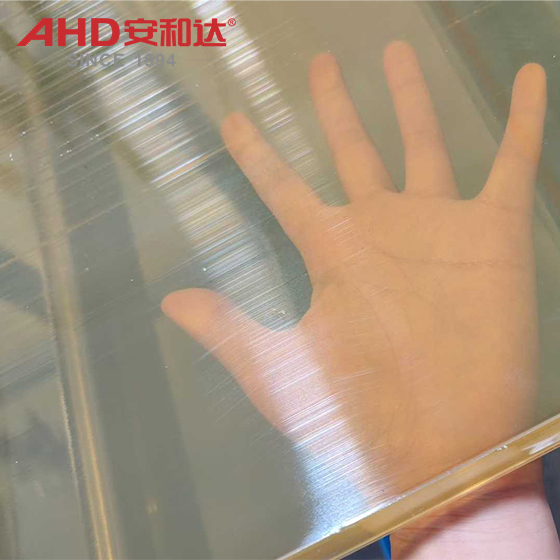
Ⅲ. Transparent Nylon
Nylon (polyamide, PA) is typically opaque, but transparent varieties can be produced through copolymerization modification (such as introducing monomers like m-phenylenediamine and p-phenylenediamine).
Core Characteristics
Transparency: 85%-90% light transmittance, low haze (<2%), and good optical uniformity.
Mechanical Properties: Combines the high strength (tensile strength 70-90 MPa), impact resistance (notched impact strength 30-50 kJ/m²), and oil resistance of nylon (superior to PC).
Temperature Resistance: Long-term operating temperature 80-120℃ (higher than general-purpose transparent plastics, lower than polysulfone).
Chemical Resistance: Resistant to weak acids and alkalis, but not resistant to strong acids and alkalis and high-temperature water vapor (easily hydrolyzed).
Typical Applications
Precision Optics: Lenses, optical lenses, fiber optic connectors.
Food Packaging: High-end transparent packaging boxes (e.g., chocolate and cheese trays). Automotive parts: Headlight lenses, sensor housings (oil and temperature resistant).
Medical equipment: Disposable syringe plungers, infusion bag connectors (transparent and easy to observe).
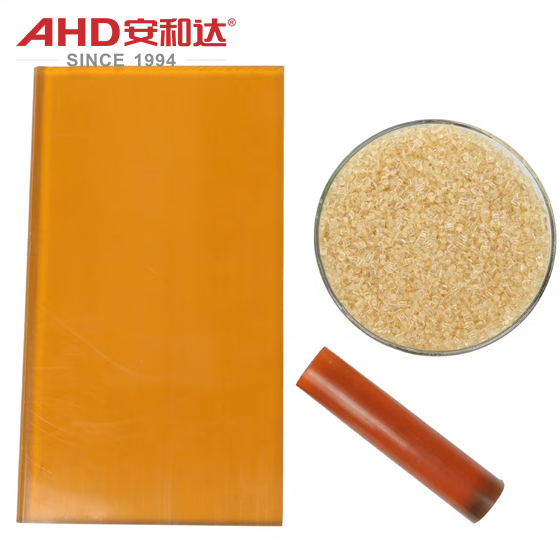
Ⅳ. Cyclo-Olefin Polymers (COP/COC)
Cyclo-Olefin polymers (COP/COC) are special engineering plastics polymerized from cyclic olefin monomers. They are divided into homopolymers (COP) and copolymers (COC), and are known for their ultra-high transparency and low birefringence.
Core Characteristics
Light Transmittance: 91%-93% (close to glass), haze <0.5%, extremely high optical purity (almost no impurity scattering).
Low Hygroscopicity: Water absorption <0.01% (far lower than PMMA), excellent dimensional stability.
Heat Resistance: Long-term operating temperature 80-130℃ (COC slightly lower than COP), good cold resistance.
Chemical Inertness: Resistant to acids, alkalis, and organic solvents; good biocompatibility.
Disadvantages: Relatively brittle (notched impact strength <5kJ/m²), high cost (approximately 3-5 times that of PMMA).
Typical Applications
Optics: Camera lenses, mobile phone camera lenses, AR/VR optical components (low birefringence reduces imaging distortion).
Medical Packaging: Pre-filled syringes, vaccine vials (transparent and sterile, gamma-ray sterilizable).
High-end Packaging: Transparent luxury packaging boxes, moisture-proof trays for electronic components (low hygroscopicity protects precision devices).
Analytical Instruments: Chromatography columns, cuvettes (optical homogeneity ensures detection accuracy).
Engineering plastic transparent sheet vs. general plastic transparent sheet
| Engineering plastic transparent sheets (such as PSU, COP, transparent nylon) | General-purpose plastic transparent sheets (such as PS, PMMA, PC) | |
| Advantages | High temperature resistance, high strength, chemical corrosion resistance, and good biocompatibility | Low cost, easy processing, and basic transparency (some components, such as PC, exhibit outstanding impact resistance) |
| Applications | Medical sterilization, precision optical components, high-temperature environments, high-end packaging | Daily necessities, advertising displays, general protective equipment, low-cost structural components |
| Cost | High | Low |
Engineering plastic transparent sheets are a "high-performance transparent solution" that makes up for the performance shortcomings of general plastics in extreme environments, and are irreplaceable, especially in high-value, high-reliability scenarios.