What is PET?
PET stands for polyethylene terephthalate. It is the core general-purpose plastic of the polyester family and belongs to Class #1 recyclable plastics. Its most common forms are the familiar transparent mineral water bottles and the raw material for textile polyester fibers.
Pure PET's chemical structure is a condensation polymer of terephthalic acid and ethylene glycol. Its physical properties are highly dependent on its crystallinity (the degree of order in the molecular arrangement): a completely disordered amorphous state is transparent and rigid; when heated, it rearranges and crystallizes, becoming milky white and brittle. Creating a highly crystalline state beforehand allows it to withstand high temperatures—APET and CPET are two branches of the same pure PET differentiated by "controlling crystallinity"; PETG is a derivative with a modified chemical structure.

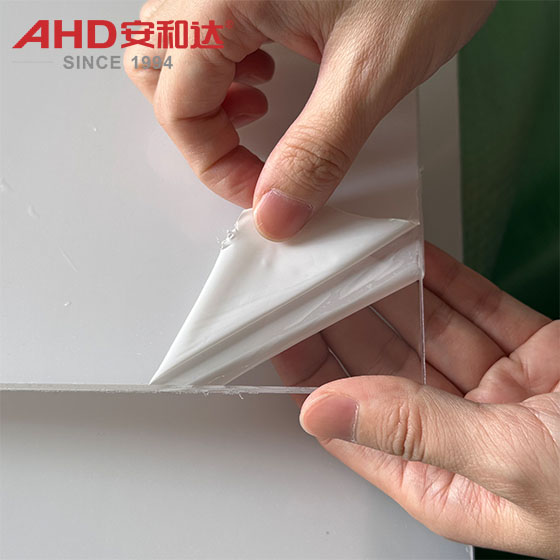
AHD PET Plastic Sheet With Protective Film
What are the three derivative product categories?
| Abbreviation | Full Name | Features | Typical Applications |
| APET | Amorphous PET | Pure PET that has not been treated with any crystallization is completely transparent at room temperature, has a high surface gloss and good hardness but is very brittle. It has a glass transition temperature of only about 70 °C, and will shrink and deform immediately when heated. It can stand a high temperature of only up to about 80 °C for a short time and its low-temperature brittleness is also obvious. | Transparent blister packs (battery/hardware/toy packaging), transparent trays for chilled food, adhesive tape substrate, standard transparent folding boxes |
| CPET | Crystalline PET | After adding nucleating agents to pure PET and high temperature annealing, the crystallinity is increased to 20%~40%, and the heat shrinkage problem is eliminated completely. Temperature resistance range is -40℃ ~ 220℃, can be directly put into the oven/microwave. That is milky white and opaque (highly crystalline state, light does not pass through). | Heat-resistant trays for pre-prepared meals/frozen microwaveable meals, oven baking trays, high-temperature food containers |
| PETG | Glycol-modified PET | This is not only a change of the form of pure PET, but the substitution of part of the ethylene glycol in the raw material with “1,4-cyclohexanediethanol (CHDM)”, which destroys the regularity of the molecular chain and makes it impossible to crystallize by itself. Therefore, it realizes “complete transparency + ultra-high toughness (impact resistance is 5 to 10 times that of APET) + extremely wide processing window (no need to worry about accidental crystallization and fogging during processing)”." But the heat resistance is a little worse than APET, and can only be used for a long time in the environment below 60℃. | High-end transparent packaging for cosmetics, medical device casings, 3D printing consumables, outdoor transparent signage, high-end blister display racks |

Clear PET Sheet (Polyethylene Terephthalate Sheets)
The core similarities among the three are:
They all belong to the polyester family, with a basic chemical skeleton of terephthalate, thus sharing most fundamental properties:
Food safety compatibility: As long as illegal additives are not used, they all meet the food contact material standards of various countries (China's GB, the US FDA, etc.), are odorless, resistant to oils, and do not easily react with food/chemicals;
Shared recycling origin: Pure PET (APET/CPET) has the official recycling code #1, and PETG is mostly classified into the #1 recycling stream (Note: If the proportion of PETG in industrial recycling is too high, it will lower the melting point of recycled PET and cause the finished product to turn yellow; therefore, high-end recycling systems will sort PETG separately);
Similar basic performance: They all have better oxygen and water vapor barrier properties than PE/PP, and their surfaces are easy to print on, metallize, and UV coated. Their densities are all around 1.38 g/cm³ (heavier than PP, slightly lighter than PVC);
Consistent environmental properties: They do not contain phthalate plasticizers (common toxic additives in PVC), and incineration only produces CO₂ and water, with no highly toxic byproducts.
Quick Tips to Avoid Common Pitfalls
Don't use APET as a heat-resistant container (it will shrink, deform, or even melt and drip when used for hot soup or microwaved). Also, try not to use CPET as transparent packaging (it's naturally milky white). While PETG looks nice and is durable, it's more expensive (generally 2-3 times that of APET). Choose products based on their temperature resistance requirements, and you won't go wrong.