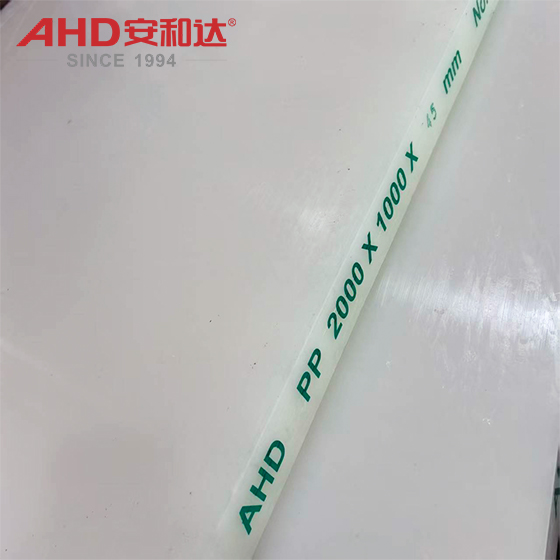
AHD distributors recently visited a precision‑plastic processing factory and looked at practical uses of PP sheet for parts of bottling‑line equipment.
The site visit was not a simple factory-tour recap but focused on real-world material-performance testing and delivered optimized parameter recommendations for non-contact PP filling-machine parts.
We gathered field-test data, conducted head-to-head material comparisons, and created standardized selection workflows to help filling-machine designers choose the best-performing polymer sheet for rotary-star-wheel assemblies and peripheral framing parts.
AHD has 32 years of experience in the engineering-plastic manufacturing and provides data-backed advice on material selection to OEM machinery builders in the food-factory and filling industries.
Core Performance Benchmark PP Sheet Vs HDPE Sheet For Non Contact Filling-Machine Parts
Most machinery engineers wrongly believe that HDPE and PP sheet will behave identically in non-contact bottling-line structures because these parts never contact the liquid, sauces or raw food materials.
Field-lab testing from the processing plant found critical thermal-rigidity gaps between the two polymers even on non-contact star-wheel guide plates and outer guard frames.
We measured four major benchmark indicators under standard CIP (Clean-In-Place) wash-cycle conditions, the universal sanitation process in all food-filling workshops:
Continuous working temperature stability: PP sheet can maintain stable dimensional performance up to 100°C, short-term heat resistance up to 120°C; HDPE will deform and creep at sustained temperature above 70°C.
Flexural‑rigidity retention : At 89% of its original bending strength, the PP sheet performs well at ambient heat of 65‑°C (common at hot‑fill stations). HDPE retains only 54% of its rigidity after 720‑hours of thermal exposure.
Chemical-resistant stability: PP sheet does not exhibit volumetric swelling in the presence of alkaline CIP cleaning fluid (pH 12-14), whereas HDPE is more easily expanded after long, repeated washing cycles.
Long-term wear life 15mm-thick PP sheet for rotary star wheel lasts 18,000 hours on high-speed bottling lines. Equivalent HDPE components warp after only 7,200 hours, causing frequent production downtime.
Non-contact plastic parts of filling machines are subjected to continuous hot-water rinsing, heat from filling valves, and repeated exposure to alkaline sanitizer, even without direct food contact.
This data clearly demonstrates that PP sheet is the far-superior polymer choice for bottling-line non-contact structures, while HDPE is viable for strictly-cold, non-washed warehouse-side buffer pads.
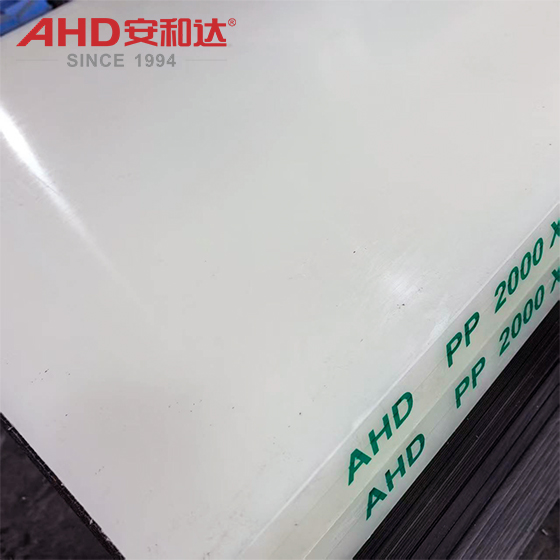
AHD Polypropylene Sheet
Global Industry Compliance Standards for Food‑Grade PP Sheet for Bottling Line
Even for non‑contact machinery parts, the PP sheet deployed in food‑processing factories still must comply with international regulatory standards, as airborne cleaning‑solution mist can settle on plastic panels during CIP cycles.
Any plastic material for bottling‑line environments needs to pass FAD, EU, GB, ISO core certification benchmarks, which AHD’s extruded PP‑sheet inventory consistently meets. Controlling resin purity and additive‑migration limits for food‑adjacent production zones.Restricting heavy‑metal and hazardous‑additive content.AHD’s PP‑sheet performance‑pass rate hits 99.2%.
Many generic‑grade PP sheets on the market skip strict additive‑screening. After repeated hot‑alkaline washing, low‑quality variants leach trace impurities and gradually turn yellow within 6‑10 months.
AHD’s PP sheet retains its original white finish and dimensional precision for 5+ years under standard bottling‑plant operating cycles.

Rotary-Star-Wheel Filling-Machine Assembly: Step-by-Step PP-Sheet Parameter-Selection Workflow
During consultation, AHD introduced a workflow for engineers to specify custom cut PP sheet dimensions for star wheel guide rings, outer limit blocks and machine base isolation plates:
Step 1: Map the local operating environment conditions
Begin by noting three critical on-site factors: max ambient temperature, number of weekly CIP washes, and whether the component is within 1-meter of hot-filling nozzles.
Where the non-contact component is adjacent to a thermal-fill station (85 – 95-°C syrup filling), homopolymer PP sheet can be selected. For all-cold ambient filling workshops, copolymer-grade PP is suitable.
Step 2: Verify the required range of sheet thickness
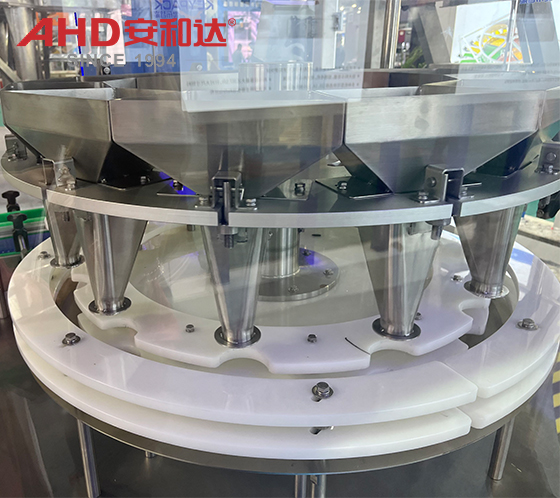
For segmented rotary-star-wheel guide plates (see exhibit, bottling-machine):
Low-speed filling-lines (≤3,000 bottles/hour): PP sheet, 10-15 mm thick
Medium-high-speed bottling-lines (6,000-12,000 bottles/hour): Reinforced-PP sheet, 18-25 mm, to resist vibration warping.
AHD extrudes PP sheet in standard thicknesses from 3 to 30 mm and supplies CNC-blank slabs sized for direct star-wheel-part production.
Step 3. Establish machining tolerance requirements
AHD custom-processes PP-sheet star-wheel segments with ±0.15 mm CNC-cutting tolerances to eliminate assembly gaps and unstable bottle-positioning on filling-production runs.
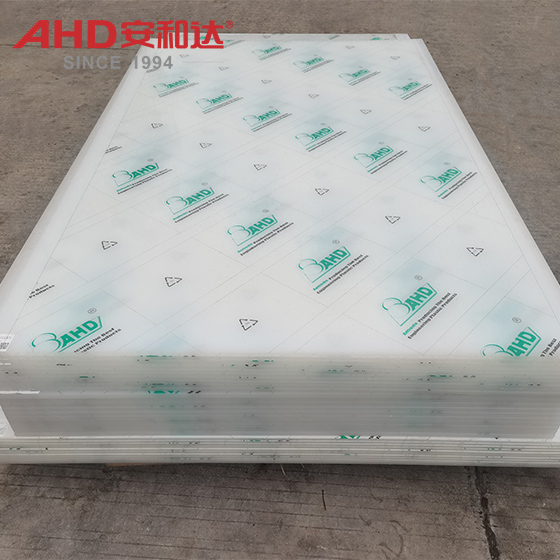
AHD Polypropylene Plastic Sheets
PP-Sheet Application Solutions for Different Segments of the Filling Industry
Hot fill beverage production (juice, iced tea): 15-25 mm homopolymer PP sheet for non-contact star-wheel guard structures, designed for repeated (90°C) daily sanitizing washes. In this case, HDPE is completely ruled out due to the risk of thermal creep.
Cold-fill carbonated drink bottling: For outer side conveyor limit blocks, 10-15 mm copolymer PP sheet will do. HDPE can be used only for off-line warehouse bumpers outside the production machine frame.
Fermented-yogurt & sauce filling lines: Modified PP sheet, chemical-resistant, for frame-isolation plates, resistant to long-term exposure to acid-sauce aerosol drift from filling nozzles.

AHD’s Unique Benefits for Sourcing Custom-Grade PP Sheet
AHD founded in 1994, has 32 years experience in the specialised engineering plastic sheet and rod production, and has a full range catalog of stock polymers: PP, HDPE, UHMW-PE, PA6, POM, PEEK, PEI and Bakelite sheets and rods.
Unlike traders who just stock generic plastic blanks, AHD formulate custom-modified PP-sheet grades in-house, tweaking rigidity, heat-resistance and anti-ageing additives to suit your specific needs.
Our in-house testing lab provides official performance-test reports, copies of FDA certification, and sample-size PP-sheet test blanks so engineers can run factory tests on-site before bulk procurement.