

Introduction to Anti-Static PC Sheet
PC (polycarbonate) anti-static sheet is a functional engineering plastic sheet based on a polycarbonate (PC) substrate modified by adding conductive fillers (such as carbon black, carbon fiber, or metal powder) or surface treatment (such as anti-static coating). Its core characteristic is a significantly reduced surface resistivity (typically 10⁶ to 10¹⁰ Ω), effectively suppressing static electricity accumulation while retaining the excellent physical and chemical properties of the PC substrate.
But why does the PC anti-static sheet maintain such high transparency even with the addition of conductive fillers?
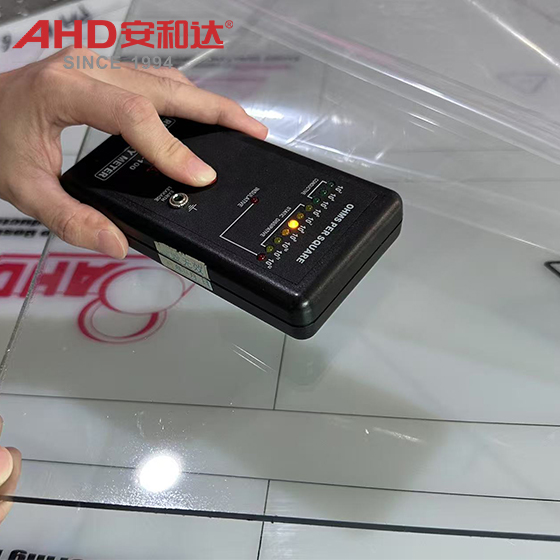
AHD anti-static polycarbonate sheet
The core reason anti-static PC sheets maintain high transparency lies in the combined effect of the optical properties of the PC substrate itself and the optimization of anti-static modification technology. The following is a detailed explanation from the perspectives of the material's nature and the modification principles:
Ⅰ. The Natural High Transparency of the PC Substrate
Polycarbonate (PC) is an amorphous thermoplastic with a long-range disordered amorphous structure (no distinct crystalline regions) within its molecular chains. This structural characteristic minimizes the scattering of visible light—light passing through it is virtually unobstructed by molecular chains or crystalline regions. As a result, PC's inherent light transmittance can reach 89% to 92% (close to the 90% of glass), significantly higher than common engineering plastics such as ABS (approximately 80%) and PVC (approximately 85%). This is the foundation of the transparency of anti-static PC sheets.
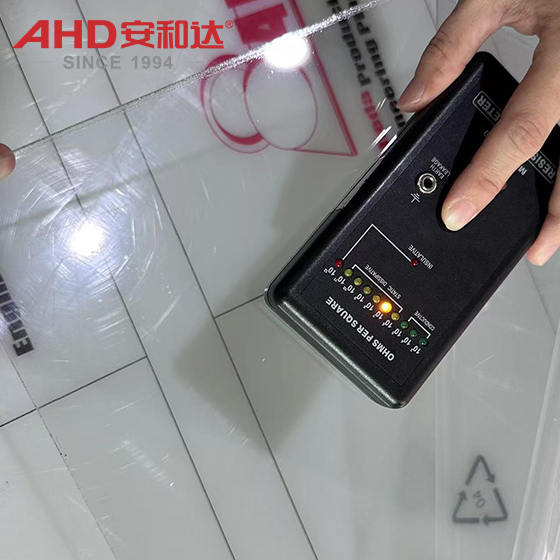
AHD ESD PC Sheet
II. "Transparency" Design of Anti-Static Modification Technology
The anti-static function of PC is typically achieved through the addition of conductive fillers or surface treatment. However, improper control of these two methods (such as filler agglomeration and coating turbidity) can impair transparency. The key to maintaining transparency in anti-static PC sheets lies in the precise control of optical properties during the modification process:
1. Internally Added Anti-Static PC: Selection of Nanoscale/Transparent Conductive Fillers
By uniformly dispersing nanoscale conductive fillers (rather than traditional coarse-particle fillers) within the PC resin, conductivity can be introduced while minimizing the impact on transmittance. Common fillers include:
Nanocarbon black: With a particle size of 50-200 nm (much smaller than the visible light wavelength of 400-700 nm), even dispersion does not create significant light scattering centers. Conductivity is imparted solely through the percolation effect (connected filler network) while maintaining high transparency (transmittance ≥ 85%). Nanometal oxides (such as antimony-doped tin dioxide (ATO) and fluorine-doped tin dioxide (FTO): They are inherently transparent conductive materials. Their nanoscale particle size (≤100nm) and high dispersion enable them to form a microscopic conductive network within PC, virtually eliminating any impact on light transmission.
Carbon nanotubes (CNTs) or graphene: When single-walled or few-walled carbon nanotubes (diameter <2nm) or graphene sheets (thickness <10nm) are dispersed within PC, they form extremely fine conductive pathways with negligible impact on light transmittance (transmittance ≥88%).
The "small size + high dispersion" design of these fillers is key to maintaining the transparency of internally added anti-static PC.
2. Surface-Treated Anti-Static PC: Application of a Transparent Conductive Coating
By applying a transparent anti-static coating (typically less than 10μm thick) to the PC sheet surface, anti-static functionality can be achieved without compromising the substrate's transparency. The key to this coating is:
Transparent conductive materials: These materials, such as indium tin oxide (ITO) nanoparticles, silver nanowires (AgNWs), or poly (3,4-ethylenedioxythiophene) (PEDOT:PSS), inherently lack absorption or scattering in the visible light range.
Coating Uniformity: Through spraying, spin coating, or chemical vapor deposition (CVD) processes, the coating forms a continuous, defect-free film on the PC surface, avoiding localized turbidity caused by uneven coating.
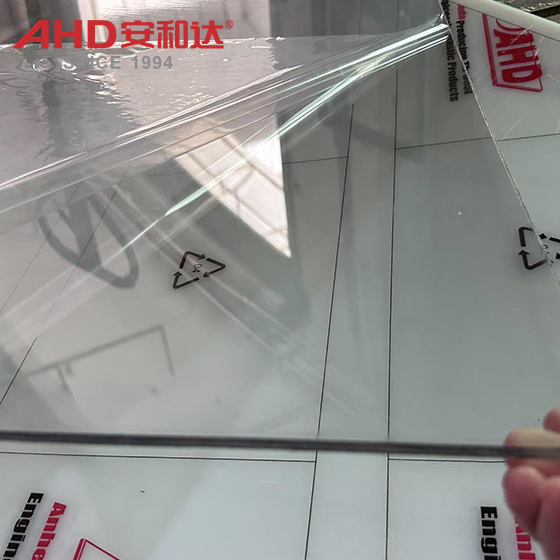
AHD ESD PC Plastic Sheet
The transparency of anti-static PC sheets stems from two key factors:
The inherent advantage of the PC substrate: its amorphous structure inherently provides high light transmittance;
The precise control of modification technology: through the use of nano-scale conductive fillers or transparent coatings, anti-static properties are introduced while minimizing light scattering.
This characteristic makes it irreplaceable in applications where both transparency and anti-static properties are required, such as electronic cleanroom observation windows, optical instrument protective panels, and transparent medical device housings.