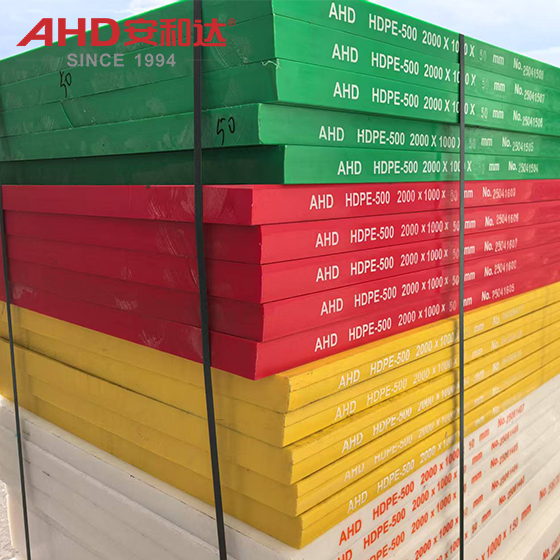
Ⅰ. Performance Differences Between 100% new material PE (Polyethylene) and Recycled PE (Polyethylene)
The core difference between 100% Virgin PE (new material) and recycled PE (recycled material reprocessed) stems from the raw material's purity and molecular integrity. Recycled PE undergoes the recycling-melting-pelletization process, resulting in molecular chain damage and impurities, leading to an overall decline in performance.

AHD New Material Polyethylene Sheet
1. Differences in Mechanical Properties
100% new material PE (such as HDPE, LDPE, and LLDPE) is directly polymerized from petrochemical raw materials. It features a regular molecular chain structure, controlled branching, and uniform molecular weight distribution. Recycled PE, on the other hand, is a reprocessed material that has been cleaned, melt-pelletized, and then reprocessed. Due to repeated heating (recycling, granulation, and remolding), its molecular chains degrade and break, resulting in a lower molecular weight and a wider molecular weight distribution. Specifically, these differences are:
Tensile Strength/Rigidity: 100% new material PE typically has a 20%-50% higher tensile strength than recycled PE, resulting in greater rigidity and resistance to deformation.
Impact Toughness: 100% new material PE has higher notched impact strength. Recycled PE, due to molecular chain breakage and impurity interference, has lower toughness and is more susceptible to brittle cracking at low temperatures.
Fatigue Resistance: 100% new material PE has a longer lifespan under repeated stress (such as when used in load-bearing structures). Recycled PE, due to its many internal defects, is prone to crack propagation, resulting in significantly lower fatigue properties.
2. Thermal Performance Differences
Recycled PE suffers from molecular chain degradation, resulting in large fluctuations in melt flow rate (MFR) and decreased thermal stability.
Melting Point and Heat Deflection Temperature: 100% new material PE has a relatively stable melting point (approximately 130-135°C for HDPE and 110-120°C for LDPE). Due to the reduced molecular weight, recycled PE may experience a 5-15°C drop in melting point and heat deflection temperature (HDT).
Processing Stability: Recycled PE readily decomposes during melting to produce small molecules (such as oligomers and monomers), which can cause bubbles, silver streaks, or yellowing on the surface of the finished product. 100% new material PE offers a wide processing window and a high yield.
3. Appearance and Dimensional Stability
Color and Transparency: 100% new material PE has a pure color (e.g., milky white, transparent). Recycled PE, due to residual impurities (e.g., pigments, oil stains, other plastics) or oxidation from multiple processing processes, tends to turn gray or yellow, resulting in reduced transparency.
Dimensional Accuracy: 100% new material PE has a stable shrinkage rate, resulting in consistent product dimensions. Recycled PE, due to its uneven molecular chains, has a large shrinkage rate fluctuation, making it prone to deformation and poor fit in precision parts.
4. Chemical and Aging Resistance
Chemical Corrosion Resistance: 100% new material PE's non-polar molecular structure and intact crystalline regions provide superior resistance to acids, alkalis, and salts.
Aging Resistance: Recycled PE, due to residual free radicals or oxidation products, has weak resistance to UV rays and oxidation. It is prone to chain oxidative breakage in outdoor environments or high temperatures, resulting in surface chalking and cracking 2-3 times faster than 100% new material PE.
5. Safety and Environmental Performance
Harmful Substance Migration: Recycled PE may contain residual contaminants from the recycling process (such as heavy metals, residual solvents, and microorganisms) or additives from other plastics (such as PVC and PP) (such as plasticizers and flame retardants), posing safety risks when used in food contact, medical, or children's products. 100% new material PE (especially food-grade) undergoes rigorous purification and is free of harmful migration.
Environmental Performance: While recycled PE reduces oil consumption, its performance degrades after repeated recycling and becomes unusable, requiring landfill or incineration. 100% new material PE, on the other hand, can improve its recycling rate through optimized design, making it more aligned with sustainable material management trends in the long term.
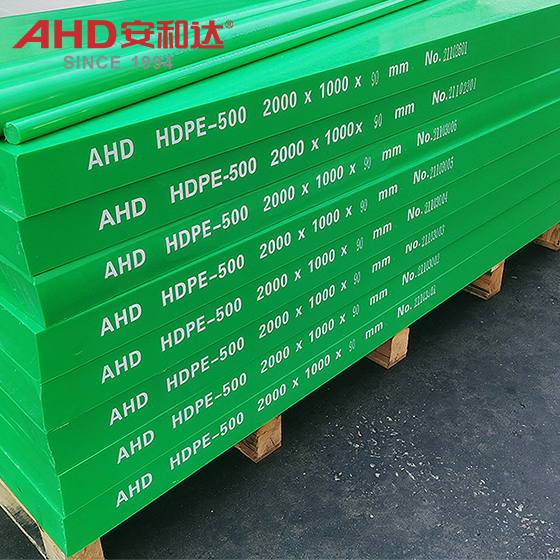
AHD High Density Polyethylene Sheet (100% new material)
Ⅱ. Summary of the Core Advantages of 100% new material PE
Stable Performance: Highly consistent mechanical, thermal, and weather resistance performance makes it suitable for high-load, precision, or long-term outdoor applications.
High Safety: No risk of impurity migration, meeting compliance requirements in demanding applications such as food and medical.
Strong Processing Adaptability: Stable melt flow and shrinkage make it suitable for forming complex parts (such as thin-walled sheets and high-precision bars).
Lower Long-Term Costs: While the initial purchase price is slightly higher, its long lifespan and minimal maintenance result in a more favorable overall cost-effectiveness.
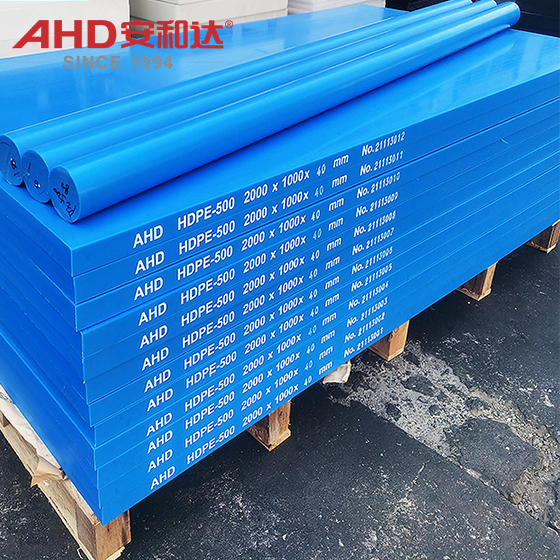
AHD HDPE Sheet
III. Main Applications of Recycled PE
Due to its low cost but limited performance, recycled PE is primarily used in low-load, non-critical, short-term applications, or where safety requirements are not stringent:
Daily necessities: Ordinary trash cans, flower pots, and storage boxes (not required for load-bearing or long-term outdoor use).
Temporary/low-quality structural components: Temporary fencing at construction sites and simple pallets (short-term use, not requiring a long lifespan).
Non-contact products: Stuffed toys (no chewing risk) and low-end packaging trays (no food contact).
Building materials with low performance requirements: Temporary sound insulation panels and simple decorative strips (not requiring aging resistance or load-bearing).
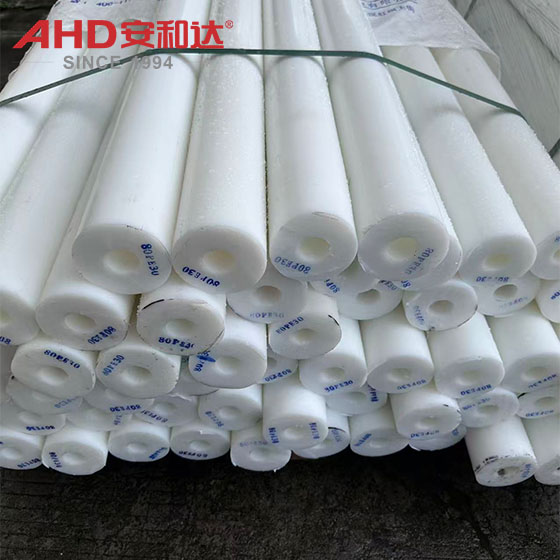
IV. Applications Where 100% new material PE Is Irreplaceable
In the following areas, recycled PE cannot meet demand due to performance or safety deficiencies, necessitating the use of 100% new material PE:
1. Food/Drug Contact Materials
100% new material PE (especially food-grade) undergoes rigorous purification and is free of the risk of harmful substance migration (such as plasticizers and heavy metals). Recycled PE may retain contaminants from the recycling process, posing safety concerns when used in food or pharmaceutical packaging.
2. High-Load/Long-Term Load-Bearing Structures
Such as heavy-duty logistics pallets, industrial shelving, and mechanical supports. 100% new material PE's high tensile strength and fatigue resistance guarantee a service life of 5-10 years. However, recycled PE, due to molecular chain breakage, is susceptible to deformation and fracture under long-term loads, posing a safety hazard.
3. Outdoor/Weather-Resistant Applications
Such as outdoor PE fencing, landscape trails, and marine buoys. 100% new material PE's UV-resistant additives and stable molecular structure slow aging. However, recycled PE, due to repeated processing and oxidation, ages rapidly, experiencing powdering and cracking within 1-2 years, leading to loss of functionality. 4. Precision/High-Precision Parts
Such as electronic device casings (requiring precise dimensions) and medical device accessories (such as IV bag holders). 100% new material PE has a stable shrinkage rate (variation <0.3%), ensuring assembly accuracy. Recycled PE has large shrinkage fluctuations, which can easily lead to poor fit or dimensional deviations.
5. Medical/Sanitary Applications
Such as surgical instrument cases and sterilization trays. 100% new material PE poses no risk of bacterial residue (due to sterility control during the production process) and is resistant to chemical disinfectants (such as sodium hypochlorite). Recycled PE may carry microbial or chemical contaminants and cannot meet medical-grade cleanliness requirements.
Ⅴ. Summary
100% new material PE is irreplaceable in its performance stability, safety, and long-term value, making it suitable for demanding applications. Recycled PE, on the other hand, fills the need in low-load, non-critical applications at a lower cost. The choice should be made based on a comprehensive assessment of safety standards, load requirements, operating environment (such as outdoor/humid environments), and life expectancy. 100% new material PE should be prioritized for critical applications.