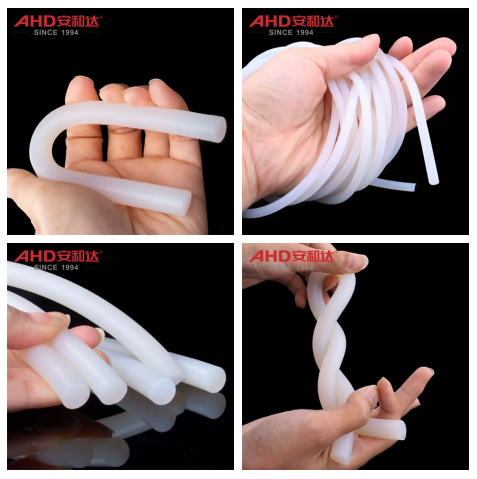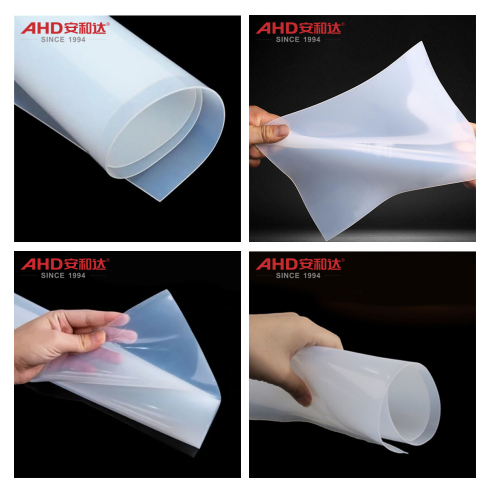
Silicone sheets and rods (generally referring to sheets and rods made of silicone rubber) are widely used in industrial manufacturing. Due to their unique physicochemical properties, they have become key materials in many scenarios. The following details their application scenarios, usage methods, and core characteristics:
I. Are they used in industrial manufacturing?
Yes, Silicone Rubber Sheet and Silicone Rubber Rod are commonly used functional materials in industrial manufacturing, especially indispensable in scenarios requiring temperature resistance, insulation, sealing, or vibration damping. Their applications cover multiple fields such as electronics, automotive, aerospace, chemical, and medical device manufacturing.
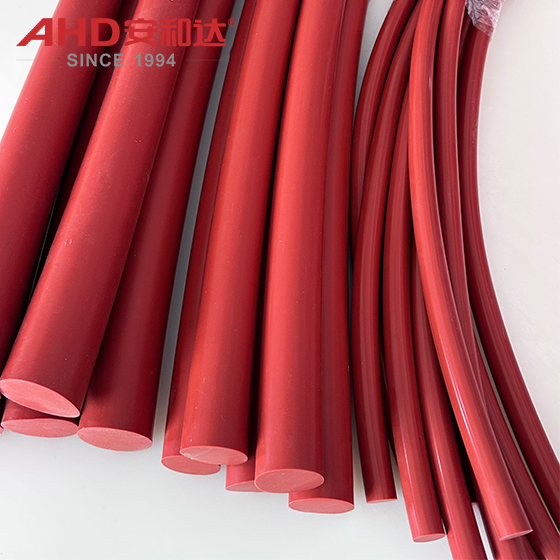
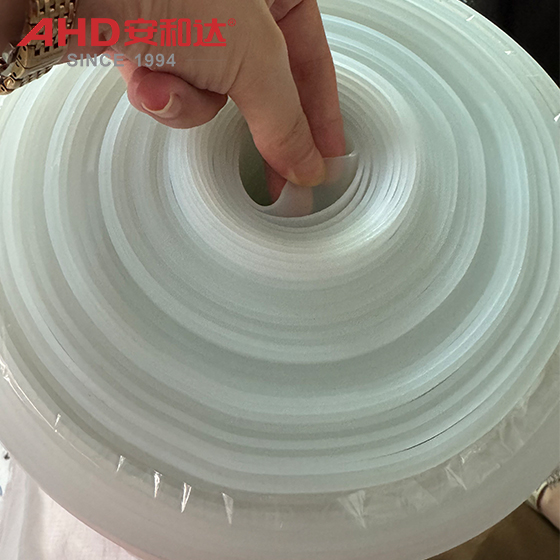 AHD Silicone Rolls
II. Common Application Scenarios
1. Sealing and Vibration Damping
Sealing Components: Used as O-rings, gaskets, sealing strips, etc., in mechanical equipment (such as engines, hydraulic systems), pipe joints, pressure vessels, etc., to prevent liquid/gas leakage.
Shock Damping and Cushioning: Made into shock-absorbing pads, corner protectors, or liner pads to protect precision instruments (such as machine tools, electronic equipment) from vibration or impact damage, while reducing noise.
2. Electrical Insulation and Protection
Insulating Components: Used as circuit board support plates, high-voltage equipment insulating partitions, motor winding wrapping materials, etc., utilizing their high dielectric strength (typically ≥15kV/mm) and arc resistance (≥180s) to ensure equipment safety.
Protective Coatings/Liners: Coated onto metal or plastic surfaces to form an insulating and moisture-proof protective layer, used in cable joints, transformer housings, etc.
3. Mold and Tooling Manufacturing
Soft Mold Materials: Used for molding small batches of complex-shaped composite material molds, or for molding plaster/resin, through compression molding or casting.
Tooling and Fixtures: Manufactured as positioning blocks, anti-slip pads, or flexible clamps to secure workpieces and reduce rigid collisions during machining, protecting the surfaces of precision parts.
4. Cleanroom and Special Environment Adaptation
Cleanroom Auxiliary Materials: In food, pharmaceutical, and semiconductor manufacturing, silicone plates and rods, due to their low leaching (no volatile toxic substances) and ease of cleaning (can be sterilized at high temperatures), are used as workbench mats, material carriers, or equipment liners to prevent product contamination.
Extreme Environment Components: In aerospace, used as vacuum-resistant and radiation-resistant seals or thermal insulation pads; in the chemical industry, as pipe seals or reactor liners resistant to strong acids and alkalis.
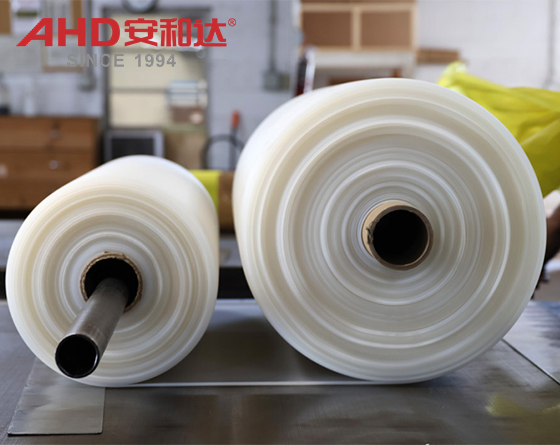
III. Usage Instructions The use of Silicone Sheet Roll and Rod needs to be tailored to specific scenarios. The core steps include:
1. Selection: Choose the type based on requirements such as temperature (-100℃~300℃, special formulas up to 500℃), chemical media (oil/solvent/steam resistance), and mechanical strength (Shore hardness 10~80A).
2. Processing and Molding: Directly purchase standard-sized sheets/rods and process them into the required shape using CNC cutting, laser drilling, punching, etc.
Customized requirements can be met through molding (high-temperature, high-pressure vulcanization) or extrusion processes. For example, complex sealing rings require molding.
3. Installation and Fixing: Small components (such as O-rings) are directly embedded into the groove and fixed using adhesives (such as silicone sealant) or mechanical pressing.
Large gaskets/backing plates can be fixed using double-sided tape, bolts, or welding (when combined with metal) to ensure a tight seal.
IV. Core Characteristics for Industrial Applications
Wide Temperature Range Stability: Remains elastic at low temperatures (non-brittle), and does not decompose during long-term high-temperature use (special formulas can withstand short-term temperatures up to 500℃), suitable for extreme temperature environments.
Excellent Electrical Insulation: Volume resistivity ≥1×10¹⁴Ω·cm, low dielectric loss, maintains insulation performance at high temperatures, making it an ideal insulating material for electrical equipment.
Chemical Corrosion Resistance: Excellent resistance to water, weak acids and alkalis, oils (some models are resistant to lubricating oil/fuel oil), and alcohols, superior to natural rubber.
High Elasticity and Shock Absorption: Elongation at break can reach 300%~800%, with good resilience, effectively absorbing vibration energy and protecting precision components of equipment.
Low Emissions and Cleanliness: No small molecule emissions after vulcanization (complies with FDA and ISO 10993 biocompatibility standards), suitable for food, pharmaceutical, semiconductor, and other applications requiring high cleanliness. Processing adaptability: It can be composite molded with metal, plastic and other materials (such as rubber-coated buttons), or customized needs can be met through secondary processing (engraving, printing).
Silicone sheets and rods, with their four core advantages of "temperature resistance, insulation, elasticity, and cleanliness," have become key materials in industrial manufacturing for sealing, insulation, mold making, and protection. Their application requires selection based on specific working conditions and adaptation through processing and installation to ultimately play a vital role in improving equipment reliability, extending lifespan, and reducing maintenance costs.
Flexible Silicone Rod (Silicone Rubber Bar)