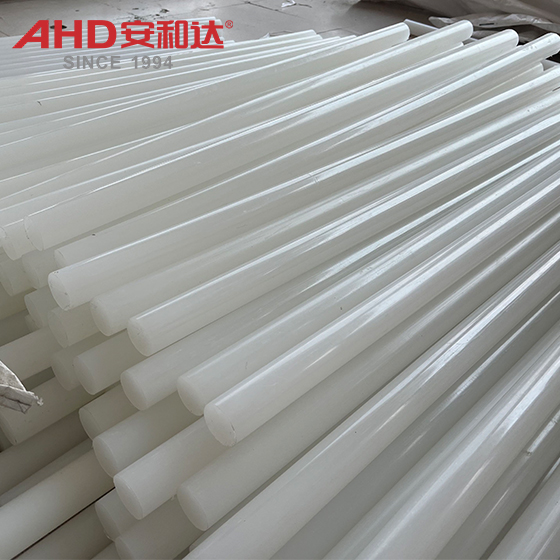
I. How to Select High-Quality PP Raw Materials?
Selecting high-quality PP (polypropylene) raw materials requires comprehensive consideration of the following factors:
1. Define Needs:
Choose the type (homopolymer PP/copolymer PP) based on the intended use. Homopolymer PP (PP-H) has better rigidity and heat resistance (melting point approximately 165-170℃), suitable for high-rigidity applications; copolymer PP has better toughness (especially at low temperatures), suitable for impact-resistant applications (such as pipes).
2. Key Performance Indicators:
Melt Flow Index (MI): Reflects fluidity. A higher MI (e.g., 30-40 g/10 min) makes it easier to process thin-walled products; a lower MI (e.g., 0.3-5 g/10 min) is suitable for thick-walled or high-strength products.
Mechanical Properties: Tensile strength (≥25 MPa), flexural strength (≥35 MPa), notched impact strength (homopolymer PP approximately 2-5 kJ/m², copolymer PP can reach 10-30 kJ/m²).
Thermal Properties: Vicat softening point (≥150℃), long-term operating temperature (-20~120℃).
Hygiene and Safety: Food-grade PP granules must comply with GB 4806.7 or FDA 21 CFR 177.1520, and be non-toxic and odorless; medical-grade PP granules must be sterile and have low leaching.
3. Appearance and Impurities:
High-quality PP granules should be uniform, free of impurities (such as black spots or colored particles), free of lumps, and have a consistent color (the natural color is translucent milky white).
4. Suppliers and Certifications:
Choose well-known brands and verify ISO 9001, REACH, RoHS, and other certifications. Avoid recycled materials (unless explicitly permitted).

AHD PP Sheet
II. Storage Methods for PP Raw Materials
PP has extremely low hygroscopicity (<0.01%), but the following precautions should still be taken:
Environmental Requirements: Store in a dry, ventilated, and cool place (temperature ≤40℃, humidity ≤70%), avoiding direct sunlight (to prevent UV aging).
Packaging Protection: Keep the original sealed bag/ton bag intact to prevent dust and oil contamination; if opened but not used up, the bag opening must be tightly sealed.
Keep Away from Chemicals: Avoid contact with strong oxidizing agents (such as concentrated nitric acid) and organic solvents (although PP is resistant to most solvents, prolonged contact may cause swelling).
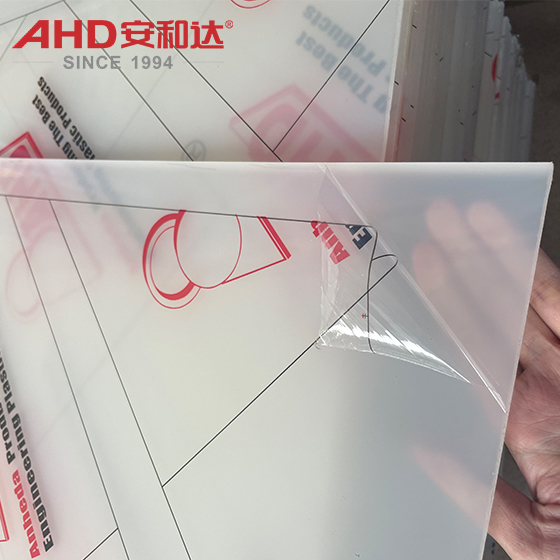
III. Processing PP into Sheets and Rods and Precautions
(I) Processing Flow (Mainly Extrusion Molding)
Raw Material Pretreatment: PP has low hygroscopicity and generally does not require drying; if the environment is humid, it can be dried with forced air at 80-100℃ for 2-3 hours.
Extrusion Molding:
Equipment: Single-screw extruder (L/D ratio L/D=25-32:1, compression ratio 2.5-3:1), equipped with special die for sheets/rods.
Temperature Control (Bug Segments): Feeding section 160-180℃, compression section 180-220℃, homogenization section 220-260℃, die temperature 200-230℃ (can be appropriately lowered for sheet dies).
Sheet Processing: Molten material is extruded into sheets through a T-die, cooled and shaped by a three-roll calender (roller temperature 60-80℃), then pulled, trimmed, and wound or cut.
Rod forming: Molten material is extruded into bars through a round die, cooled by a water cooling tank (water temperature 20-40℃) or air, and then drawn and cut to a fixed length.
Post-processing: Sheets can be hot-pressed to relieve internal stress (110-130℃), while bars can be used directly.
(II) Precautions
Temperature Control: Avoid exceeding the temperature (>280℃) as this can lead to degradation (yellowing, decreased molecular weight); too low a temperature will result in poor plasticization (rough surface).
Traction Speed: Match the extrusion speed; too fast will cause thinning/deformation, too slow will cause material piling.
Additive Usage: Add antioxidants and UV absorbers as needed to improve weather resistance.
Prevent Contamination: The equipment must be cleaned (especially during material changes) to prevent other plastics (such as PE) from contaminating and affecting compatibility.
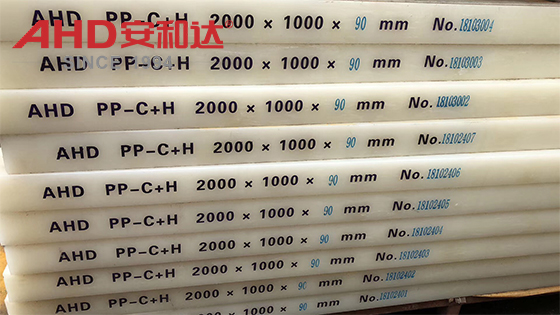
IV. Storage Methods for PP Sheets and Rods
Environment: Dry, well-ventilated, and protected from light (to prevent UV aging), away from heat sources (such as radiators) and corrosive chemicals.
Stacking: Sheets should be laid flat, separated by soft paper/foam to prevent scratches; rods should be stacked vertically or horizontally to avoid deformation under heavy pressure (stack height ≤ 1.5m).
Identification: Mark the production date; first-in, first-out (long-term storage may cause slight embrittlement due to oxidation).
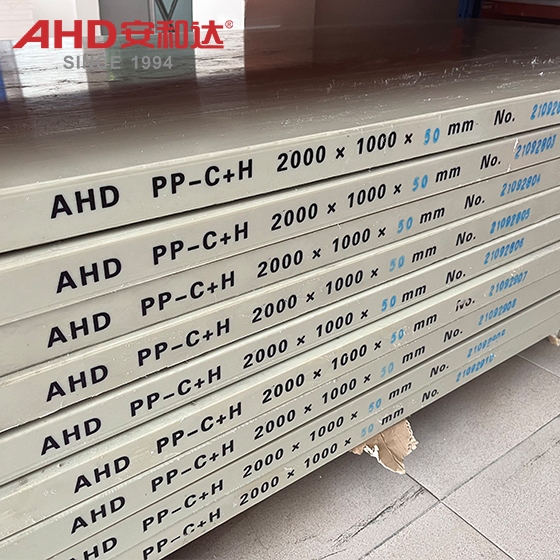
AHD PP -C+H Sheet Grey
V. Characteristics of High-Quality PP Sheet and PP Rod
Physical Properties: Low density (lightweight), smooth surface without burrs/bubbles.
Mechanical Properties: High rigidity (flexural modulus ≥ 1000MPa), fatigue resistance (not easily broken after repeated folding), good low-temperature toughness (copolymer PP remains flexible at -20℃).
Chemical Resistance: Resistant to acids (except concentrated nitric acid), alkalis, and salt solutions; resistant to organic solvents (such as alcohols and oils), but not resistant to strong oxidizing agents (such as concentrated sulfuric acid).
Thermal properties: Good heat resistance (long-term operating temperature 100℃, short-term operating temperature 120℃), Vicat softening point ≥150℃.
Hygiene and safety: Non-toxic and odorless (food grade, safe for food contact), no exudation (compliant with FDA/GB standards).
Electrical properties: High insulation (volume resistivity ≥10¹⁶Ω·cm), suitable for electrical components.
When selecting PP raw materials, it is necessary to consider performance, certification, and appearance; during processing, temperature and speed should be controlled, and necessary additives should be added; storage should be done in a way that protects against moisture and light; high-quality sheets and bars should have high rigidity, chemical resistance, and hygiene safety.
AHD Polypropylene Rod (white and grey)