

PTFE (polytetrafluoroethylene), commonly known as the "King of Plastics" or "Teflon", is a semi-crystalline fluorinated polymer material polymerized from tetrafluoroethylene monomers. Its unique molecular structure (carbon chains completely wrapped by fluorine atoms, forming a "fluorocarbon protective layer") endows it with extreme chemical inertness, wide temperature range stability, ultra-low friction, and excellent insulation properties, making it one of the engineering plastics with the most outstanding comprehensive performance currently available.
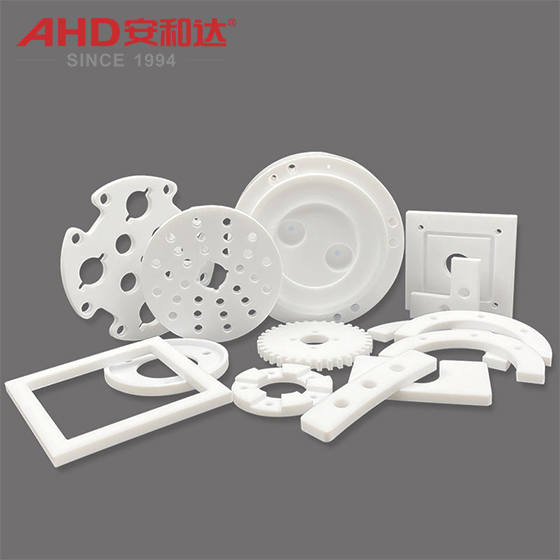
Ⅰ. Core Characteristics of PTFE (Teflon)
1. Extreme Chemical Stability
Molecular Structure Basis: The C-F bonds in the PTFE molecule have extremely high bond energies, and the fluorine atoms have small radii and are densely packed, forming a dense protective layer that isolates it from external chemical corrosion.
Specific Manifestations: Almost insoluble in any organic solvent (including highly polar solvents such as concentrated sulfuric acid, concentrated nitric acid, aqua regia, etc.); Resistant to strong acids, strong bases (sodium hydroxide, potassium hydroxide), oxidizing agents (potassium dichromate, potassium permanganate), and reducing agents; Does not react with common gases (such as chlorine, oxygen, ammonia), and may decompose to produce trace amounts of hydrogen fluoride only at high temperatures (>400℃).
2. Wide Temperature Range Adaptability
High Temperature Resistance: Melting point approximately 327℃, long-term operating temperature range -200℃ to 260℃ (short-term up to 300℃), far exceeding most engineering plastics;
Low Temperature Resistance: Embrittlement temperature as low as -196℃, maintaining flexibility and mechanical strength at low temperatures without cracking.
3. Ultra-Low Friction and Self-Lubricating Properties
Extremely Low Coefficient of Friction: Dry friction coefficient of only 0.04, one of the lowest known coefficients of friction among solid materials;
Self-Lubricating Properties: Achieves low-friction movement without additional lubricant, with extremely low wear rate.
4. Excellent Non-stick Properties
Extremely Low Surface Energy: Surface tension of only 18 mN/m (compared to 72 mN/m for water), almost all liquids and solids cannot adhere to its surface, hence the term "non-stick."
5. Excellent Electrical Insulation
Stable Dielectric Properties: Dielectric constant approximately 2.1 (close to vacuum), dielectric loss factor <0.0002 , volume resistivity >10¹⁸ Ω·cm; Arc Resistance: Surface does not carbonize after arcing, insulation performance is almost unaffected.
6. Special Mechanical Properties
Relatively Soft at Room Temperature: Hardness approximately D50~60 (Shore hardness), low elastic modulus, easy to machine;
Weak Cold Flow Resistance: Prone to "cold flow" (creep deformation) under long-term pressure; pure PTFE will gradually deform under continuous load (requires modification with glass fiber, carbon fiber, etc. to improve this).
7. Other Properties
Weather Resistance: Resistant to UV and ozone aging; Radiation Resistance: Better resistance to high-energy radiation such as gamma rays and X-rays than most plastics; Non-toxic and Harmless: Meets FDA and EU food contact standards, suitable for direct contact with food and pharmaceuticals.
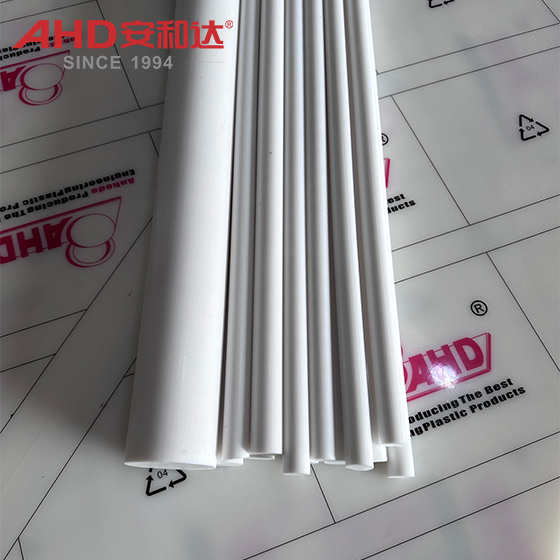
AHD PTFE Round Bar (Teflon Bar)
Ⅱ.PTFE Sheet and Rod for Core Components
PTFE sheets and rods, with their core properties such as high and low temperature resistance, chemical inertness, ultra-low coefficient of friction, aging resistance, and non-stick properties, are the preferred material for components operating under harsh conditions in the industrial field, especially suitable for the following types of key components:
1. Sealing Components (Both Sheets and Rods Applicable)
Sealing is the most mainstream application of PTFE sheets/rods. Utilizing their chemical stability and deformation adaptability, they solve sealing problems in highly corrosive, high-temperature, and high-wear environments.
Corrosion-Resistant Flange Gaskets
Suitable Applications: Flange connections for chemical pipelines, acid and alkali storage tanks, and pharmaceutical reactors.
Advantages: Compared to rubber gaskets, they are resistant to strong acids and alkalis (such as concentrated nitric acid and hydrofluoric acid) and organic solvents, and will not age and fail due to media corrosion; PTFE Plate can be directly cut into gaskets of different sizes, and rods can be processed into irregularly shaped sealing rings.
Piston/Piston Rod Seals
Suitable for: Dynamic seals in hydraulic cylinders, pneumatic components, and food machinery plungers.
Advantages: Ultra-low coefficient of friction reduces piston movement resistance; stable operation even without lubrication; resistant to hydraulic oil and food-grade media, preventing media contamination.
Valve Seat/Valve Disc Seals
Suitable for: Core sealing components in chemical valves, high-temperature valves, and vacuum valves.
Advantages: High pressure resistance (up to 30MPa and above), resistance to alternating high and low temperatures; maintains sealing performance even under extreme conditions, preventing media leakage.
2. Wear-Resistant Transmission Components (Mainly Bar Stock, Sheets Can Be Processed into Bushings)
Utilizing the self-lubricating and wear-resistant properties of PTFE, these components are suitable for oil-free lubrication or low-noise transmission applications.
Bearings/Sleeves
Suitable Applications: Yarn guide sleeves in textile machinery, roller bearings in papermaking machinery, conveyor sleeves in food processing machinery.
Advantages: Oil-free lubrication, avoiding oil contamination of products (e.g., food, textiles); coefficient of friction is only around 0.04, significantly reducing wear and noise.
Gears/Rollers
Suitable Applications: Small gears and conveyor rollers in lightly loaded transmission equipment (e.g., printers, packaging machinery).
Advantages: Lightweight, low operating noise; resistant to chemical corrosion, usable in humid or corrosive environments, no rust prevention treatment required.
Guide Rail Slider Pads
Suitable Applications: Wear-resistant pads for precision instrument guide rails and sliders in automated equipment.
Advantages: Low coefficient of friction ensures motion accuracy; good dimensional stability in high and low temperature environments.
3. Corrosion-Resistant Structural Components (Applicable to Plates/Rods)
Utilizing the chemical inertness of PTFE, these components are used for structural support or isolation in highly corrosive environments.
Chemical Equipment Linings/Baffles
Suitable Applications: Electroplating tank linings, pickling tank baffles, chemical reactor linings.
Advantages: Completely resistant to acid and alkali corrosion; will not react with electroplating or pickling solutions; PTFE sheets can be welded together to form large-area linings, protecting the metal equipment substrate.
Semiconductor/Electronics Industry Insulating Supports
Suitable Applications: Insulating pads for semiconductor wafer processing equipment, high-temperature insulating supports for electronic components.
Advantages: Excellent electrical insulation performance (dielectric strength ≥20kV/mm), resistant to alternating high and low temperatures, does not attract dust, meets the cleanliness requirements of the semiconductor industry.
Food/Pharmaceutical Industry Conveying Components
Suitable Applications: Food conveyor belt scrapers, pharmaceutical tablet press mold linings, wear-resistant pads for filling equipment.
Advantages: Meets food contact safety standards, with no harmful substances released; non-stick properties prevent material residue and are easy to clean and disinfect.
4. Special Function Components
High-Temperature Insulation Components
Suitable Applications: Aerospace equipment insulation gaskets, high-temperature oven insulation partitions, new energy battery pack insulation components.
Advantages: Does not decompose under long-term use at 260℃, maintains flexibility at -200℃, and exhibits excellent insulation performance.
Anti-stick Demolding Components
Suitable Applications: Plastic molding die release linings, rubber vulcanization die gaskets.
Advantages: Non-stick properties allow for easy demolding without the need for release agents, improving production efficiency and product surface quality.
Selection Tips
PTFE Sheet(Teflon Sheet): Suitable for processing large-area, flat components (such as gaskets, linings, partitions).
PTFE Rod(Teflon Bar): Suitable for processing round and irregularly shaped components (such as bearings, gears, sealing rings), and can be machined into complex shapes through turning and milling.
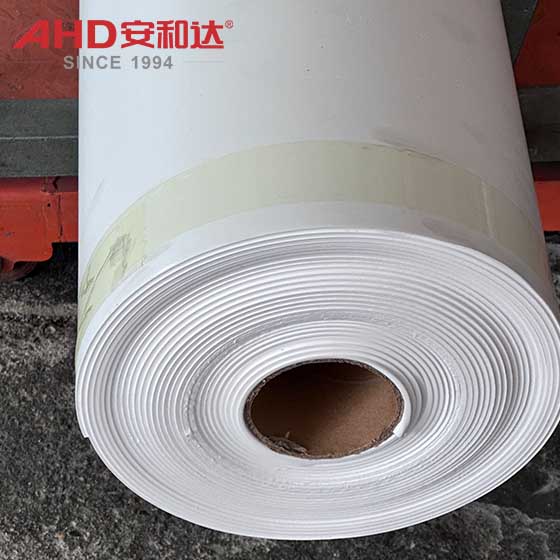
AHD PTFE Roll Sheet
Ⅲ. Feasibility of PTFE Sheet and Rod Machining
PTFE sheets and rods can be processed into various parts through machining, molding, and sintering. Their machinability primarily relies on mechanical material removal or hot pressing, rather than molten flow (due to the extremely high viscosity of the melt, injection molding is difficult).
1. Machining(Main Machining Methods)
Machining PTFE sheets and rods is similar to that of metals, but parameters need to be adjusted to suit their soft, low thermal conductivity characteristics. It is suitable for manufacturing simple shapes or precision parts (through subsequent grinding).
Turning: Used for machining rods into shaft-like parts.
Milling: Used for grooving and contouring of sheets.
Drilling: The drill bit must be sharp to prevent material from sticking to the drill bit due to compression.
Sawing: Use a fine-toothed saw blade with low-speed advance to prevent chipping.
2. Compression Molding-Sintering (Complex Shapes) For batch or large-sized parts, a "compression molding + sintering" process can be used:
Pressure Forming: PTFE fine powder is loaded into a mold and cold-pressed into a blank at 10~30MPa.
Sintering: The blank is placed in a furnace and heated to 360~380℃ (above the melting point), held for 1~4 hours to allow molecular chain rearrangement, and then slowly cooled (to avoid internal stress).
Post-Processing: The sintered blank needs to be dimensionally corrected by cutting and grinding.
3. Other Auxiliary Processes
Welding: PTFE is difficult to melt and weld; hot-press welding (heated to 350~380℃, pressure bonding) or indirect welding can be used.
Adhesion: The surface needs to be treated with sodium naphthalene solution (or plasma) to break C-F bonds to increase surface energy, and then bonded with epoxy or polyurethane adhesive.
