In the plastics family, abrasion resistance cannot be defined by a single indicator—it needs to be evaluated by combining multiple factors such as wear rate (material loss per unit load), coefficient of friction (resistance at the contact interface), and environmental adaptability (temperature, corrosion, and lubrication conditions). Currently, the top abrasion-resistant plastics recognized by academia and industry include Ultra High Molecular Weight Polyethylene (UHMWPE), polytetrafluoroethylene (PTFE), and polyimide (PI). Among them, UHMWPE represents the "ceiling" of abrasion resistance under comprehensive working conditions, while PTFE and PI are more advantageous in extreme environments. Today, let's compare UHMWPE and PTFE.
Ⅰ. Key Performance Comparison Table
| Material | Molecular Weight Range | Wear Rate (mm³/N·m) | Dry Friction Coefficient | Long-Term Operating Temperature | Core Advantages | Typical Scenarios |
| UHMWPE | 10⁶-10⁷ | ~1×10⁻⁶ | 0.05-0.1 | -269-80℃ | Lowest overall wear, self-lubricating | Artificial joints, conveyor liners |
| PTFE | 10⁵-10⁶ | ~5×10⁻⁶ | 0.04-0.1 | -200-260℃ | No lubrication/Corrosion resistant | Seals, chemical pump impellers |
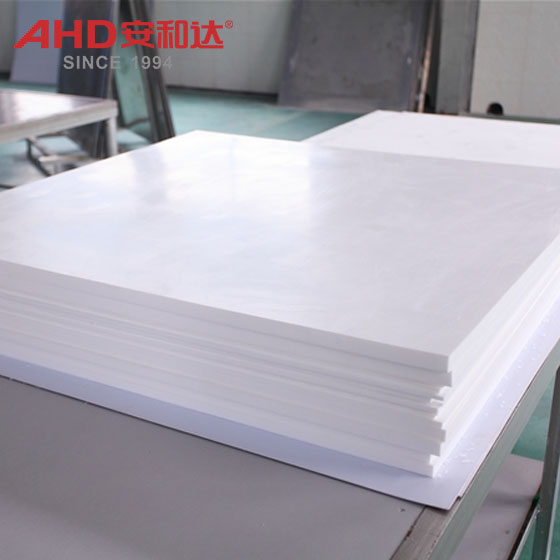
AHD offers UHMWPE Sheet in thicknesses ranging from 10 to 150mm and UHMWPE Sheet in diameters ranging from 10 to 250mm. Colors available in white, black, and many colors. Welcome to contact us for more details.

UHMW Polyethylene Sheet
Ⅱ. In-depth analysis of their respective characteristics
1. Ultra-High Molecular Weight Polyethylene (UHMWPE): An All-Round Performer in Comprehensive Wear Resistance
Structural Nature: With a molecular weight of 1 million to 10 million (compared to tens of thousands for ordinary PE), the molecular chains form an entangled network, achieving a crystallinity of 50%-70%, resulting in a semi-crystalline, high-toughness structure.
Core Characteristics:
Extreme Wear Resistance: Lowest wear rate in the industry, suitable for long-term high-load friction;
Self-Lubricating: No additional lubrication required, reducing maintenance costs;
High Impact Resistance: Notched impact strength is 5 times that of POM (Polyoxymethylene), capable of withstanding impacts from mining and medical implants;
Low Temperature Resistance: Maintains toughness at -269℃ (liquid helium temperature), suitable for extreme aerospace environments;
Limitations:
Low upper temperature limit (80℃), easily softens at high temperatures;
Relatively low hardness (Shore D60-70), easily scratched by sharp objects;
Slightly high hygroscopicity (0.01%-0.03%), requires protection in long-term humid environments.
2. Polytetrafluoroethylene (PTFE): An "Extreme Environment Expert" with No Lubrication and Corrosion Resistance
Structural Nature: A linear polymer composed of C-F bonds (F atoms completely encapsulate the carbon chain), forming a "fluorocarbon barrier" with extremely strong chemical inertness and ultra-low surface energy.
Core Characteristics:
Lubrication-free wear resistance: Dry friction coefficient of 0.04 (close to ideal lubrication), ensuring long-term stability even without oil;
Extreme corrosion resistance: Resistant to strong acids and alkalis such as aqua regia, concentrated nitric acid, and sodium hydroxide, it is the only plastic stable in "fluorine gas";
Wide temperature range adaptability: Long-term operating temperature -200℃ to 260℃ (short-term up to 300℃);
Limitations:
Extremely low hardness (Shore D50-60), prone to creep (deformation rate reaches 2%-5% under long-term load);
Wear resistance depends on "low friction" rather than "wear resistance," with a significant increase in wear rate under high load;
Difficult to process (melting point 327℃, but decomposes into toxic gases above 300℃).

Ⅲ. Key Differences in Scope of Application: Scene Adaptability
The core of choosing between the two application scenarios is "operating condition requirements," and the specific differences are as follows:
| Scenario Types | Advantageous Scenarios of UHMWPE | Advantageous Scenarios of PTFE |
| Load and Wear Types | High impact loads (e.g., mining conveyors, artificial joints), long-term sliding wear | Unlubricated sliding (e.g., seals, guide rails), low-load corrosive wear |
| Environmental Conditions | Normal/Low Temperature (-269-80℃), Non-corrosive (e.g., mining, medical) | Extreme Temperature (-200-260℃), Strong Corrosive (e.g., chemical, semiconductor) |
| Functional Requirements | Comprehensive wear resistance + high toughness (must withstand impact) | No lubrication required + corrosion resistance (must avoid adhesion and chemical damage) |
| Typical Applications |
Artificial hip/knee joint pads;
Mine conveyor trough liners;
High-speed bearing cages;
Ski bottom material;
|
Chemical pump seals;
Semiconductor wafer transport rails;
Spacecraft fuel pipe gaskets;
Modified non-stick coatings for kitchen cookware;
|
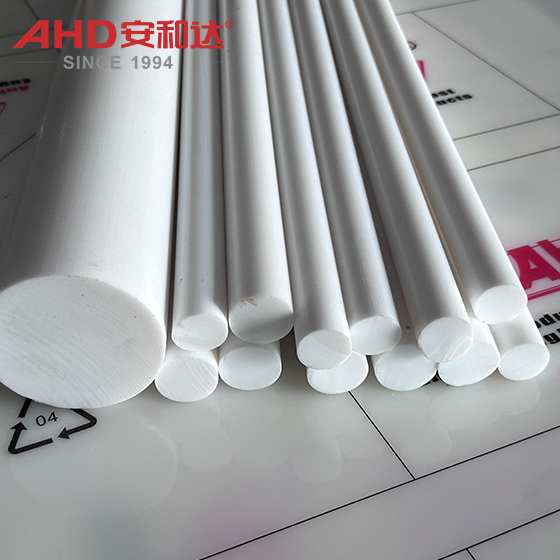
AHD offers PTFE Sheet in thicknesses ranging from 0.1 to 100mm and PTFE Rod in diameters ranging from 4 to 260mm. Colors available in white. Welcome to contact us for more details.

Ⅳ. How to choose?
There is no single "most wear-resistant" plastic, only the choice that best suits the operating conditions:
For extreme wear resistance under all operating conditions (room temperature, with/without lubrication), choose UHMWPE (e.g., medical implants, mining equipment);
For stability in extreme environments with no lubrication and high corrosion, choose PTFE (e.g., chemical seals, aerospace components).
AHD PTFE Round Bar