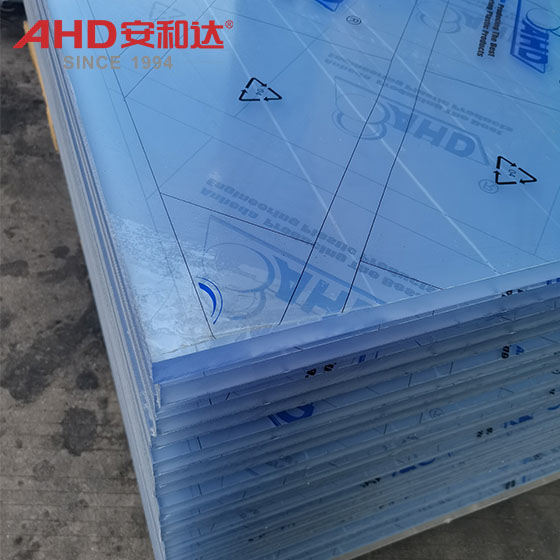
Currently, extrusion molding remains the mainstream process for PC transparent sheets (accounting for over 90% of the market) due to its high efficiency and low cost in continuous production, making it suitable for large-scale production of general-purpose transparent sheets. Other processes are used to supplement specific needs (such as ultra-thickness, high transparency, and functional composites). So, besides extrusion molding, what other processes are involved?
Besides extrusion molding, the production processes for PC (polycarbonate) transparent sheets also include casting molding, injection molding, and compression molding (or lamination).

1. Cast Molding
Process Principle: PC resin is heated and melted into a liquid state, then poured between two preheated flat molds. The resin is slowly polymerized or cooled and solidified by controlling the temperature (120-150℃), and finally demolded to obtain the sheet material.
Advantages:
Extremely high transparency: No shear friction (unlike the high temperature and pressure of extrusion), low internal stress, and optical properties close to glass (light transmittance can reach over 89%).
Suitable for thick sheet production: Can produce sheets 20mm or even thicker (extrusion is usually used for thin sheets).
High flexibility: Intermittent production, suitable for small batches and multi-specification customization (such as special sizes or surface textures).
Simple equipment: No complex extruder required, lower initial investment.
Disadvantages:
Low efficiency: Intermittent production, long cycle time (requires several hours of curing), not suitable for large-scale continuous production.
Poor thickness uniformity: Dependent on mold gap precision, prone to local thickness deviations (especially wide sheets). High cost: There is a large loss of raw materials (precise measurement is required), and the production cost of thick plates is significantly higher than that of extrusion.
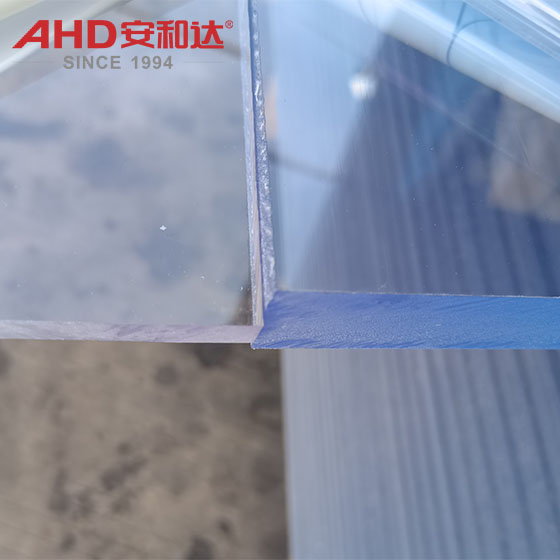
AHD Light Blue PC Sheet
2. Injection Molding
Process Principle: PC granules are heated to a molten state (280-320℃) in an injection molding machine and injected under high pressure into a closed metal mold. After cooling and solidification, the mold is opened and the molten material is removed, forming a sheet material of a fixed shape.
Advantages:
Complex Shape Processing: Can produce irregularly shaped sheets with reinforcing ribs, snap-fit mechanisms, holes, grooves, etc. (e.g., transparent panels for electronic devices).
High Dimensional Accuracy: High mold precision ensures good dimensional consistency of the sheets.
High Automation: Suitable for mass production of small-sized, thin-walled sheets.
Disadvantages:
Limited to Large/Thick Sheets: Limited by the clamping force of the injection molding machine and the size of the mold, it is difficult to produce large-sized or ultra-thick sheets.
Internal Stress and Defects: High-speed injection can easily lead to uneven molecular orientation, generating internal stress and weld lines, reducing transparency and impact resistance.
High Equipment Investment: High-precision molds and large injection molding machines are expensive, making small-batch production uneconomical.
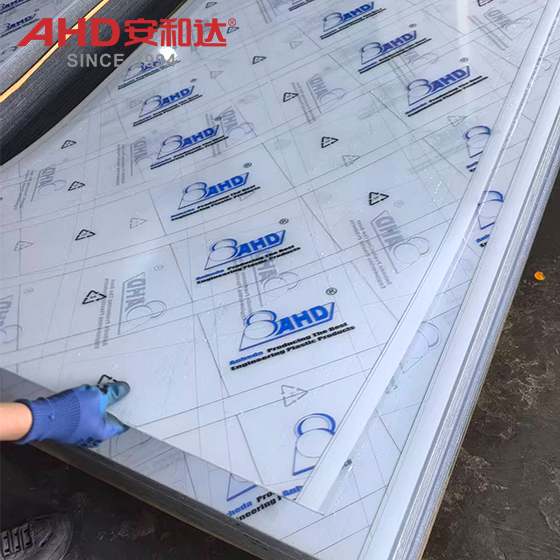
AHD PC Plastic Sheet
3. Compression Molding/Lamination Molding
Process Principle: PC prepolymer (or sheet) is laminated with functional layers (such as UV coating, scratch-resistant layer) and placed in a heated mold. Pressure (5-20 MPa) is applied to force the material to flow and fill the mold cavity. Simultaneously, heating (150-180℃) promotes polymerization or cooling and curing, ultimately resulting in a multi-layer composite sheet.
Advantages:
Multi-layer Composite Capability: Can integrate UV protection, anti-fog, flame retardant, and other functional layers to produce functional sheets (such as polycarbonate sheets, bulletproof glass).
Low Internal Stress: Slow pressure and heating reduce molecular orientation, resulting in better crack resistance than injection-molded parts.
Suitable for Large Sizes/Thick Sheets: Can produce large-format or ultra-thick sheets (such as bulletproof plates).
Disadvantages:
Complex Process: Requires precise control of temperature, pressure, and holding time (long cycle time); parameter fluctuations can easily lead to bubbles and delamination.
Expensive Equipment: Requires large hot presses and high-precision molds, resulting in high initial investment.
Low efficiency: Intermittent production is not suitable for large-scale manufacturing of low-cost general-purpose boards.
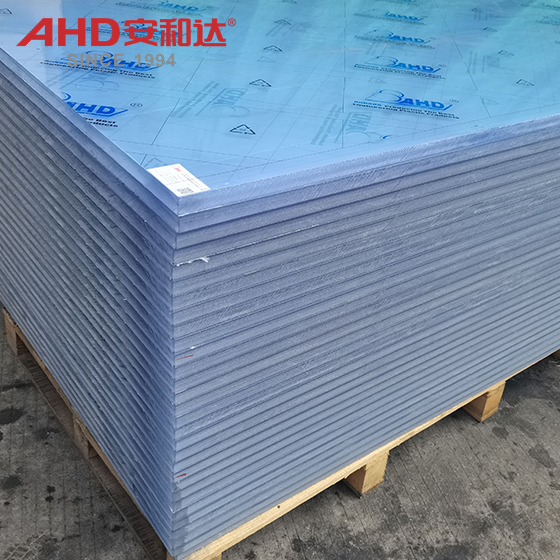
Summary and comparison
| Process | Core Advantages | Main Limitations | Typical Applications |
| Casting | High transparency, thick plates, flexible small batch production | Low efficiency, poor thickness uniformity | High-end decorative panels, optical lenses |
| Injection Molding | Complex shapes, high precision | Limitations on large/thick plates, high internal stress | Transparent panels for electronic devices |
| Compression Molding | Multi-layer composites, large/thick plates | Complex processes, high equipment investment | Bulletproof glass, functional polycarbonate sheets |