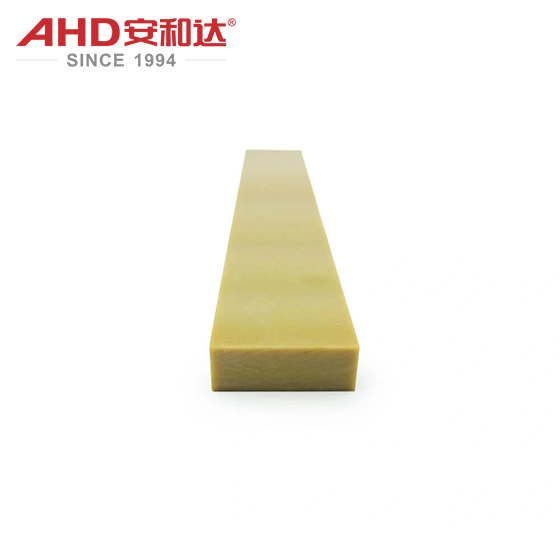
Engineers who work on precision structural components at high temperature often encounter a series of recurring material problems: part warpage during thermal cycling, low stiffness under long-term load, dimensional drift during long-term operation, and low compressive strength of fixture hardware. The glass filled PEI sheet (also called Ultem 2300 Sheet) alleviates these key pain points by offering the natural high heat resistance of virgin PEI resin with the stiff chopped glass fiber reinforcement.
This guide describes the entire process of making GF PEI sheets, explains the important functions of glass fibers in PEI composites, compares the properties of GF10, GF20 and GF30 PEI grades, and distinguishes the differences between unfilled pure PEI sheets and glass-filled PEI sheets. Visit AHD to learn more!
What are the core functions of glass fibers added to PEI base resin?
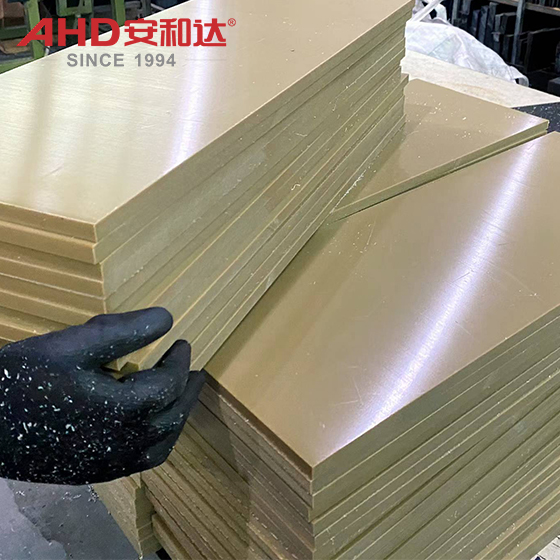
Chopped glass fibers serve as a rigid internal skeleton in the PEI polymer. They offer obvious performance improvements with small tradeoffs designers have to consider when choosing materials.
Main Advantages of Glass Fiber Reinforcement
Enhance Mechanical Strength and Rigidity
Tensile modulus, flexural strength and compressive modulus increase significantly with increase in the glass fiber content. GF PEI composites resist permanent deformation under long static load, thus significantly reducing creep risk at continuous high temperature.
Greatly improves dimensional stability
Glass fiber has ultra-low coefficient of thermal expansion. The addition of glass filler greatly reduces the linear thermal expansion rate (CTE) of PEI. This helps to minimize shrinkage and warpage during repeated hot-cold cycles. GF30 PEI has the same dimensional stability as lightweight aluminum alloys.
Reduced molding shrinkage
Molding shrinkage of unfilled PEI is 0.5%–0.7% and glass filled PEI shrinks 0.1%–0.3%. This advantage allows tight tolerance control for precision machined jigs and electronic connectors.
Enhance heat distortion resistance
Glass fiber slightly improves the heat deflection temperature (HDT) of PEI. GF PEI Plastic Sheet do not soften or collapse at high operating temperatures for long periods and maintain their structural integrity.
Extend fatigue life
Fiber reinforcement spreads external stress evenly through the material matrix. It improves resistance to cyclic mechanical influence and long-term bearing pressure.
Tradeoffs of filling with glass fibers
Decreased toughness and elongation
Pure PEI shows good ductility with high break elongation. Glass filled grades are more rigid and brittle, with a lower impact resistance and higher notch sensitivity.
Optical transparency loss
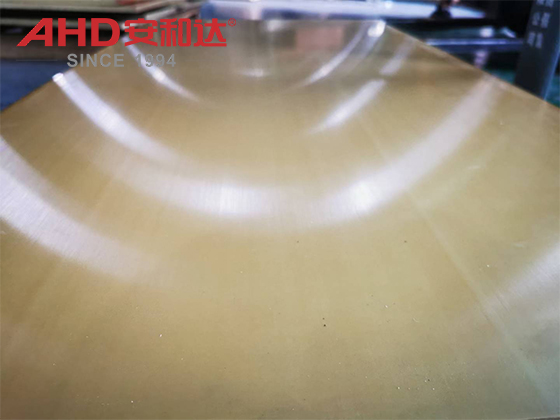
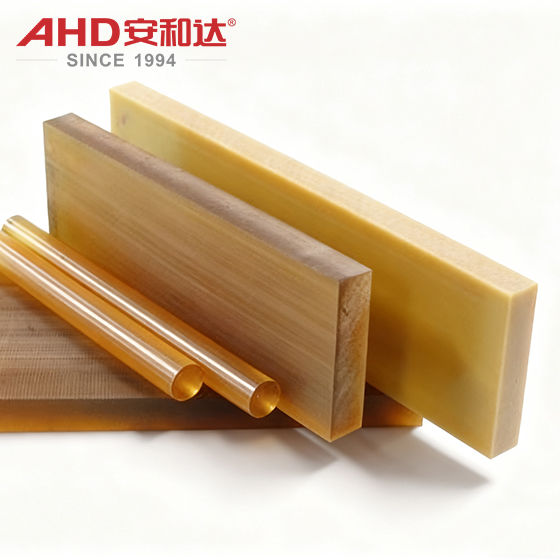
Neat PEI is amber translucent. GF PEI is completely opaque tan . The glass fibers scatter light . This precludes any optical applications .
Fast wear of cutting tools
Hard glass particles wear down standard high speed steel cutters. The CNC process needs carbide tools and changed cutting parameters for longer tool life.
Anisotropic behaviour
The mechanical and thermal properties are different in extrusion flow direction and cross direction, so this should be considered in symmetrical structural design.
PEI GF10 vs GF20 vs GF30: Property Differences & Matching Industrial Applications
Three mainstream glass fiber loadings dominate industrial GF PEI supply: 10wt%, 20wt% and 30wt%. Each grade balances rigidity, toughness, machinability and cost for distinct working conditions.
| Rigidity & Modulus | Thermal Expansion (CTE) | Toughness & Impact | Machining Difficulty | Best Fit Applications | |
| GF10 PEI | Mild reinforcement, 40% higher modulus than neat PEI | 30% lower than unfilled PEI | Retains 70%-80% original PEI toughness | Low, minimal tool abrasion | Medical sterilizable housings, lightweight electronic brackets, small precision connectors, components with minor temperature fluctuation |
| GF20 PEI | Medium high rigidity, 90% modulus improvement | 55% CTE reduction | Balanced strength and ductility | Moderate, standard carbide tools work well | Automotive sensor shells, general semiconductor jigs, medium-sized structural parts, mass CNC machined components |
| GF30 PEI | Maximum stiffness, 170% modulus boost vs neat PEI | 73% CTE drop, near aluminum level | Low toughness, sensitive to sharp notches | High, premium carbide cutting tools required | Aerospace lightweight structures, new energy battery supporting frames, high-temperature heavy-load fixtures, parts under continuous cyclic heat |
Tips on Choosing glass fiber reinforced Polyetherimide Sheet !
If your parts demand dimensional stability and are prone to frequent cracking due to impact or bending during assembly, choose GF10 PEI.
GF20 PEI is the most balanced grade with the lowest cost and the highest global market demand Choose GF20 PEI for general industrial applications.
Use GF30 PEI only for extreme working environments with high static load, wide temperature swings and strict zero-warpage tolerance requirements.

Unfilled PEI Sheet vs. Glass Filled PEI Sheet: Complete Performance Comparison
Buyers often have a hard time deciding when to use neat PEI or glass filled PEI sheet.
Appearance & Light Transmission (LTA)
PEI, unfilled: Amber, translucent. High light transmission. Useful for visual inspection windows and optical components.
Glass filled PEI: Opaque dark brown, no transparency, not suitable for optical observation parts.
Mechanical Performance
Unfilled PEI: Very high ductility Elongation at break 6%-10% Very good notch impact resistance Excellent for snap-fit assemblies with slight deformation.
Glass-filled PEI: Ultra high tensile and flexural modulus, virtually no elongation, preferred for load bearing structural hardware.
Thermal & Dimensional Properties
Unfilled PEI: high CTE value, obvious shrinkage and warpage under temperature change, HDT about 215°C.
Glass filled PEI: Reduced thermal expansion, stable dimensions after thermal cycling, HDT increased to ~220C.
CNC Machining & Manufacturing Costs
PEI: Smooth cutting surface, low tool wear, low processing cost for mass production.
Glass filled PEI: Wear on the cutting tools is enhanced by the presence of glass particles. This necessitates slower feed rates, leading to higher overall machining costs.
Target Application Segment
Unfilled PEI: Transparent components for medical equipment, optical inspection screens, high-impact electronic housings.
PEI filled with glass: aerospace structural fittings, semiconductor processing fixtures, new energy vehicle high temperature modules, precision industrial tooling.
Key Industries & Typical Parts Made With Glass Filled PEI Sheet
GF PEI sheet’s excellent heat resistance, dimensional stability and insulation make it the top engineering composite in high-end manufacturing sectors.
Aerospace Industry
Lightweight interior support brackets, insulation frames, auxiliary cabin components exposed to high temperature with low thermal expansion and flame retardance requirements.
Electronic & Semiconductor
wafer handling jigs, test fixture bases, high temperature connector insulators and circuit board supporting frames that do not change dimensionally during thermal processing.
New Energy Auto
Structural separators for battery modules, motor sensor housings, insulating shells for power control units capable of withstanding constant engine heat.
Medical Devices
Frames for sterilizable (autoclave compatible) equipment, non-transparent instrument backplates, structural supports meeting FDA biocompatibility standards.
Industrial Tooling Precision
High temperature test fixtures, positioning blocks, long-cycle molding auxiliary hardware with tight tolerance retention.
CNC Machining Tips for Glass Filled PEI Plate
Optimal cutting parameters directly reduce production costs and improve finished surface quality for GF PEI sheets.
Tool Selection: Replace standard HSS tools with solid carbide cutters to offset glass abrasion; coated carbide tools extend service life further.
Feed & Speed Control: Use lower feed rates compared to unfilled PEI to prevent surface chipping and edge burrs.
Cooling System: Apply air cooling during dry machining to avoid localized overheating and material melting.
Post-Processing: Add annealing before precision machining to eliminate internal sheet stress and prevent post-cutting warpage.

Q1: Is the glass filled PEI sheet transparent?
No. Mixed glass fiber scatters visible light with the result that all GF PEI grades are opaque tan. Translucent amber optical properties are only kept by unfilled pure PEI sheet.
Q2: Between GF10, GF20 and GF30 PEI, which glass fiber grade should I choose?
GF10 for a balance of toughness and dimensional stability. GF20 for general industrial structural use. GF30 for maximum rigidity and ultra-low thermal expansion under heavy load and wide temperature variation.
Q3: What is the continuous working temperature of GF30 PEI plate?
GF30 glass filled PEI can run continuously at 200°C with short term peak temperature tolerance up to 225°C without permanent deformation.
Q4: What is the best method to decrease tool wear when machining glass filled PEI?
Abrasive damage from internal glass fibers Use carbide cutting tools Reduce the cutting feed speed Use air cooling Avoid deep single-pass cuts