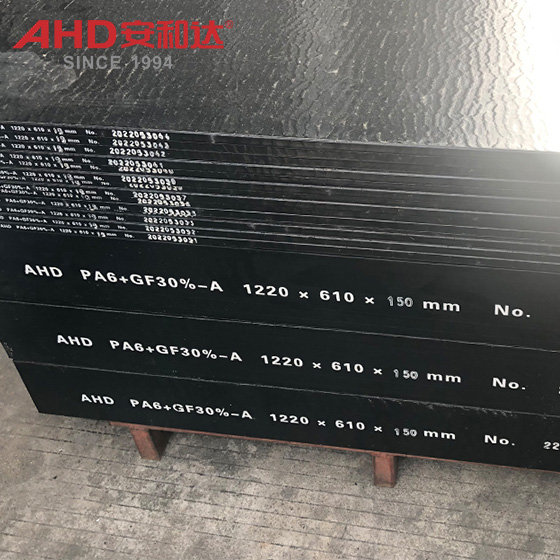
Unfilled pure PA6 (Nylon 6) features excellent toughness, wear resistance and chemical resistance, but it suffers from obvious defects: low rigidity, poor dimensional stability, easy thermal deformation, high water absorption and weak load-bearing capacity. To fix these drawbacks, manufacturers add chopped glass fiber into PA6 resin to produce customized PA6 glass-filled sheet and PA6 glass-filled rod, the most cost-effective engineering plastic composite for metal replacement, automation machinery and structural component manufacturing.
Global industrial buyers often ask three core questions before bulk procurement: How are glass-filled PA6 sheets and rods made? What role does glass fiber play in PA6 composite? What performance differences do different glass fiber percentages bring? This article breaks down all details for material selection, procurement and machining reference.

Fiberglass PA6 Sheet
How Are PA6 Glass Filled Sheet & Rod Manufactured?
PA6 fiberglass board and rod are thermoplastic composite products, processed via modified compounding + fixed extrusion forming, divided into 4 standardized industrial production steps, adopting short glass fiber modification technology for mainstream commercial grades:
Step 1: Raw Material Proportioning & Modification Compounding
Base raw material: virgin PA6 nylon resin pellet. Reinforced material: silane-treated chopped E-glass fiber (industry standard for plastic reinforcement). Auxiliary additives: coupling agent, anti-oxidant, hydrolysis stabilizer, demolding agent.
All materials are fed into a twin-screw extruder. Glass fiber is side-fed to avoid fiber crushing, ensuring uniform fiber dispersion inside PA6 matrix. This step makes finished PA6 GF compound pellets with fixed glass fiber content (15%, 30%, 40%, 50% standard grades).
Step 2: Melting Extrusion Molding
Qualified PA6 GF pellets are dried at 85℃-100℃ for 4-6 hours to remove moisture (nylon is hygroscopic). Then pellets are melted at 230℃-270℃ and extruded via professional mould: circular mould for solid PA6 glass filled rod, flat mould for integral PA6 glass filled sheet. Continuous extrusion guarantees uniform density without internal bubbles.
Step 3: Constant-temperature Setting & Cooling
Different from pure PA6 rapid cooling, PA6 GF profiles adopt gradient water cooling to reduce internal stress, prevent warping, fiber exposure and surface cracking, which guarantees flat sheet surface and straight rod roundness for later CNC machining.
Step 4: Cutting, Finishing & Quality Inspection
Products are cut into customized length/thickness,and tested for fiber content, tensile strength, density and flatness before packaging.
Note: Compression molding is adopted for ultra-thick customized PA6 glass filled sheets for special industrial use.

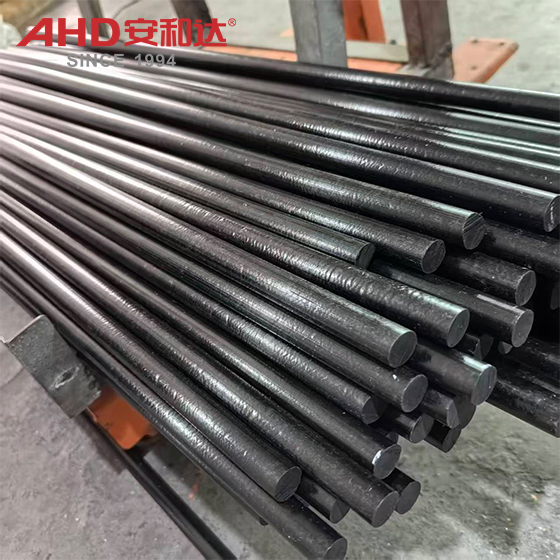
AHD Glassfiber PA6 Nylon Rod
Core Functions of Glass Fiber in PA6 Composite Materials
E-glass fiber is the core reinforcing filler of modified PA6, it is chemically bonded with PA6 molecular chain via coupling agent, not simply physical mixing. It solves almost all weaknesses of raw pure PA6, with 6 irreplaceable functions:
1. Boost Mechanical Rigidity & Load-Bearing Strength
Glass fiber has ultra-high tensile modulus. It shares external stress instead of PA6 resin alone. Reinforced PA6 gains 2-4 times higher flexural strength and tensile strength than unfilled PA6, suitable for long-term heavy-load structural parts.
2. Greatly Improve Dimensional Stability
Pure PA6 absorbs water easily and expands/shrinks obviously in humid environment. Glass fiber lowers water absorption rate by 30%-60%, reduces molding shrinkage, keeps part size stable in wet, high-low temperature alternating working scenarios.
3. Elevate Heat Resistance & Anti-Deformation Performance
Glass fiber improves HDT (Heat Deflection Temperature) sharply. Unfilled PA6 HDT is around 65℃, while PA6 GF30 HDT reaches 205℃, avoiding thermal bending under continuous high-temperature working conditions.
4. Reduce Creep Deformation
Long-term static pressure will make pure PA6 permanent creep deformation. Glass fiber framework restricts molecular flow, making PA6 GF rod/sheet qualified for long-term stressed bracket, shaft and spacer parts.
5. Lower Material Cost & Replace Metal Parts
Glass fiber is low-cost inorganic filler, cutting overall material cost of modified PA6. Meanwhile, reinforced PA6 features lighter weight than aluminum alloy, brass and iron, reducing equipment overall weight and operational energy consumption.
6. Enhance Chemical & Abrasion Resistance
Compact glass fiber network improves anti-corrosion performance against weak acid, weak alkali, lubricating oil and industrial coolant, extending service life of transmission and guide parts.
Performance Difference: PA6 GF15 / GF30 / GF40 / GF50 Full Comparison
Glass fiber content is the decisive factor of final product performance, machinability and price. 15%,30%,40%,50% are global standard commercial grades. Higher GF content means stronger rigidity, worse toughness and poorer surface finish. Below is practical industrial comparison for buyer selection:
| Core Performance Feature | Advantages | Disadvantages | Typical Industrial Applications | |
| Pure PA6 (0% GF) | High toughness, best impact resistance | Easy machining, smooth surface, low brittleness | Easy deformation, poor heat resistance | Gasket, soft buffer wheel, non-load wear parts |
| PA6 GF15 (15% Glass Fiber) | Balanced toughness & rigidity | Good surface finish, easy CNC cutting, low wear on cutting tools, moderate price | Limited high-load bearing capacity | Medium-load gears, automation fixture, conveyor accessories |
| PA6 GF15 (30% Glass Fiber) | Industry mainstream grade, optimal cost-performance | Standard rigidity, stable size, widely stocked, balanced heat resistance | Moderate tool wear during machining | Most popular grade: machinery shaft, support block, pump parts, electronic insulating board |
| PA6 GF15 (40% Glass Fiber) | High rigidity, ultra-low shrinkage | Excellent anti-creep, stable size in extreme temperature | Lower impact toughness, obvious tool abrasion | High-precision fixture, high-temperature bracket, heavy load spacer |
| PA6 GF15 (50% Glass Fiber) | Max strength & heat resistance | Near-metal rigidity, strongest anti-deformation, lowest water absorption | Brittle, poor impact resistance, hard machining, highest tool loss | Special high-temperature structural plate, corrosion-resistant metal replacement parts |
Procurement Selection Tip: Choose PA6 GF15 if you need easy machining and anti-break performance; choose PA6 GF30 for universal industrial use; pick GF40/GF50 only for high-precision, high-temperature heavy-load scenarios.
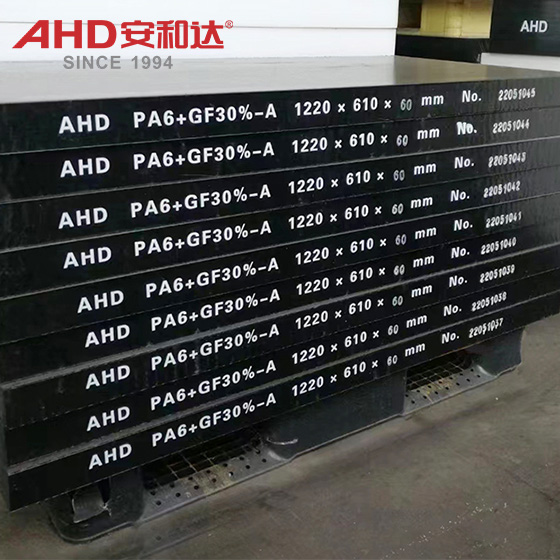
AHD Glassfiber PA6Nylon Plastic Sheet
Frequently Asked Questions (FAQ)
Q1: Is glass filled PA6 stronger than pure PA6?
Yes. All glass fiber reinforced PA6 owns higher rigidity, heat resistance and dimensional stability than unfilled PA6, while sacrificing partial impact toughness.
Q2: Will higher glass fiber content make PA6 harder to machine?
Absolutely. Glass fiber is abrasive. GF50 PA6 rod wears CNC drill and cutter seriously, requiring carbide cutting tools for processing.
Q3: Can PA6 Glass Filled Nylon Plate replace aluminum alloy?
PA6 GF30/GF40 can replace low-load aluminum parts, featuring lighter weight, better insulation and lower noise, not suitable for ultra-high pressure bearing scenarios.
Q4: Does PA6 GF absorb water?
It still absorbs minor moisture, but far less than pure PA6. Higher glass fiber content brings lower water absorption rate.
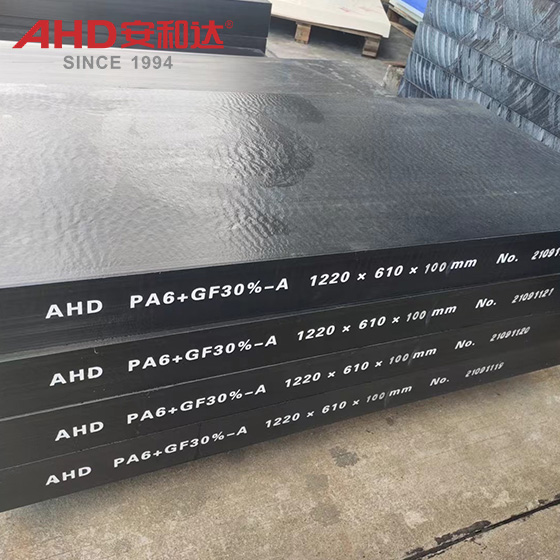
PA6 glass-filled sheets and rod are manufactured via twin-screw compounding + continuous extrusion molding, taking E-glass fiber as a rigid reinforcing skeleton. Glass fiber optimizes PA6’s strength, size stability and heat resistance fundamentally. Among all grades, PA6 GF30 remains the best-selling grade for global industrial processing, with balanced performance and cost.
If you need a customized size or cut-to-size PA6 glass-filled sheet and rod, contact our team for a material data sheet and bulk wholesale quotation.