

If you are running a plastic CNC workshop or sourcing precision POM components, you must have experienced a frustrating problem: CNC machining POM always fails unexpectedly.
The two most common defective issues that destroy mass production are internal bubbles inside POM workpieces and severe warpage after cutting.
Many buyers change POM suppliers or adjust CNC parameters repeatedly, but the defects never go away.
The guide classifies all the real data in the workshop and the standardized processing solutions of CNC machining POM, including raw material selection, pre-drying, stress relief, and CNC cutting parameters.
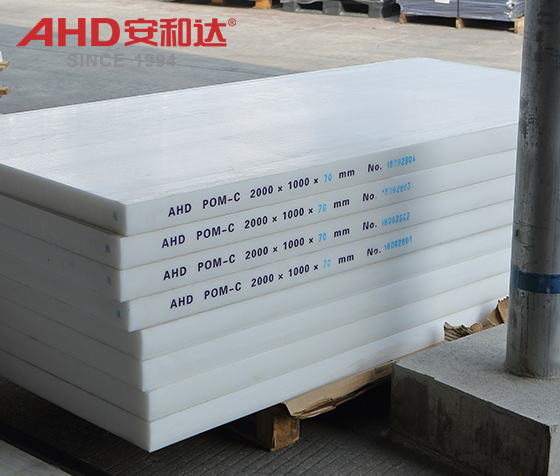
AHD Polyoxymethylene Sheet
What are bubbles in CNC Machining POM?
In CNC machining of POM, bubbles are classified into four main types: raw stock native voids, moisture vaporization, thermal degradation gas, and secondary contamination.
Each defect source has different surface symptoms for quick on-site judgment.
First, intrinsic central porosity of large diameter homopolymer POM rods due to extrusion molding.
The inner core cools more slowly than the outer surface, creating honeycomb micro voids locked inside solid stock.
If the CNC machining POM cuts through the central area, there will be dense bubbles exposed and the entire part will be scrapped.
Second, invisible moisture absorption is the most overlooked trigger for CNC machining POM bubbles.
Although POM has a low water absorption rate, the tiny water molecules would evaporate instantly when subjected to the heat of CNC cutting which is over 230°C.
The trapped steam causes pinholes and silver streaks across the machined surface.
The risk is increased by improper storage. Unsealed POM sheets or rods will absorb ambient humidity if left exposed for more than 1 month.
Humidity over 70% in workshops leads to 60% higher reject rate on CNC machining POM because of moisture bubbles.
Third, overheating during cutting causes POM molecular decomposition and releases formaldehyde gas.
Concentrated friction heat is generated by dull multi-flute cutting tools, excessive cutting depth, and inadequate cooling.
And gas cannot escape fast enough, so internal bubbles are sealed and edges are white burnt marks.
Fourth, volatile compounds are added with contaminated cutting fluid or mixed recycled stock.
These impurities volatilize at cutting temperature and create scattered tiny bubbles randomly on the POM workpieces.
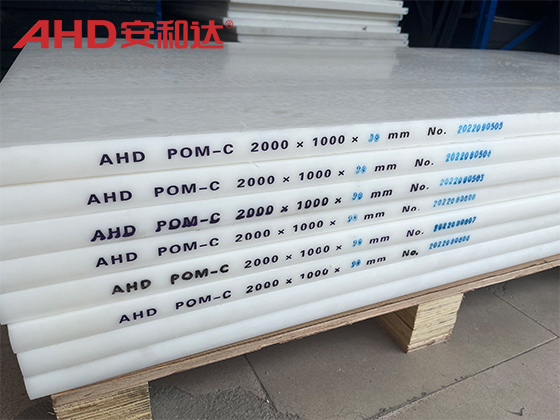
Total Solutions to Remove Bubbles in CNC Machining POM
To fix bubbles, POM needs closed loop control from raw material purchase to post-processing before CNC machining.
AHD, a professional manufacturer of POM sheets and rods, summarizes four executable standards for global processors.
1. Optimization of POM Material Grade Selection
For precision parts with zero bubble requirements, choose copolymer POM-C instead of homopolymer POM-H.
Copolymer POM stock has far fewer natural central voids, it is suitable for thick workpieces over 25mm.
Regrind material should be limited to less than 10%. Only virgin POM should be used for high precision medical and automation parts.
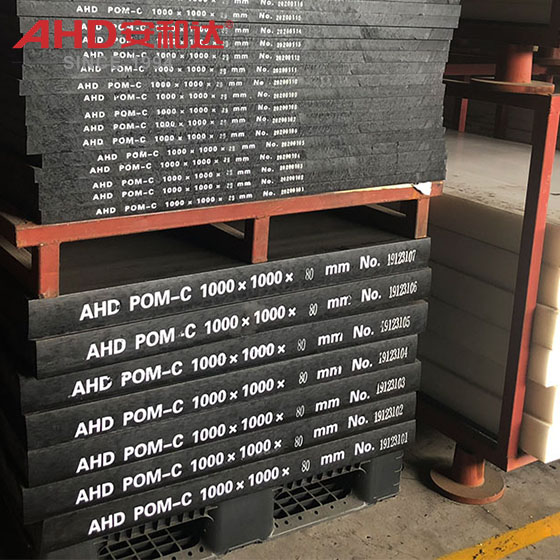
AHD supplies homopolymer and copolymer POM sheet and rod with 100% virgin POM material.
2. Standardized Pre-drying Procedure of POM before CNC Machining
CNC machining POM is guaranteed to have bubble defects if the moisture content exceeds 0.02%. Drying is a must.
New sealed POM sheet: Keep at constant temperature of 80℃ for 2 hours
Opened stock storage 1-3 months: drying at 85 °C for 4 hours
Damp exposed POM rod: 90°C for 6 hours
After drying, seal the stock in moisture proof bags and allow to cool completely to room temperature.
Skip this step and no subsequent CNC parameter changes will fix pin hole bubbles.
3. Special CNC Cutting Settings to Prevent Thermal Degradation
CNC machining POM . Use 2 flute plastic specific end mills instead 4 flute aluminum cutters .
Tools with large chip grooves: reduce friction and heat build up from blocked chips.
Use air cooling + micro oil mist instead of flooding water cooling.
Mass water cooling causes rapid changes in temperature, which can cause micro cracks and hidden micro bubbles.
Use low depth of cut and high feed speed to reduce the contact time between tool and POM surface.
4. Optimization of structure for thick POM rod workpiece
When machining parts from thick POM rods, do not cut through the central porous core.
If core penetration can not be avoided: Change to low-porosity copolymer POM supplied by AHD. AHD POM thick plates almost zero porosity, which has earned a deep market trust, and got the market feedback.
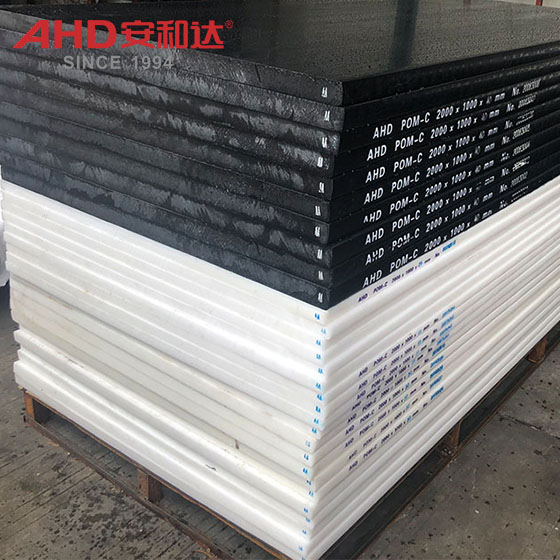
Complete Bubble Removal in CNC Machining POM Solution
Bubbles you need closed loop control from raw material purchase to post processing before CNC machining POM to fix.
AHD is a professional manufacturer of POM sheet and rod, summarizes the four standards that can be executed for global processors.
1. Select the Appropriate POM Material Grade
Choose copolymer POM-C (not homopolymer POM-H) for precision parts that require zero-bubbles.
Copolymer POM stock has much fewer native central voids, suitable for thick workpieces >25mm.
Regrind material should be limited to less than 10% and high-precision medical and automation parts should only be made from virgin POM.
AHD provides extrusion reports with internal void inspection data for homopolymer and copolymer Polyacetal Sheet and rod.
To avoid potential bubble risks at the source, buyers can ask for material performance test reports before placing bulk orders.
2. Standardized Pre-Drying Process of CNC Machining POM
The moisture content must be below 0.02% to avoid bubble defects during the CNC machining of POM, thus drying is needed.
New sealed POM sheet Constant temperature drying at 80 °C for 2 h
Opened stock stored 1-3 months: Dry 85°C 4 hours
Damp exposed POM rod: dry 6 hours at 90 deg C
Seal the stock in moisture proof bags and cool to room temperature. When dry,
Failure to do this step will result in no fix for pinhole bubbles with all subsequent CNC parameter adjustments.
3. Special CNC Cutting Conditions to Avoid Thermal Degradation
CNC machining POM: 2-flute end mills made for plastic, not 4-flute aluminum cutters.
The large chip grooves on the tools help reduce friction and prevent the heat build up from packed chips.
Use air cooling plus micro oil mist instead of flood water cooling.
Sharp temperature swings from mass water cooling cause micro cracks and hidden micro bubbles.
Small depth per cut and large feed speed to reduce contact time between tool and POM surface.
4. Structural Optimization of Thick POM Rod Workpiece
Drawings of parts cut from thick POM rods must not cut through the porous central core.
If core penetration is unavoidable, use AHD supplied copolymer of POM. Market feedback: AHD POM thick plates have almost no pores, have gained deep market trust.
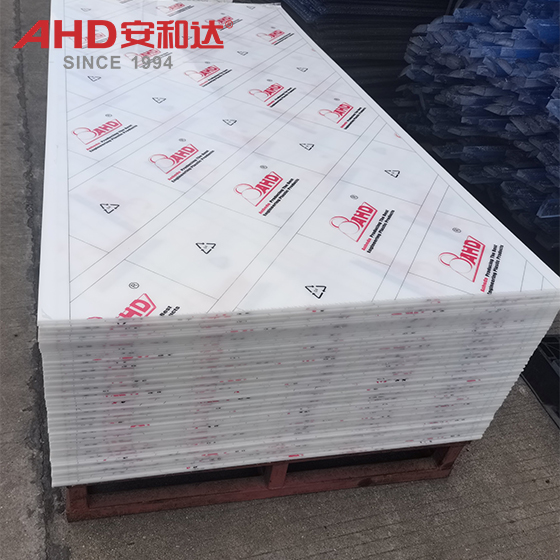
AHD POM Sheet, some call Delrin Sheet
AHD classifies general countermeasures for stabilizing dimensional accuracy in CNC machining POM products.
Annealing of POM Blanks for Stress Relief
Annealing eliminates native extrusion stress before CNC machining POM and reduces warpage reject rate by over 80%.
Copolymer POM-C: Keeping heat at 120-140°C for 2-4 hours, then cooling down at 5°C per hour
Homopolymer POM-H: Insulation 150–160°C, add 30 min holding time per 6mm material thickness
Small-batch workshops without ovens can leave blanks at room temperature for 24 hours to naturally stress age.
Symmetric rough and finish machining process
Low-warpage CNC machining POM:3 steps of the machining process rough cut stress release aging finish milling
Roughing: Reserve 0.5-1mm uniform allowance on all surfaces, balance cutting volume at both sides.
- Rough machining demount workpieces and age 6-24 hours as required by tolerance.
Finish the cut with a very small depth of cut to minimize the generation of new machining stresses.
Common CNC Machining Myths about POM Breakdowns
Wrong industry beliefs about CNC machining POM cause many processors to make the same failures again and again.
Address those misconceptions at the root to dramatically reduce the scrap rate.
Misconception 1: POM does not absorb much water so pre-drying can be skipped.
Fact: When POM is CNC machined, invisible trace moisture evaporates under cutting heat and creates dense pinholes.
Even slightly damp stock will cause bubble scrap on thick POM parts.
Myth 2: Flood water cooling will provide a better surface finish on the cut edge of POM.
Fact: A large volume of water causes a sudden cold-hot shock that creates micro pores and latent internal stress.
For high volume production of CNC machined POM air cooling is still the norm.
Myth 3: All cuts are made at once to speed up shop efficiency.
Fact: The unbalanced single-side cutting immediately releases stress, bending the thin POM plates severely.
All mass production factories use separated rough and finish flow for CNC machining POM.
Myth 4: One homopolymer, POM-H, is suitable for all precision machined parts.
Fact: Thick homopolymer POM rods have central voids. Cutting through the core produces large bubbles.
Thin plates below 15mm without central cutting only suitable for homopolymer stock.
Misconception 5: Warped POM parts can be fixed with external pressure.
Fact: The crystallization stress inside POM is non-reversible. Manual calibrated workpieces come back in days.
Raw material and processing control must be used to prevent defects before CNC machining POM.
Get Professional POM Processing Support from AHD
Persistent bubbles and warpage during CNC machining POM waste raw materials, labor and delivery time.
Instead of spending weeks adjusting unstable processing parameters, cooperate with AHD for standardized POM sheet and rod matched to CNC production.
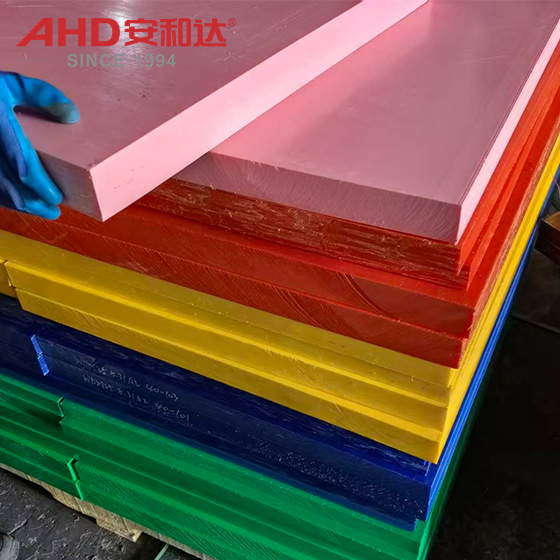
AHD provides virgin copolymer and homopolymer POM stock with strict internal void during extrusion, also provides ESD POM Sheet.
We can offer POM samples for your CNC test cutting to verify bubble and deformation performance before mass order.
