POM (acetal) and nylon (PA) are both thermoplastics that are easy to machine and are self-lubricating, making them popular choices for custom-machined fixture components. These two engineering plastics, however, reach clear performance limits with increasing operating temperatures, increasing static load pressure or when electrical isolation becomes a project requirement.
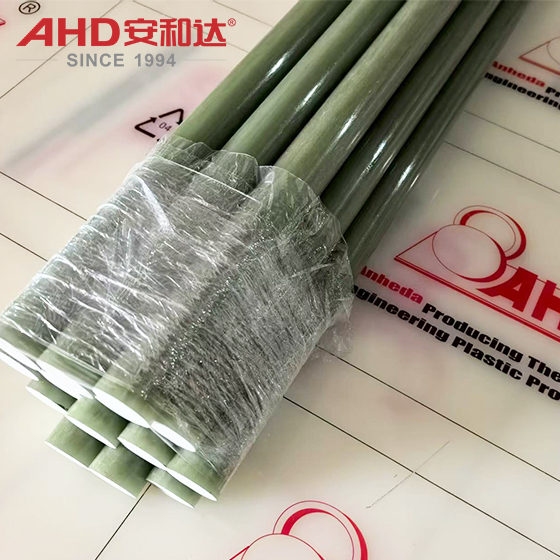
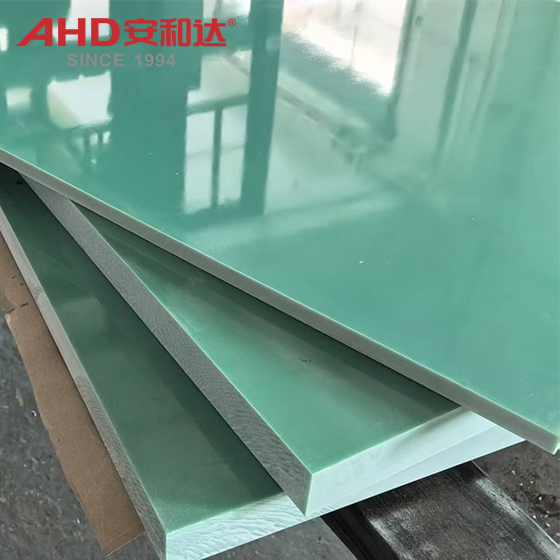
Many mold-makers finally migrate to aqua-green FR4 Glass Fiber Sheet and FR4 Rod when POM-based or nylon-based plates start to warp, deform or drift out of tolerance after weeks of continuous production runs. We highlight applications that still favor POM or nylon, so you can make correct material-sourcing decisions before placing custom-cut orders.
Material Profiles: POM, Nylon & Aqua-Green FR4 Basic
Before comparing real‑world performance, it is critical to understand the fundamental composition of each material. Below are their respective strengths and weak points in mold-tool and fixture-building workflows.
1. Acetal (POM)
POM is a rigid semi-crystalline thermoplastic. Its main selling point is a low-friction surface and good wear resistance. It machined cleanly on standard CNC routers and mills without the need for specialised cutting tools. It works well for low temperature moving parts.
Its main disadvantages are its limited heat resistance and moderate creep behaviour under constant pressure.
2. Polyamide (PA, Nylon)
Another thermoplastic used extensively for machined fixture parts is nylon. It has a high tensile strength and is quite impact resistant. The principal disadvantage of standard grade nylon is its high water absorption. The material absorbs moisture from the air causing it to swell, change dimensions and lose pre-set fixture tolerances. Its continuous-use temperature ceiling is about 80 °C-100 °C, lower than most mold-side operating environments. Nylon exhibits a slow creep and compression under repeated production cycles of continuous static compression.
3. Aqua-Green FR4 Fiberglass
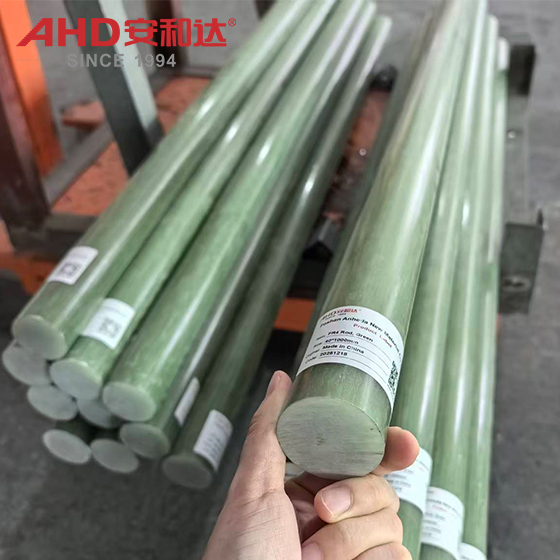
Aqua-green FR4 is a thermosetting composite of woven glass-fabric matrix bonded with high-quality aqua-tinted epoxy resin. Thermoset structures do not melt under prolonged heat, unlike thermoplastics such as POM and nylon. Aqua-green epoxy formulation with low water absorption, stable dimensional properties under constant load and consistent dielectric properties.
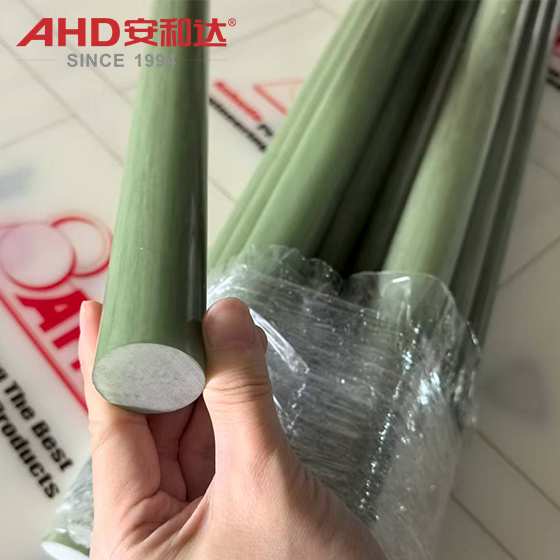
Aqua-green FR-4 is available in solid sheets and rods and is fully compatible with CNC milling, drilling, grooving and precision profiling for custom-built mold insulation blocks and fixture base frames. It was designed for high heat static structural applications where thermoplastics start to fail.
Performance Comparison: Aqua‑Green FR‑4 vs POM vs Nylon
| POM | Nylon | Aqua‑Green FR4 | |
| Max continuous operating temperature | 110 °C | 100 °C | 130‑150 °C |
| Water‑absorption rate | Low | High | Ultra‑low |
| Creep resistance under static load | Moderate | Poor | Excellent |
| Electrical insulation | insulating, but decreases slightly under high humidity conditions. | insulating, but decreases under high humidity conditions. | High‑grade dielectric |
| Coefficient of friction | Low (self‑lubricating) | Medium | High |
| Dimensional stability under humidity | Fair | Poor | Exceptional |
| Best‑suited part type | Sliding moving components | Low‑stress wear parts | Static plates, insulation panels |
The dividing line between thermoplastics and aqua-green FR4 is clear from this performance table. POM and nylon have the advantage in friction based applications. Aqua-green FR4 Sheet is king in the high temperature, high pressure, insulated static plate environments of injection mould setups and test fixture systems.
When POM and Nylon are still the best choice for fixture plates
However, aqua-green FR4 can not completely replace POM and nylon in fixture making industry due to the superior heat resistant properties of aqua-green FR4. They are an indispensable part of any moving or sliding fixture assembly.
POM is the preferred material for sliding guide blocks, linear wear strips, positioning sliders and movable jigs. Its low friction surface eliminates the need for external grease in many low temperature assembly-fixture stations. Nylon is a good choice for low heat toggle brackets, spacer blocks and wear pads that are subject to repeated physical contact and for which slight dimensional swelling from moisture is acceptable within the project tolerance budget.
If the component is dynamic (slides, rubs, shifts back-and-forth), working temperatures remain below 100 °C and electrical isolation isn’t a concern, engineers will continue to choose POM or nylon over aqua-green FR4. Aqua-green FR4 on sliding parts would generate excessive friction, surface scuffing and early component failure, making it uneconomical for these applications.
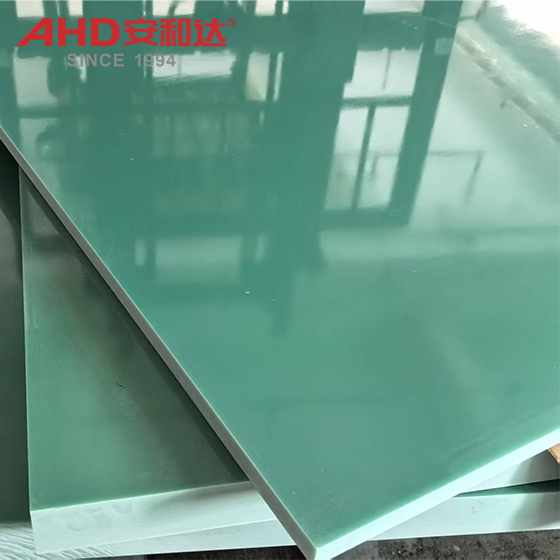
AHD FR4 Sheet
When to Choose Aqua-Green FR4 Instead of POM and Nylon for Mold Insulation & Static Fixture Plates
If the working temperature is high, if there is static constant compression, or if electrical isolation is required, aqua-green FR4 Sheet is the material of choice.
1. Insulating boards for injection moulding
Injection-molding machines operate on constant heat cycles. Mold halves are maintained at constant temperatures, usually between 120 °C–140 °C. If you are fabricating insulation plates that sit between the mold and the machine platen, POM and nylon can not survive the long-term heat exposure.
At temperatures above 110 °C POM starts to soften, creep and compress under the clamping pressure of the injection press. Nylon deforms faster, soaking up workshop humidity and warping out of flatness. Warping of insulation plates takes place over a few production runs, heat transfer becomes uneven, mould-temperature fluctuates, resulting in inconsistent plastic-part quality and higher machine-energy consumption.
Aqua-green FR4 Fiberglass Sheet has rigid structure integrity under continuous 130-150°C operating heat. The system prevents the thermal transfer from the hot mould to the machine platen, stabilizes the mould temperature, cuts down the energy waste and maintains the flat geometry even at a constant high clamping load. It resists creep for years of continuous mass production eliminating frequent plate-replacement costs that come with POM- or nylon-made mould insulation panels.
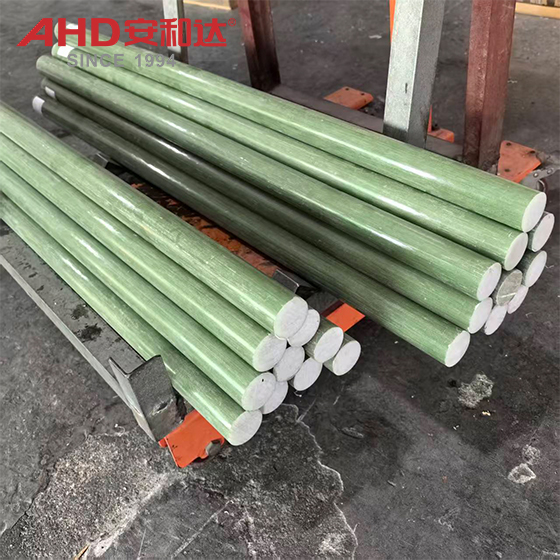
2. Fixed Base Plates for CNC-Machined Fixtures
Many assembly jigs, positioning backing plates and clamping frames are completely stationary. They have continuous static pressure without sliding motion. Long-term compression leads to thermoplastic materials compressing slowly, losing flatness and throwing off precision positioning.
The Aqua-green FR4 glass-epoxy thermoset structure provides superior anti-creep properties. After CNC machining to fixture-base geometry, it holds exact dimensions over a long period of time, even under continuous clamping load. Its extremely low water-absorption rate also means no plate warping in humid production workshops, a common pain-point with nylon fixture substrates.
3. Substrates for Electrical and ICT Test Fixtures
Test fixtures used for checking the quality of circuit boards must be electrically isolated to prevent signal interference and current leakage. POM or nylon cannot be relied upon as an insulator. Electric current can leak across fixture plates, distorting test readings and resulting in false quality-control results.
Aqua-green FR4 is a common base-plate material for ICT test jigs because of its inherent dielectric property. Engineers machine mounting holes, probe cut-outs and positioning slots onto aqua-green FR4 sheets, to make insulated fixture frames that stabilize electrical signals during circuit-component testing. For this specific use-case there is no alternative value suitable for POM and nylon.
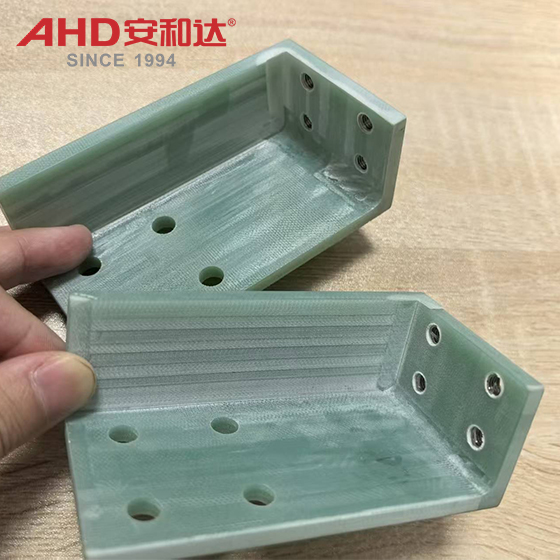
Aqua-Green FR-4 Sheet and Rod Machining Guidelines
Aqua-green FR4 epoxy glass-laminate can be machined accurately with standard CNC milling, drilling, tapping and grooving equipment used for POM and nylon, but minor machining adjustments must be observed by operators.
Carbide-tipped cutting tools have the longest service life when cutting the glass-fibre-reinforced composite. High spindle speed and moderate feed rates prevent fraying on cut edges. Coolant can be optional for ultra precision jobs .
Mold insulation blocks, spacer pins, fixture support pillars and base frames are made from custom profiled flat aqua-green FR4 sheets and round solid rods. Tight-tolerance CNC work can be used for high-end mold-tool and semiconductor fixture projects.
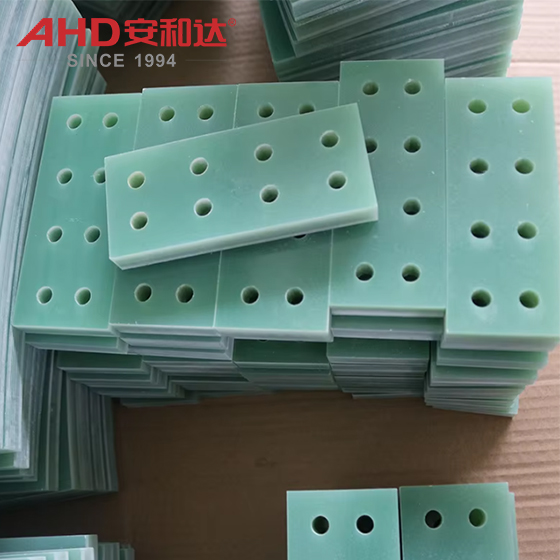
FR4 Glass Reinforced Plastic Sheets Processing into Parts
Q1. Can aqua‑green FR4 replace POM for sliding‑type fixture components?
No. Aqua‑green FR4 has a high‑friction surface. It is not engineered for moving, sliding‑wear‑prone parts. POM or nylon remain the better pick for sliding fixture slides and guide blocks. Aqua‑green FR‑4 is reserved for static fixture bases and mold‑insulation panels.
Q2. What continuous‑use temperature can aqua‑green FR4 mold‑insulation plates withstand?
Our aqua‑green FR4 maintains stable dimensional performance at a continuous operating temperature up to 130 °C‑150 °C, ideal for long‑term heat‑blocking in injection‑mold set‑ups without warping or creeping.
Q3. Is aqua‑green FR4 electrically insulating for test‑based fixture plates?
Yes. The aqua‑green epoxy‑glass‑laminate delivers reliable dielectric‑insulating properties, which makes it ideal for ICT test fixtures where electrical isolation is required, something POM and nylon cannot reliably deliver.
Aqua-green FR4, POM or nylon? The choice of material for mold-insulation sheets and CNC fixture plates finally depends on operating temperature, load type, movement behaviour and insulation requirements.
For low-temperature, sliding wear-based fixture parts, POM and nylon excel. For high-heat mold-insulation panels, static precision fixture bases and electrically-isolated test-jig substrates, aqua-green FR-4 is better than the two thermoplastics in dimensional stability, anti-creep performance and long-term service life.
AHD Polymer provides custom high quality aqua-green FR4 sheet & rod for mold insulation & CNC fixture-plate applications.