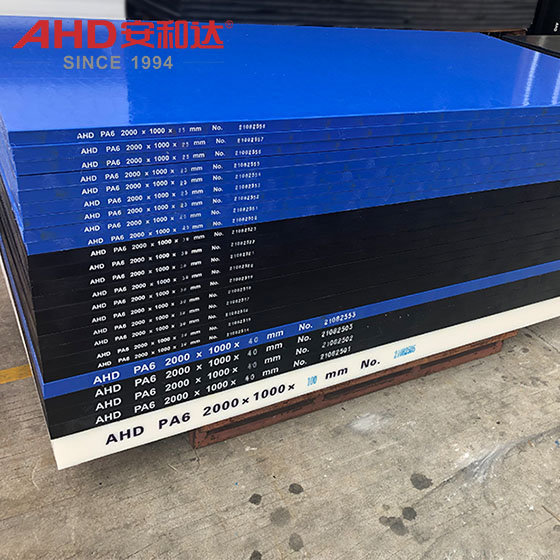
AHD PA6 Nylon Sheet
MC Casting Nylon (MC Nylon) and PA6 Extruded Nylon both belong to the polyamide 6 (PA6) material system, but due to differences in production processes and technical approaches, they have significant differences in microstructure, performance, and application scenarios. The following is a detailed analysis of the similarities and differences:
Similarities
1. Common Basic Chemical Composition
Both are based on polyamide 6 (PA6) resin, with the main chain connected by repeating amide bonds (-NH-CO-) and pendant methylene groups (-CH₂-). Therefore, they share the core properties of PA6:
• Polarity and Hydrogen Bonding: The presence of amide bonds imparts strong intermolecular forces (hydrogen bonding), contributing to its high melting point and solvent resistance (stable to non-polar solvents).
• Basic Mechanical Properties: These properties include certain tensile strength, flexural strength, and impact toughness, as well as self-lubrication and wear resistance.
• Chemical Resistance: They are resistant to weak acids, bases, and oils, but are susceptible to corrosion from strong acids and bases.
2. Engineering Plastic Properties
Both are high-performance engineering plastics, primarily used to replace traditional metal materials (such as steel, cast iron, and aluminum alloys) in the manufacture of mechanical parts requiring friction and wear resistance or lightweighting, such as gears, bearings, sliders, turbines, and pump bodies.
3. Modification Potential
Both materials can be modified by adding fillers (such as glass fiber, graphite, and molybdenum disulfide), toughening agents, or flame retardants to further optimize performance (e.g., increasing strength, reducing friction, or meeting flame retardancy requirements).
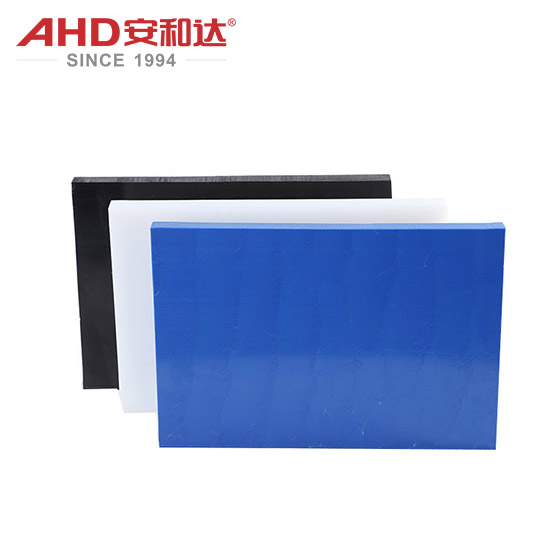
AHD MC Nylon Sheet
Differences
1. Essential Differences in Production Process
• MC Casting Nylon (Monomer Casting Nylon):
Utilizes a "monomer anionic polymerization + casting molding" process. Using caprolactam (the monomer of PA6) as the raw material, anionic polymerization occurs directly in the mold under the action of an initiator (such as sodium hydroxide). The polymerization process is exothermic, requiring controlled temperature (approximately 160-220°C) and time (several minutes to several hours) to ultimately produce large, thick-walled products.
Key Features: One-step polymerization and molding, without melt extrusion, makes it suitable for manufacturing large, complex-shaped products (such as thick-walled and special-shaped parts).
• PA6 Extruded Nylon:
Utilizes a "polymerization followed by extrusion molding" process. PA6 resin pellets (molecular weight approximately 20,000-30,000) are produced through a polymerization reaction (such as hydrolysis polymerization or solid-state condensation polymerization). These pellets are then heated and melted in an extruder (melting point approximately 220-230°C). The pellets are then extruded through a die into a specific cross-sectional shape (such as tubes, rods, sheets, or profiles), and finally cooled to set.
Key Features: This two-step process (polymerization + extrusion) relies on melt processing, making it suitable for the continuous production of standardized profiles or small precision parts.
2. Molecular Structure and Crystallization Behavior
• Molecular Weight and Distribution:
MC nylon has an extremely high molecular weight (typically 100,000-200,000, or even higher). Because anionic polymerization lacks significant chain termination, the molecular chain can grow fully, resulting in a narrow molecular weight distribution.
PA6 extruded nylon has a lower molecular weight (approximately 20,000-30,000). Because the polymerization process requires controlled reaction intensity to ensure melt fluidity, and because shear forces during extrusion may cause molecular chain breakage, the molecular weight distribution is relatively broad.
• Crystallinity and Crystal Form:
MC nylon has a high crystallinity (up to 50-65%) due to the long molecular chain relaxation time after polymerization. This allows for a more complete crystallization process, resulting in larger grain size and a more complete structure.
PA6 extruded nylon has a lower crystallinity (approximately 40-55%) due to the shear effect and rapid cooling during melt extrusion. It may contain more disordered structures or secondary crystalline regions, resulting in smaller grain size.
3. Dimensional Precision and Surface Quality
• MC nylon: Internal stress may be generated during the casting process due to uneven cooling. Furthermore, mold precision is limited, resulting in wide dimensional tolerances and high surface roughness. It is generally suitable for applications where precision is not a priority.
• PA6 extruded nylon: Extrusion molds offer high precision, uniform melt processing temperatures, tight dimensional tolerances, and a smooth surface. It is suitable for manufacturing parts requiring high-precision cross-sections (such as precision gears and guide rails).
4. Water Absorption and Dimensional Stability
• MC nylon has a low water absorption rate due to its high crystallinity and dense molecular chain stacking.
• PA6 extruded nylon has a higher water absorption rate due to its lower crystallinity and potentially more disordered structure.
This difference in water absorption directly affects dimensional stability: MC nylon exhibits less dimensional change in humid environments and is suitable for outdoor or high-humidity applications. PA6 extruded nylon requires more rigorous drying to prevent deformation during processing or use.
5. Application Focus
• MC Casting Nylon:
Due to its ability to mold large, thick-walled, or complex-structured products, it is primarily used in heavy machinery, mining equipment, and marine components. Applications include large gears, bearing retainers, hydraulic valve bodies, and wear-resistant liners.
• PA6 Extruido Nylon:
Due to its ability to continuously produce standardized profiles (such as bars, tubes, and sheets) and small precision parts, it is widely used in general machinery, electronics, and automotive applications. Applications include small gears, pulleys, bearings, electrical insulation components, and appliance parts.
Summary
MC Casting Nylon and PA6 Extruido Nylon both belong to the PA6 family and share a common core chemical structure. However, fundamental differences in their production processes (one-step polymerization vs. polymerization followed by extrusion) lead to significant differences in molecular weight, crystallinity, mechanical properties, dimensional accuracy, and application scenarios. The selection process should be based on specific needs: MC nylon is suitable for large size, high strength, and complex structures; PA6 extruded nylon is suitable for high precision and standardized profiles.
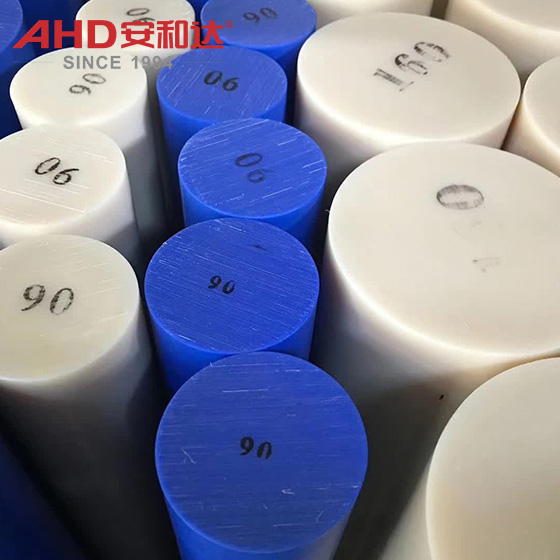
AHD MC 901 Rod