Silicone Sheets & Rod and Silicone Foam Sheet & Rod both use silicone rubber as their base material, and therefore share certain commonalities in core chemical properties. However, due to the porous structure introduced by the foaming process, the two differ significantly in physical properties, functional advantages, and application scenarios. The following analysis focuses on similarities and differences in properties and applications:
I. Common Properties
Both products are based on silicone rubber (with polydimethylsiloxane as the primary component), and therefore share the following core properties:
1. Extreme Temperature Resistance: Both products remain stable within a temperature range of -60°C to +250°C (some modified varieties can reach higher temperatures), without brittleness or softening. They are suitable for high-temperature environments (such as industrial equipment and automotive engine areas) or low-temperature environments (such as cold chain and outdoor equipment).
2. Chemical Stability: They are resistant to ozone, UV rays, and weak acids and alkalis (strong acids and alkalis require special formulations), are resistant to aging, and exhibit slow performance degradation with long-term environmental exposure.
3. Biocompatibility: They are non-toxic and non-irritating, suitable for contact with human skin or tissue (FDA or medical-grade certification required), and are widely used in the medical field.
4. Electrical Insulation: They have high volume and surface resistivities (typically >10¹²Ω·cm), making them excellent insulating materials suitable for electronic and electrical protection.
5. Environmentally friendly: Does not contain harmful substances such as halogens and phthalates, and some products are recyclable (depending on the production process).
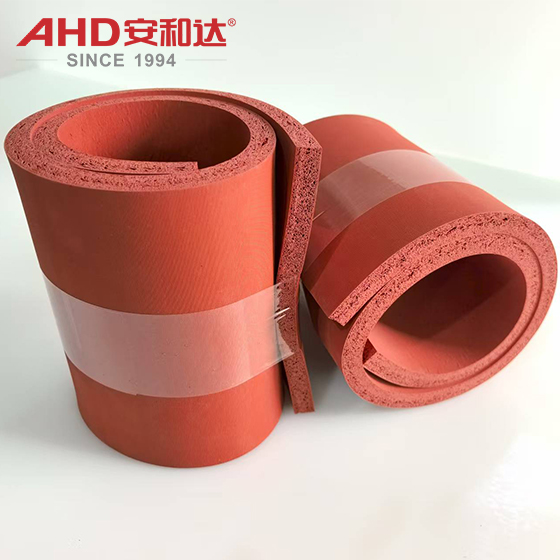
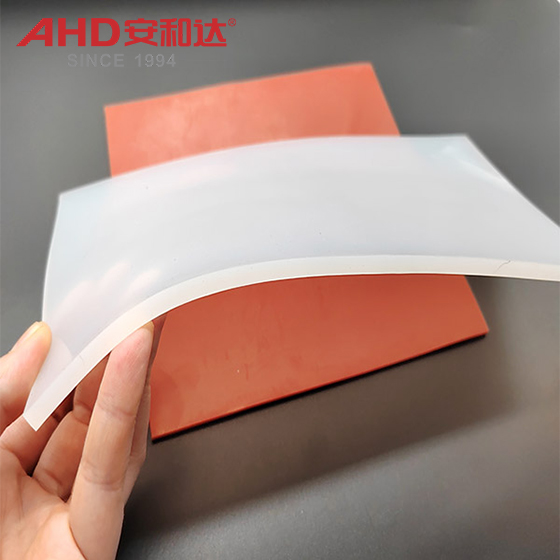
AHD closed cell silicone foam sheeet
II. Different Properties and Applications
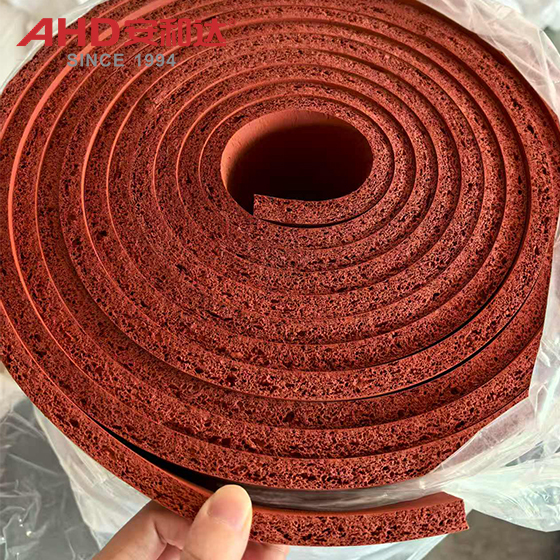
Due to the foaming process (chemical or physical foaming), foamed silicone has a porous internal structure (primarily closed or open cells). Compared to ordinary solid silicone, it exhibits significant differences in density, mechanical properties, and functionality. A detailed comparison is as follows:
1. Differences in physical properties
| Features | Silicone Sheet/Rod (Solid) | Silicone Foam Sheet/Rod (Porous) |
| Density | High (typically 1.1-1.3 g/cm³) | Low (0.2-0.8 g/cm³, depending on expansion ratio) |
| Hardness | Conventional Shore A 30-80 (customizable hardness) | Typically softer (Shore A 10-50, closed-cell foam is softer) |
| Mechanical Strength | High tensile strength (3-10 MPa) and high tear strength | Lower tensile and tear strength (1-5 MPa), but better elasticity |
| Compression Resilience | Average resilience (compression set approximately 10-30%) | Closed-cell foam has excellent resilience (compression set <10%) |
| Porosity | No pores (solid structure) | High porosity (closed cells: 80-95%; open cells: 70-90%) |
2. Functional Advantages
Solid Silicone Sheet/Rod:
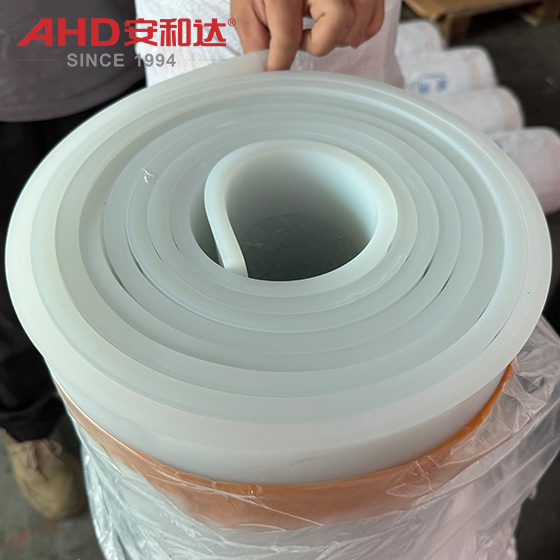
The core advantages lie in structural strength and sealing. The solid structure provides high tear and puncture resistance, making it suitable for components that require mechanical stress or sealing.
Porous Silicone Foam Sheet/Rod:
The core advantages lie in lightweight, cushioning, sound absorption, heat insulation, and breathability.
• Lightweight: The low density reduces overall weight (50-80% compared to solid silicone), making it suitable for weight-sensitive applications such as aviation and new energy vehicles.
• Cushioning: The porous structure absorbs impact energy (closed-cell foam is better at static shock absorption, open-cell foam is better at dynamic energy absorption). It is used in protective pads, shock-absorbing brackets, and other applications.
• Sound absorption and thermal insulation: The air trapped within the pores effectively blocks sound waves (reducing noise by 5-20dB) and heat transfer (thermal conductivity of 0.02-0.05 W/(m·K), superior to solid silicone), making it suitable for sound insulation and thermal insulation.
• Breathable and moisture permeable: Open-cell foam allows the passage of gas and water vapor (air permeability > 1000 L/(m²·s)), making it suitable for medical dressings (promoting wound healing) and filter materials (coarse filtration).
3. Differences in Application Scenarios
Silicone Sheets/Rods (Solid):
Mainly used in applications requiring structural support, sealing, or high mechanical strength:
• Industrial Sealing: O-rings, gaskets (for pipes and flange connections);
• Medical: Surgical instrument handles, medical catheters (such as urinary catheters), and plastic surgery filling materials;
• Electronics and Electrical: Insulating gaskets, heat sinks (requires thermally conductive fillers), and buttons;
• Daily Necessities: Kitchen gaskets, silicone molds, and maternal and child products (pacifiers and teething sticks).
Silicone Foam Sheets/Rods (Porous):
Mainly used in applications requiring shock absorption, sound absorption, heat insulation, or lightweighting:
• Automotive: Seat cushioning, instrument panel sound insulation, engine compartment insulation;
• Construction/Home Furnishings: Wall sound insulation, floor shock-absorbing pads, door and window seals (flexible cushioning);
• Medical: Postoperative pressure dressings (to promote blood circulation), rehabilitation braces (for pressure relief and support);
• Industrial Protection: Equipment shock-absorbing bases, precision instrument packaging cushioning materials;
• Aerospace: Lightweight insulation, astronaut seat cushions.
Conclusion
Silicone sheets/rods and silicone foam sheets/rods share the fundamental properties of silicone rubber (heat resistance, weather resistance, biocompatibility, etc.). However, due to structural differences (solid vs. porous), the former excels at high strength and sealing, making them suitable for structural support or sealing applications. The latter, with its lightweight, cushioning, shock absorption, sound absorption, and thermal insulation, is suitable for applications requiring enhanced functionality. When choosing between these two options, consider the balance between density, strength, and functionality based on specific requirements (such as load-bearing capacity, shock absorption, and weight restrictions).
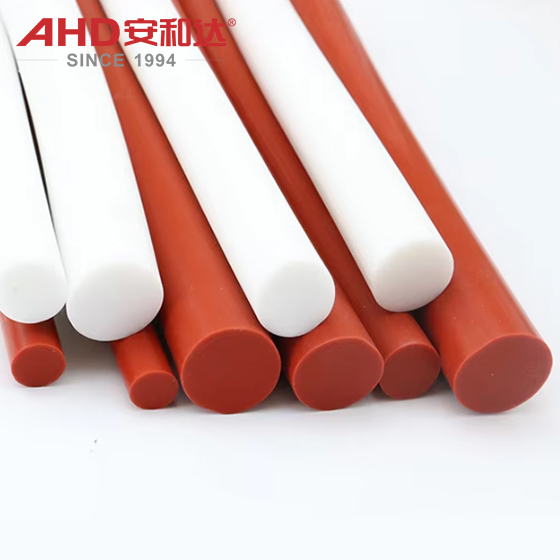
AHD round silicone rod