


ESD POM plastic sheet is an engineering plastic material that combines the high performance of polyoxymethylene (POM) with electrostatic discharge (ESD) protection. It is primarily used in static-sensitive environments. Let's take a closer look at what ESD POM is.
Core Concept: Combining ESD with POM
•POM (polyoxymethylene): A high-performance semi-crystalline thermoplastic engineering plastic with excellent mechanical strength, friction resistance, chemical resistance, and dimensional stability, it is widely used in gears, bearings, precision molds, and electronic component housings. However, ordinary POM is a strong insulator (surface resistivity typically >10¹⁴Ω), which can easily accumulate static electricity, potentially damaging sensitive electronic components or causing dust explosions.
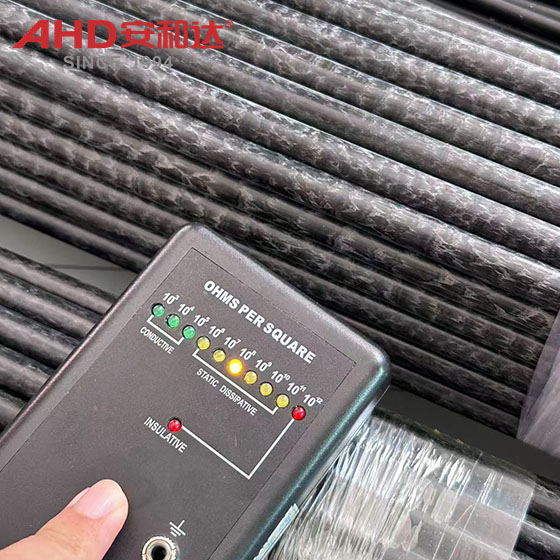
•ESD (electrostatic discharge) protection: This refers to materials that reduce surface/volume resistivity, allowing static charge to be quickly conducted away (rather than accumulated), thereby preventing electrostatic discharge (ESD) damage to electronic devices, precision instruments, or flammable environments. The surface resistivity of ESD materials is generally controlled between 10⁶ and 10¹¹Ω (between conductors and insulators).
ESD POM: By adding antistatic agents, conductive fillers, or surface modification to the POM matrix, it imparts ESD protection while retaining the original mechanical and thermal properties of POM.
Modification Principles and Technologies
To ensure ESD performance in POM, its resistivity must be reduced through physical or chemical methods. The main modification methods include:
1. Adding an Antistatic Agent (Blending Modification)
• Principle: By blending an antistatic agent (such as a quaternary ammonium salt, polyethylene glycol, or an imidazole ionomer) with POM resin, the antistatic agent migrates to the surface of the material, absorbing moisture from the air to form a conductive layer, accelerating static dissipation.
• Features: The process is simple (melt blending), but the antistatic effect is significantly affected by humidity (hygroscopic antistatic agents) and may lack long-term stability. Non-hygroscopic antistatic agents (such as permanent ionomers) provide more stable protection but are more expensive.
2. Filling with Conductive Fillers
• Principle: By adding conductive fillers (such as carbon black, carbon nanotubes, metal powder/fiber, or conductive ceramic particles) to POM, a conductive network is formed through contact or tunneling between fillers, reducing resistivity.
• Common Fillers:
• Carbon black: Low cost; a filler content of 5%-15% can achieve a surface resistivity of 10⁶-10⁹Ω. However, this may darken the material (black) and affect transparency.
• Metal fibers/powders (e.g., copper, aluminum, stainless steel): Excellent conductivity (resistivity <10³Ω), but high density (increasing material weight), high cost, and may poor interfacial bonding with POM (requiring surface treatment).
• Conductive polymers (e.g., polyaniline, polythiophene): Compatible with POM and provide uniform conductivity, but exhibit low conductivity (requiring high filler content).
• Features: Stable conductivity (unaffected by humidity), resistivity can be precisely controlled by adjusting the filler content. Currently, this is the mainstream modification method for ESD POM.
3. Surface Coating/Plating
• Principle: Applying an antistatic coating (e.g., polyurethane, epoxy resin with an antistatic agent) or plating a metal layer (e.g., nickel, chromium) to the surface of the POM sheet creates a conductive interface.
• Features: Does not affect the mechanical properties of the POM substrate and can be used locally; however, the coating is susceptible to wear (protection becomes ineffective after long-term use) and the process is complex (surface pretreatment is required).
Key Features
ESD POM combines the inherent advantages of POM with ESD protection. Its core features are as follows:
ESD Protection Performance
Surface resistivity: 10⁶~10¹¹Ω, volume resistivity: 10⁸~10¹²Ω·cm, and static decay time: <1s (compliant with ANSI/ESD S20.20).
Mechanical Properties
Tensile strength ≥48 MPa, flexural strength ≥56 MPa, notched impact strength ≥46 kJ/m²
Thermal Properties
Long-term operating temperature range: -40°C to 100°C, with a heat deflection temperature (ISO 75) ≥ 100°C. Its temperature resistance is comparable to that of standard POM.
Chemical Stability
Resistant to organic solvents (such as alcohols and hydrocarbons), but not resistant to strong acids (such as concentrated sulfuric acid), strong bases (such as sodium hydroxide), and strong oxidizers.
Wear Resistance
Inheriting POM's low coefficient of friction and high wear resistance, it is suitable for high-friction applications (such as guide rails and fixtures).
Dimensional Stability
Low shrinkage and low linear expansion coefficient make it suitable for precision parts.
Main Application Areas
ESD POM, due to its combination of mechanical properties and ESD protection, is widely used in electrostatically sensitive industries such as electronics, semiconductors, and precision manufacturing:
1. Electronics and Semiconductor Manufacturing
• Electronic component carriers: Such as PCB trays, integrated circuit (IC) packaging molds, and chip test jigs, to prevent electrostatic damage to chips.
• Automation equipment components: Robot grippers, conveyor guides, and vacuum chucks, to prevent the adsorption of tiny components and the generation of static sparks.
2. Precision Instruments and Medical Equipment
• Optical instrument holders: Structural components of microscopes and laser equipment, to prevent static dust from attracting and affecting accuracy.
• Medical testing tools: Sample trays for biochemical analyzers and surgical instrument accessories, to prevent static interference with test results or the adsorption of biological samples.
3. Cleanrooms and Explosion-Proof Environments
• Cleanroom Equipment: Conveyors and storage racks in semiconductor cleanrooms, to reduce static particle adsorption.
• Explosion-proof applications: Instrument housings in chemical workshops and operating tools in dusty environments to prevent explosions caused by static sparks.
4. Packaging and Transportation
• Electronic component packaging: Lined trays for IC chips and sensors replace traditional foam plastics, providing long-term ESD protection (especially suitable for long-distance transportation).
Production Process and Precautions
The production of ESD POM sheets requires a combination of POM processing characteristics and modification processes.
1. Raw Material Pretreatment: Select an appropriate POM matrix (homopolyoxymethylene (POM-C) or copolymerized polyoxymethylene (POM-CO)) and select an antistatic agent or filler as needed (for example, carbon black must be dried and dehydrated to prevent hydrolysis).
2. Blending and Modification: Melt-blend the POM with the antistatic agent/filler in a twin-screw extruder at a desired ratio (for example, POM:carbon black = 95:5). Control the processing temperature (170-200°C) to prevent resin degradation.
3. Sheet Forming: The modified material is extruded into sheets, which are then calendered and cooled to form ESD POM sheets (typically 5-100 mm thick).
4. Performance Testing: Test surface resistivity (four-probe method), volume resistivity (high-resistance meter), and tensile strength (universal testing machine) to ensure compliance with ESD standards (such as IEC 61340-5-1).
Precautions:
• The amount of antistatic agent added must be strictly controlled (excessive addition may reduce the rigidity and weather resistance of POM);
• The dispersion of conductive fillers directly affects the formation of the conductive network (this should be optimized using coupling agents or dispersants);
• Avoid high temperatures during processing (POM decomposes easily above 220°C, producing formaldehyde).
Advantages and Disadvantages
• Advantages:
① Combines the high mechanical strength and wear resistance of POM with ESD protection;
② Customizable resistivity (e.g., 10⁶Ω to 10¹¹Ω) upon request;
③ Superior temperature and chemical resistance compared to common antistatic plastics (e.g., PS and ABS).
• Disadvantages:
① Higher cost than common POM (due to the addition of antistatic agents or fillers);
② Some modifications (e.g., carbon black filling) may affect transparency;
③ The protective effect of hygroscopic antistatic agents is affected by ambient humidity (must be used in a dry environment).
ESD POM plastic sheet is a functional engineering plastic. Modified through the construction of a conductive network or the introduction of antistatic ingredients within the POM matrix, it provides ESD protection while maintaining high mechanical properties. It is widely used in electrostatically sensitive fields such as electronics, semiconductors, and precision manufacturing, and is a key material for addressing the hazards of static electricity. With the trend toward miniaturization and sophistication of electronic devices, demand for ESD POM is expected to continue to grow. Future development directions include the development of new antistatic systems with low filler content and high stability (heat and weather resistance).