

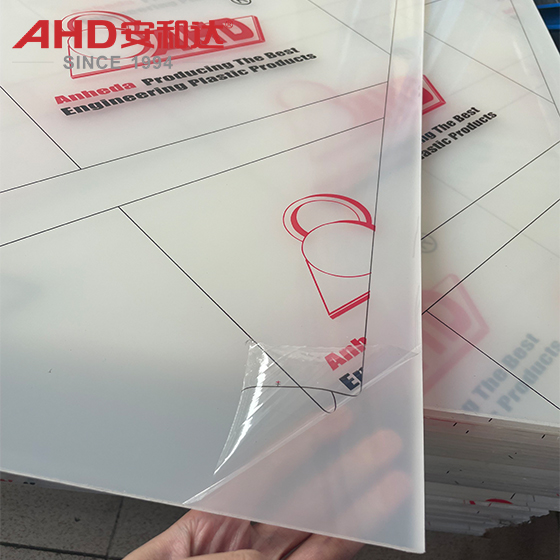
AHD PP-H Sheet (Polypropylene Sheet)
Definitions of PP-C and PP-H
PP (polypropylene) is a widely used thermoplastic. Based on differences in molecular structure and comonomers, it is primarily classified into the following categories:
PP-H: Homopolymer PP, formed from the polymerization of a single propylene (C₃H₆) monomer. The molecular chain contains only propylene units, exhibiting high crystallinity (approximately 60%-70%) and excellent rigidity and heat resistance.
PP-C: Block copolymer PP (also referred to as PP-B in some literature) is formed from the block copolymerization of propylene with a small amount of ethylene (typically 2%-7%). Its molecular chain is composed of long segments of propylene units and "blocks" of ethylene units, achieving a balance of rigidity and toughness.
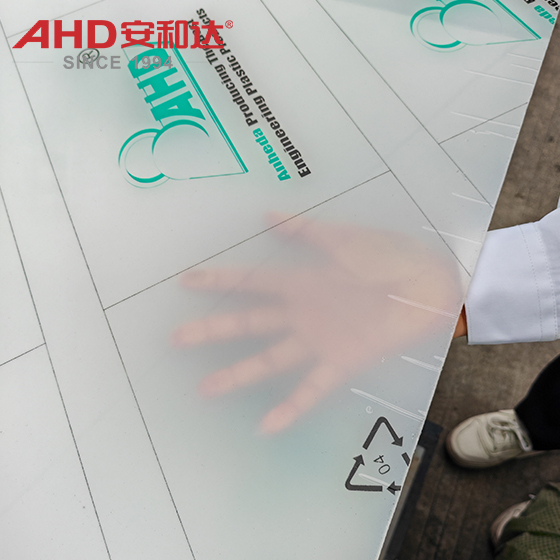
The following is a detailed analysis of their similarities from multiple dimensions:
Chemical Composition and Basic Structure
1. Common Core Resin Source: Both are produced through polymerization using propylene (C₃H₆) as the primary monomer. PP-H contains only long chains of propylene units (-CH₂-CH(CH₃)-); PP-C incorporates small "blocks" of ethylene (C₂H₄) units embedded within the propylene chain (e.g., -PP-PPE-PP-, where PPE is an ethylene-propylene block), but propylene still dominates (typically containing only 2%-7%).
2. Similar Molecular Chain Polarity: The polypropylene molecular chain consists of a carbon-carbon single bond (C-C) in the backbone, with non-polar methyl groups (-CH₃). Therefore, both are non-polar polymers with stable chemical properties.
Basic Commonalities in Physical Properties
1. Density Range Overlap: Both materials share a density close to 0.90-0.91 g/cm³, making them lightweight plastics suitable for weight-sensitive applications (such as turnover boxes and daily necessities).
2. Resistance to Most Chemical Reagents: Due to their non-polar structure, both materials are resistant to acids (such as hydrochloric acid and dilute sulfuric acid), alkalis (such as sodium hydroxide), saline solutions, and most organic solvents (such as alcohols, hydrocarbons, and ketones). Degradation is only likely to occur in the presence of strong oxidizing acids (such as concentrated nitric acid and sulfuric acid) or at high temperatures.
3. Excellent Electrical Insulation: The molecular chain lacks polar groups, resulting in excellent electrical insulation, with a volume resistivity >10⁴Ω·cm and a dielectric constant (23°C, 1kHz) of approximately 2.2-2.3. They are suitable for insulating components of electronic and electrical equipment (such as appliance housings and wire ducts).
4. Non-toxic and environmentally friendly: Both materials do not contain toxic additives (such as plasticizers and heavy metals), meet food contact grade standards, and are widely used in food packaging and medical devices.
Highly Similar Processing Performance
1. Compatible Molding Processes: Both can be molded using common thermoplastic processing techniques such as extrusion, injection molding, compression molding, and blow molding, offering high equipment versatility.
2. Similar Processing Temperature Ranges:
• Melting Temperature: Approximately 160-180°C (PP-H slightly higher due to its high crystallinity, requiring higher temperatures to destroy the crystalline regions; PP-C, due to the ethylene block reducing crystallinity, has a slightly lower melting temperature, but the difference is generally less than 20°C);
• Heat Deflection Temperature (0.45 MPa): Both are approximately 90-105°C (PP-H slightly higher, approximately 100-105°C; PP-C approximately 90-100°C). Short-term heat resistance (without external force) can reach 120°C, and long-term operating temperature (10⁴ hours) is ≤80°C.
3. Controllable Shrinkage: Both have relatively high molding shrinkage (approximately 1.5%-2.5%), requiring mold design to control warpage. The shrinkage ranges of the two are largely overlapping.
Overlapping Application Scenarios
Although PP-H and PP-C focus on different niche applications due to performance differences (such as rigidity vs. toughness), they can be used interchangeably in applications where basic performance requirements are low and cost-effectiveness and versatility are a key consideration. For example:
• General daily necessities: plastic basins, trash cans, and storage boxes (need chemical resistance and lightweight);
• Industrial auxiliary components: standard pallets, turnover boxes, and shelf shelves (need moisture resistance and general impact resistance);
• Architectural decoration: ceiling panels and interior partitions (need low cost, easy processing, and stain resistance);
• Agriculture: plastic film (need weather resistance and low cost) and irrigation pipes (need water resistance and easy welding).
Basic Commonalities in Aging and Weathering Resistance
Both materials experience similar aging mechanisms in natural environments (such as UV rays, oxygen, and humidity): performance degradation is caused by the cleavage of carbon-carbon bonds in the main chain or oxidation of side groups (methyl groups). General-purpose PP-H and PP-C, without antioxidants, exhibit similar tensile strength retention and impact strength degradation under the same conditions. The addition of light stabilizers and antioxidants significantly improves the weathering resistance of both materials, further narrowing the lifespan differences after modification.
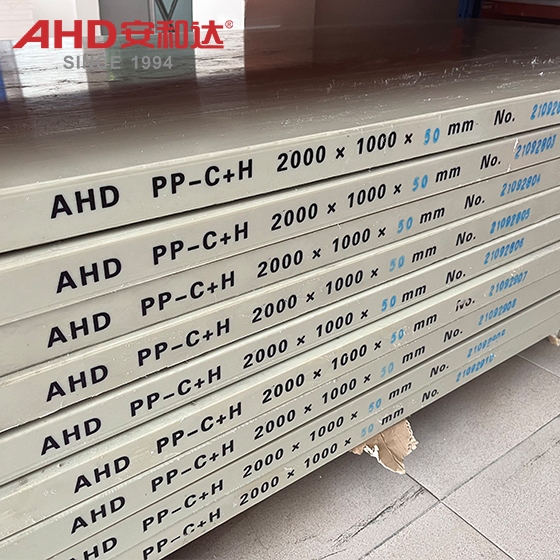
AHD PP Sheet
The following is a detailed analysis of the differences from multiple dimensions:
Features difference:
| Features | PP-H Sheets/Rods | PP-C Sheets/Rods |
| Crystallinity | High (60%-70%), densely packed molecular chains | Lower (40%-50%), due to the disruption of crystalline regularity by the ethylene block |
| Stiffness/Hardness | High (tensile strength ≥ 30 MPa, flexural modulus ≥ 1500 MPa) | Slightly lower (tensile strength 25-30 MPa, flexural modulus 1200-1500 MPa) |
| Impact toughness | Low (Notched impact strength: approximately 2-5 kJ/m² at 23°C; ≤ 1 kJ/m² at -20°C) | High (Notched impact strength: approximately 5-10 kJ/m² at 23°C; ≥ 3 kJ/m² at -20°C) |
| Low-temperature brittleness | Significant (brittle fracture below -10°C) | Improved (maintains some toughness at -20°C) |
| Stress Crack Resistance | Fair (notch-sensitive, prone to cracking due to stress concentration) | Excellent (ethylene block mitigates stress concentration) |
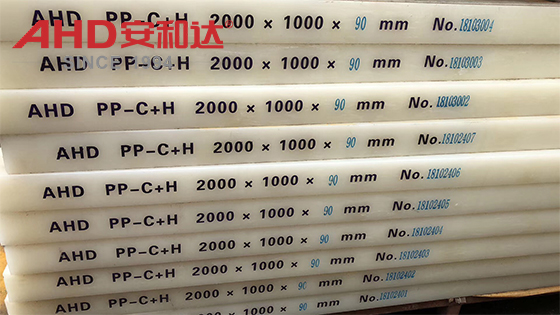
Differences in Application Areas
PP-H Sheet/Rod
• Advantages: High rigidity, excellent temperature resistance, and low cost, suitable for applications requiring high strength and dimensional stability.
• Typical Applications:
• Sheet: Chemical storage tank linings, industrial pallets, billboards, ventilation ducts;
• Rod: Gears, bearing retainers, tool handles, and mechanical component brackets.
PP-C Sheet/Rod
• Advantages: Improved toughness and strong low-temperature impact resistance, suitable for applications requiring a balance between rigidity and impact resistance.
• Typical Applications:
• Sheet: Automotive interior components (e.g., dashboard support panels), appliance housings (washing machine drums), and anti-collision guards;
• Rod: Pipe connectors, sports equipment (ski bindings), and low-stress structural components.
The core difference between PP-H and PP-C stems from their molecular structure: PP-H's homopolymer structure imparts high stiffness and temperature resistance, but sacrifices toughness and low-temperature performance. PP-C's block copolymer structure, through ethylene blocks, balances stiffness and toughness, making it more suitable for applications requiring impact resistance or low-temperature environments. When selecting a material, it's important to balance performance and cost based on specific operating conditions (such as load, temperature, and impact risk) to ensure the material is compatible with the application.