

PET (polyethylene terephthalate) has become one of the most commonly used materials in food packaging due to its unique combination of properties. The following details the logic behind its widespread use in food packaging, focusing on its core characteristics, application advantages, potential drawbacks and considerations, and processing techniques.
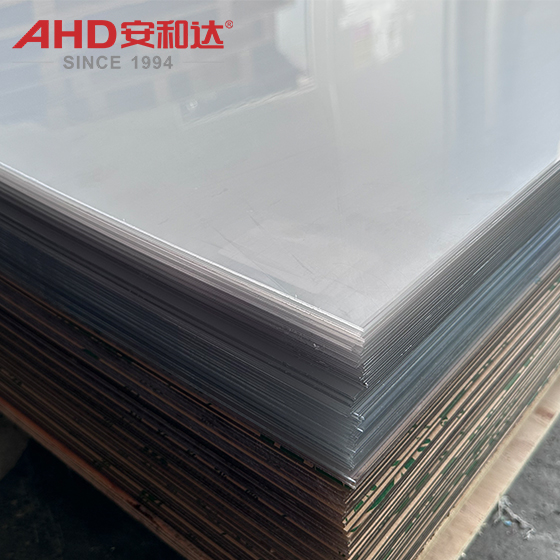
AHD PET Plastic Sheet Clear
I. PET's Core Characteristics: The Foundation for Food Packaging
PET is a semi-crystalline polyester with a regular molecular chain structure (-O-CH₂-CH₂-O-CO-C₆H₄-CO- repeating units). Combined with its processed physical and chemical properties, it is naturally well-suited for food packaging needs:
Excellent Transparency: The molecular chains are tightly packed and lack obvious crystallinity (or the degree of crystallinity can be controlled). Its high light transmittance (over 90%) allows consumers to directly observe the contents (e.g., juice, beverages, condiments).
Lightweight and High Strength: Its density is approximately 1.38 g/cm³ (much lower than glass), and its high mechanical strength per unit weight (tensile strength approximately 50-70 MPa, flexural strength approximately 90-120 MPa) reduces transportation energy consumption and packaging costs.
Strong Chemical Stability: It is resistant to most food-grade acids, alkalis, oils (such as citrus juice and vegetable oils), and organic solvents, and is unlikely to react with the contents (such as leaching harmful substances or causing food spoilage).
Moderate Barrier Properties: It offers superior barrier properties to oxygen (O₂) and water vapor (H₂O) compared to PE and PP (polyethylene and polypropylene), effectively delaying food oxidation or moisture exposure for short periods (several months). However, its barrier properties to oils and fats (e.g., long-term contact with fried foods) and carbon dioxide (CO₂) are weak (requiring lamination with other materials).
High Safety: It complies with mainstream global food contact material standards and releases no toxic substances under normal use (e.g., extremely low migration of antimony and oligomers).
Excellent Processability: It exhibits excellent melt flowability (processing temperature approximately 250-280°C) and can be formed using a variety of processes, including injection molding, blow molding, and extrusion, making it suitable for large-scale automated production.
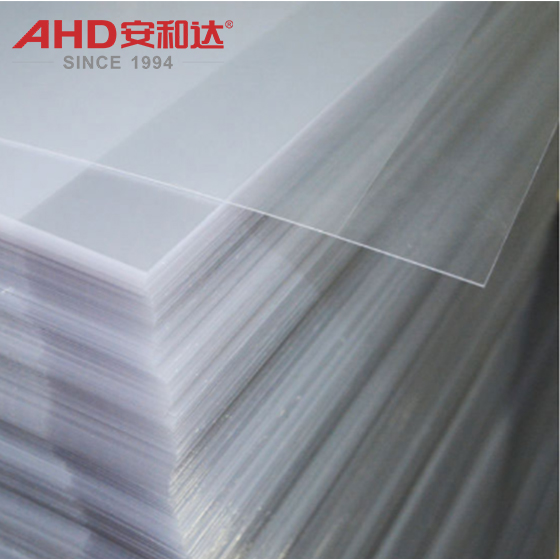
Clear PET Sheet
II. The Core Advantages of PET's Widespread Use in Food Packaging
Based on the above characteristics, PET's advantages in food packaging can be summarized as a triple balance of "functionality, economy, and adaptability":
1. Functional Adaptability: Meeting Diverse Packaging Needs
Beverage Packaging: Transparency showcases beverage color (e.g., juice and tea beverages); high barrier properties slow microbial growth and flavor loss (e.g., cola bottles need to maintain their bubbles and sweetness for a long time); lightweight bottles reduce shipping costs and are resistant to breakage.
Ready-to-eat Food Packaging: For example, sandwich trays and fruit boxes, PET leverages its low-temperature resistance (no cracking at -40°C) and oil resistance (short-term exposure to vegetable oils) combined with a heat-sealing layer (e.g., PE composite) to achieve a sealed, fresh-keeping effect.
Dry Goods/Bakery Packaging: High oxygen barrier properties slow oxidation and spoilage of cookies and nuts, while the transparent film facilitates product identification.
2. Economics: Balancing Cost and Performance
PET raw material prices are lower than those of materials like glass and aluminum, and its processing efficiency is high (e.g., the injection stretch blow molding process offers a short cycle time), making it suitable for large-scale production.
3. Environmental Potential: Recyclability supports a circular economy
PET is currently one of the most recycled plastics (globally, approximately 20%-30%, and in China, approximately 30%-40%). It can be physically recycled (cleaning, melt pelletizing) into new packaging (e.g., fibers, non-food packaging) or chemically recycled (depolymerization into monomers for repolymerization).

III. Potential Disadvantages of PET and Usage Considerations
Although Polyethylene Terephthalate Sheets offers significant advantages, its limitations must be avoided:
1. Limited Temperature Resistance
PET's glass transition temperature (Tg) is approximately 78°C, and its long-term operating temperature should not exceed 60-70°C (short-term resistance is 80-90°C). If used for hot beverages or subjected to high-temperature sterilization, it will soften, deform, and even release oligomers.
Note: PET bottles in food packaging are primarily used for cold beverages (such as mineral water and carbonated beverages) or ambient temperature foods (such as condiments). For hot beverages, high-temperature-resistant materials (such as PP) should be used instead.
2. Degradation and Recycling Challenges
Although PET is recyclable, it takes hundreds of years to degrade in the natural environment. Mixing it with other plastics (such as PE and PP) reduces its recycling value. Some low-quality recycled PET may not meet food contact standards due to residual contaminants (such as detergents and microorganisms).
Note: Strict recycling classification is required, and compliant recycling processes must be used (for example, EU rPET must comply with EFSA food contact certification).
3. Risk of Optical Performance Degradation
Prolonged exposure to ultraviolet (UV) light or high temperatures can cause photo- or thermal-oxidation of PET, leading to molecular chain breakage and yellowing (for example, PET soy sauce bottles may turn yellow after long-term storage).
Solution: Add UV absorbers or apply a UV-blocking coating to improve weather resistance.
IV. Processing Technology for PET Food Packaging Containers
PET requires specific processes to form packaging containers. Common processes include:
1. Injection Stretch Blow Molding (ISBM)
Applications: Beverage bottles (such as mineral water bottles) and transparent oil bottles.
Process:
① Injection Molding into Bottle Preforms (Parison): PET pellets are heated to 260-280°C to melt and injected into a mold to form a transparent preform (wall thickness approximately 1-3mm).
② Stretch + Blow Molding: The preform is heated above its Tg (approximately 90-110°C) using infrared radiation. It is then axially stretched (stretch ratio approximately 3-5x) by a stretch rod while simultaneously blowing high-pressure air (0.5-1.5 MPa) into the bottle to orient the molecular chains and form the final bottle shape (uniform wall thickness and extremely high transparency).
Key Controls: Stretch temperature and ratio directly affect the strength and transparency of the bottle (excessive stretching can lead to crystallization and whitening).
2. Extrusion Blow Molding (EBM)
Applications: Large-capacity PET containers (such as large beverage bottles and condiment bottles).
Process:
① Extrusion of tube billets: PET granules are melted in an extruder and extruded through a circular die to form a tubular billet.
② Blow molding: The billet is clamped into a mold, a blow rod is inserted, and compressed air is introduced. The billet expands and conforms to the mold wall. After cooling, it is demolded to form a container.
Limitations: Transparency is slightly lower than that of injection stretch blow molding (due to the slower cooling rate, slight crystallization may occur). It is mostly used in applications where transparency is not a priority.
3. Thermoforming
Applications: Disposable food trays (such as fruit boxes and lunch boxes) and lunch box lids.
Process:
① Sheet Preparation: PET granules are melted in an extruder and extruded through a T-die into thick sheets (approximately 0.2-1mm thick). Calendering is performed using cooling rollers.
② Heating and Softening: The sheet is heated in a furnace (either radiant or contact heating) to a temperature above its Tg (approximately 100-120°C), softening it to a plastic state.
③ Molding: The softened sheet is placed over a mold and formed using vacuum or pressure suction (e.g., blister forming). After cooling, the sheet is trimmed to obtain the finished product.
Optimization: To improve barrier properties and temperature resistance, it is often laminated with PE or CPP (cast polypropylene) (e.g., PET/PE trays).
4. Injection Molding
Applications: Small food packaging accessories (e.g., bottle caps, label holders), rigid food trays (e.g., baking molds).
Process: PET pellets are heated and melted, then injected into the mold cavity via the injection molding machine screw. Cooling and solidification are then achieved. Mold design (e.g., cooling circuits) should be carefully considered to prevent warping or yellowing caused by crystallization.
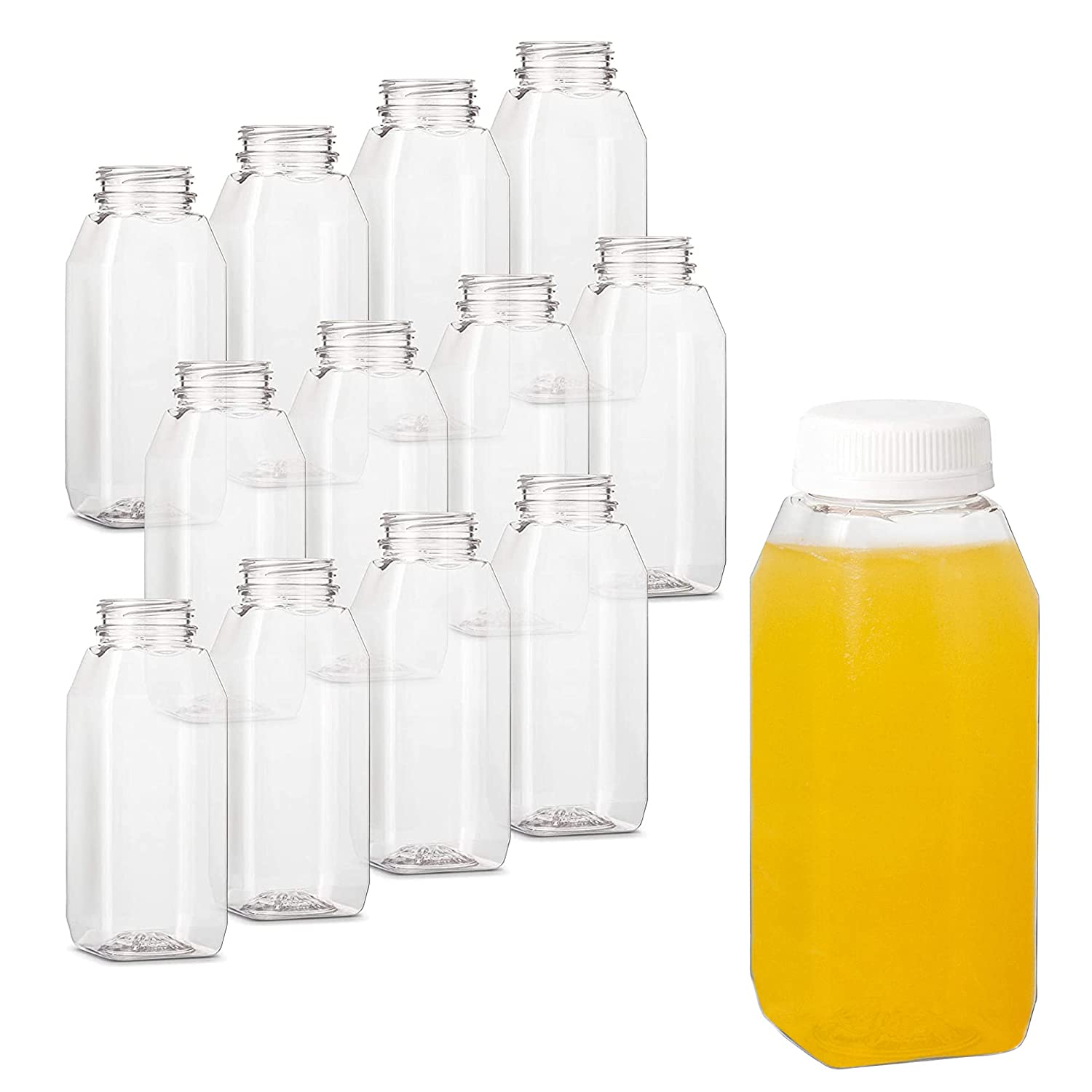
Summary
PET, with its high transparency, lightweight, high strength, chemical stability, easy processing, and food contact safety, has become an all-rounder in food packaging, particularly dominating beverage, ready-to-eat, and dry goods packaging. Despite shortcomings such as limited temperature resistance and insufficient barrier properties, its application continues to expand through lamination, barrier-enhancing modifications, and standardized recycling. In the future, with the development of recycling technologies (such as chemical recycling) and new modified PET (such as bio-based PET and high-barrier PET), the sustainability and functionality of PET in food packaging will be further enhanced.