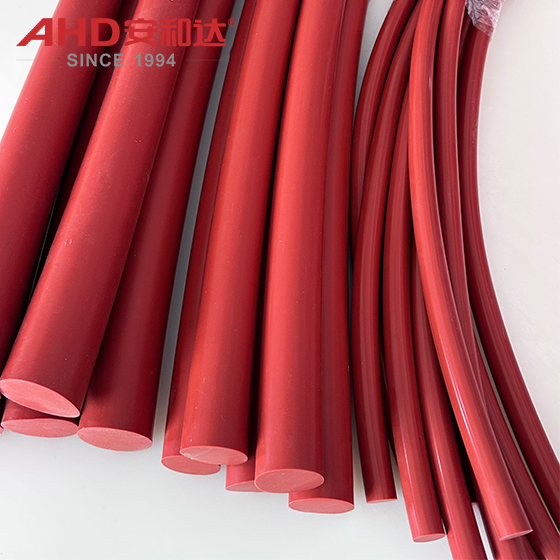
Silicone rubber sheets and rods are not only widely used in the electrical and electronics industry but are also a key insulation, sealing, and protective material. Their applications range from basic insulation components to high-precision electronic devices. This is due to their unique physical and chemical properties, which are highly compatible with the demanding requirements of electrical and electronic equipment. The following describes their application scenarios, usage, and core compatibility characteristics:
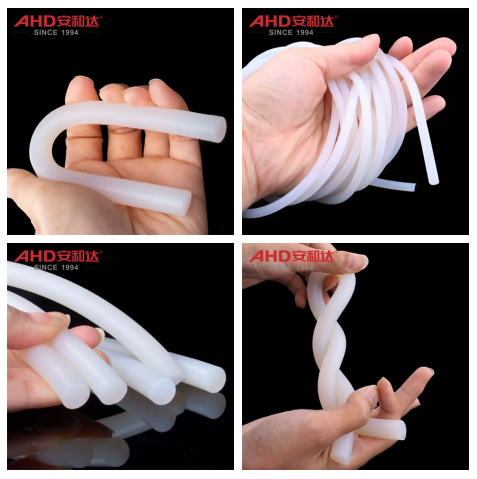
AHD Silicone Rods
Ⅰ. Applications and Usage of Silicone Sheets and Rods in the Electrical and Electronics Industry
Silicone sheets and rods are solid products made from silicone materials through molding, extrusion, or injection molding. They are primarily used in applications requiring insulation, sealing, temperature resistance, or protection. Specific applications and usage are as follows:
1. Insulation, Isolation, and Fixing
Applications: Component fixation in printed circuit board (PCB) assembly, insulation spacing within high-voltage equipment, support gaskets for motor/transformer windings, and insulation wrapping or sheathing for wires and cables.
Usage: Silicone sheets/rods can be cut into specific shapes (such as gaskets or strips) based on equipment size requirements, or standard sheet/rod stock can be used directly. For example, in high-voltage switchgear, silicone sheets can serve as insulating barriers between live components; after soldering on PCBs, silicone rods can fill gaps to prevent component displacement.
2. Sealing and Protection
Applications: Waterproof and dustproof sealing of electronic components (such as LED drivers and junction boxes for outdoor communication equipment), sealing of battery packs (to prevent electrolyte leakage and external moisture intrusion), and moisture-proof protection of optical devices (such as camera modules).
Usage: Silicone sheets/rods are combined with metal or plastic housings through molding or coating to form a sealed cavity. Alternatively, they can be made into O-rings or sealing gaskets for installation at device interfaces.
3. Thermal Conductivity and Heat Dissipation
Applications: Thermal interface materials (TIMs) for power devices (such as IGBTs and LED chips) facilitate heat transfer from the chip to the heat sink; and thermal protection for 5G base station RF modules.
Usage: Customized high-thermal conductivity silicone sheets/rods (with thermal conductivity coefficients of up to 1-5 W/m·K) are created by adding thermally conductive fillers such as alumina and boron nitride. These sheets/rods are then laminated between heating components and heat sinks, ensuring both insulation and thermal conductivity.
4. Corona and Breakdown Protection
Applications: Insulation wrapping for high-voltage cable terminals, outer protection for high-voltage bushings, and corona-resistant coating substrates for radar/antenna systems.
Usage: Wrapping or wrapping the silicone rod around the surface of a high-voltage conductor leverages its high breakdown voltage (typically ≥20 kV/mm) and corona resistance to prevent partial discharge damage to equipment.
5. Flexible Connection and Cushioning
Applications: Cushioning for vibration-sensitive components in precision instruments (such as hard disk drives and optical sensors), and stress relief for pluggable connectors.
Usage: Leveraging the elasticity of silicone (available in Shore A hardness ranges from 20 to 80), this material can be formed into thin sheets or strips to fill gaps between components and absorb mechanical stress.
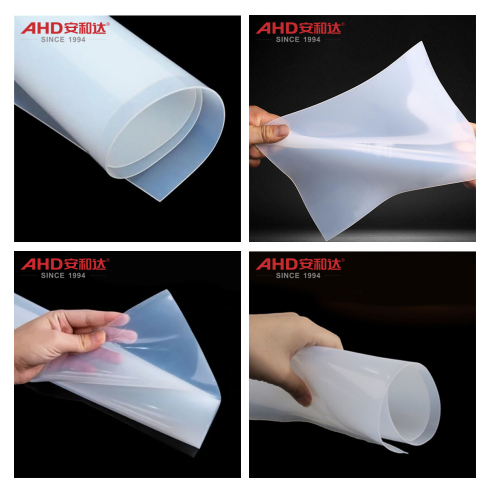
AHD Rubber Silicone Sheets
II. Core Properties of Silicone Rods Suitable for the Electrical and Electronics Industry
Silicone (polysiloxane)'s molecular structure (-Si-O- backbone + organic side groups) imparts the following key properties, making it irreplaceable in the electrical and electronics sector:
1. Excellent Electrical Insulation
Silicone boasts a volume resistivity of 1×10¹⁴–1×10¹⁶ Ω·cm and a breakdown field strength of 20–30 kV/mm (far exceeding the 10–15 kV/mm of common plastics like PVC). Its performance degrades minimally in humid and high-temperature environments. This enables it to reliably isolate live components in high-voltage (e.g., above 10 kV) and high-humidity (e.g., 85% RH outdoors) environments, preventing short circuits and leakage.
2. Wide Temperature Range
Silicone's operating temperature range is -60°C–200°C (some modified varieties can reach 300°C), far exceeding the typical -40°C–125°C operating temperature range for electrical and electronics equipment. For example, in the engine compartment of automotive electronics (high temperature) or polar communication equipment (low temperature), silicone sheets/rods will not crack or harden due to thermal expansion and contraction, maintaining their insulation properties.
3. Weather Resistance and Chemical Stability
Silicon-oxygen (Si-O) bonds have high bond energy (approximately 452 kJ/mol), resisting UV rays, ozone, and chemical corrosion (such as acid, alkali, and salt spray). They resist aging even after long-term exposure to outdoor or industrial environments. This is crucial for seals in outdoor electronic devices (such as photovoltaic inverters and 5G base stations), extending maintenance cycles.
4. Low Shrinkage and Dimensional Stability
Silicone has a shrinkage rate of less than 0.5% after curing (cross-linking), resulting in precise dimensions after molding. This makes it suitable for insulating components in precision electronic devices (such as connector sockets and chip packaging gaskets), avoiding contact problems caused by deformation.
5. Flexibility and Processability
Silicone can be flexibly designed in various hardness (Shore A 10-90) and form (soft/hard) by adjusting its formulation. Soft silicone sheets/rods (such as Shore A 30-50) are used for cushioning and sealing, while hard silicone (Shore A 70-90) is used for structural support, meeting diverse application requirements. Furthermore, its easy cutting and molding properties reduce processing costs.
6. Safety and Environmental Compliance
Silicone is halogen-free and low in VOCs (volatile organic compounds), complying with electronics industry standards such as RoHS and REACH. It also produces non-toxic silicon dioxide upon combustion, meeting the safety requirements of medical electronics and food-grade equipment (such as kitchen appliance control panels).
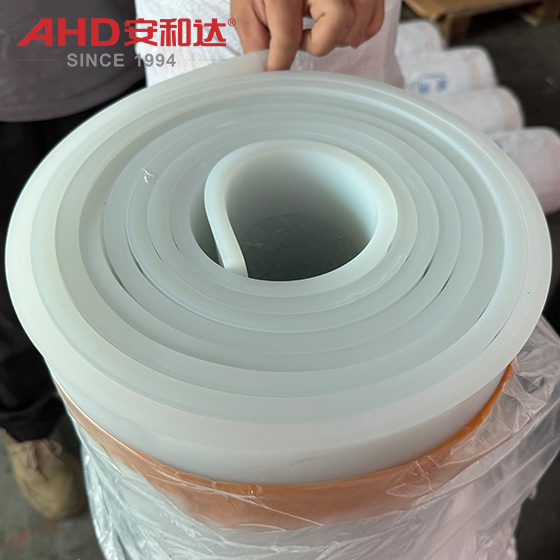
AHD Thermal Insulation Silicone Sheet Roll
Summary:
Silicone sheet and rod, with its high insulation, wide temperature and weather resistance, low shrinkage, and easy processing properties, has become a core material for insulation, sealing, and protection in the electrical and electronic industry. It is widely used in applications such as circuit board mounting, high-voltage sealing, and thermal dissipation. As electronic devices move towards miniaturization, higher power, and outdoor use, demand for silicone sheet and rod will continue to grow, particularly in the 5G, new energy vehicle, and photovoltaic sectors, where its performance advantages will be further highlighted.
AHD Round Silicone Rod