I. Definition and Origin
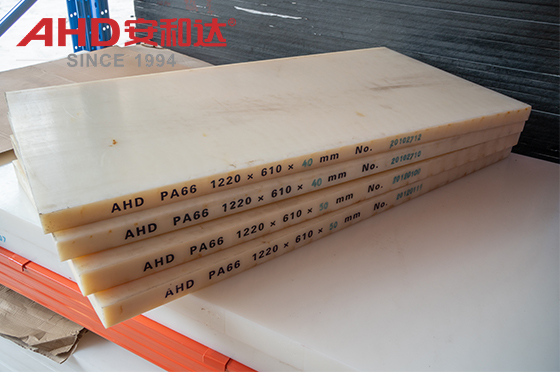
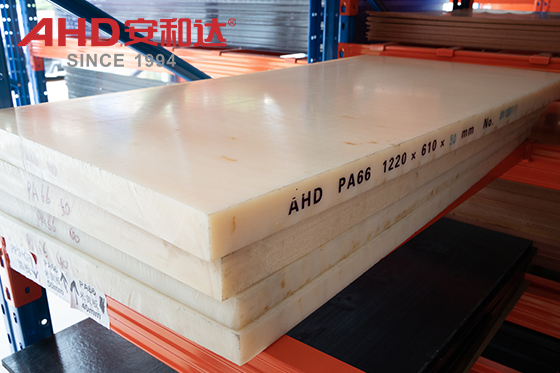
PA66 sheets and rods are solid materials made from nylon 66 (polyhexamethylene adipamide, Polyamide 66) resin through a molding process.
The basic raw materials of PA66 are adipic acid (HOOC-(CH₂)₄-COOH) and hexamethylenediamine (H₂N-(CH₂)₆-NH₂). These react to form nylon 66 salt (hexamethylene adipamide salt), which then undergoes a polycondensation reaction (high-temperature dehydration) to produce high-molecular-weight PA66 resin. After pelletizing, the resin is made into sheets/rods through the following processes:
Extrusion: After the resin is heated and melted, it is extruded through an extruder die into a continuous rod or sheet. After cooling and setting, it is cut into sheets.
Compression molding: Suitable for sheets with high precision or special structures, the resin pellets are pre-pressed, placed in a mold, and cured under high temperature and high pressure.
II. Core Characteristics and Advantages
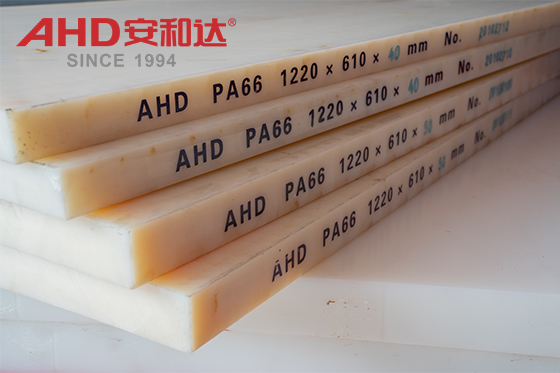
PA66 is a high-performance engineering plastic. Its sheet/rod form inherits these characteristics and optimizes processing adaptability:
Characteristics:
1. Excellent mechanical properties: High tensile strength (approximately 75-90 MPa), flexural strength (approximately 100-130 MPa), and impact resistance (notched impact strength approximately 5-8 kJ/m²), with a balance of rigidity and toughness.
2. Excellent temperature resistance: Melting point approximately 260°C (higher than PA6 Nylon), long-term operating temperature range -40°C to 100°C (short-term operating temperature up to 120°C), superior to most general-purpose plastics.
3. Chemical Resistance: Resistant to oils, hydrocarbon solvents, and weak acids and bases, but susceptible to corrosion from strong acids (such as concentrated sulfuric acid) and highly polar solvents (such as phenol).
4. Self-lubricating and wear-resistant: Low coefficient of friction, suitable for dynamic friction applications (such as bearings and pulleys).
5. Disadvantages: High hygroscopicity, which can lead to dimensional expansion and reduced mechanical properties.
Advantages:
1. Lightweight: With a density of approximately 1.14 g/cm³, it is suitable for metal replacement.
Easy to process: It can be turned, drilled, and milled, eliminating the need for complex casting or forging equipment.
2. Corrosion-resistant: No surface corrosion treatment is required, reducing maintenance costs.
3.Design flexibility: Complex shapes can be customized through injection molding or extrusion (even secondary processing of sheet or bar stock is possible).

III. Main Applications
Due to its comprehensive properties, PA66 Nylon Plastic Sheet and rod are widely used in applications requiring strength, heat resistance, and friction resistance:
Mechanical Industry: Gears, bearing cages, pulleys, guide rails, fixtures, and brackets.
Automotive Industry: Engine peripheral components, brake caliper brackets, and connectors.
Electronic and Electronics: Insulated terminals, coil bobbins, and equipment housings (requiring flame retardant modification).
Aviation/Rail Transportation: Light-load structural parts (requiring flame retardancy and low-smoke compliance).
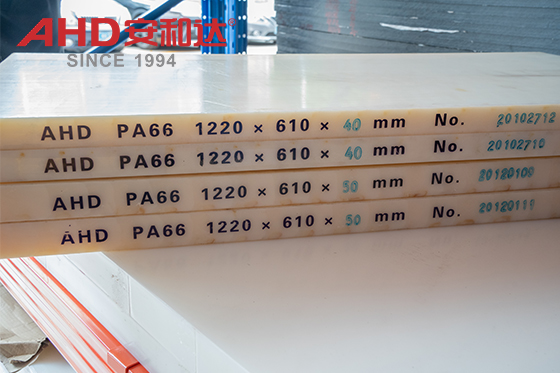
AHD PA66 Nylon Plate
IV. Usage Precautions
Hygroscopicity:
In humid environments, allow for dimensional tolerances or choose modified grades with low hygroscopicity.
For long-term storage, seal tightly to prevent moisture. Dry the material before processing (80-100°C for 4-6 hours) to minimize moisture interference.
Temperature Limits:
Avoid prolonged use above 120°C (this may exacerbate creep). For high-temperature applications, use glass fiber-reinforced grades (such as PA66 GF 30%).
Processing Tips:
It is recommended to use carbide tools when cutting to avoid high-speed frictional heat generation that could cause material melting (the rotation speed should be kept low and the feed rate moderate).
For hot forming (such as bending), control the temperature (180-220°C) to avoid exceeding the melting point and causing cracking.
Environmental Adaptability:
For outdoor use, UV inhibitors (such as carbon black or hindered amines) should be added to prevent UV aging (manifested by surface embrittlement and yellowing).
For exposure to highly corrosive media, chemically modified grades (such as fluorinated coatings or special copolymer structures) should be selected.
Summary
PA66 sheets and rods are typical examples of high-performance engineering plastics. Their mechanical strength, temperature resistance, and processing flexibility make them a valuable metal replacement. When using PA66, attention should be paid to its hygroscopicity, temperature limits, and environmental compatibility. Maximizing its advantages can be achieved through appropriate material selection (such as reinforced or modified grades) and optimized processing techniques.