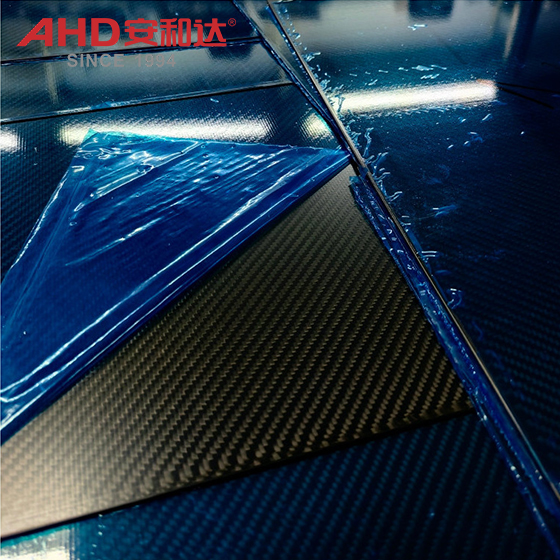
The performance of carbon fiber reinforced plastic (CFRP) sheets (CFRP) depends largely on the carbon fiber weave. Different weave structures affect the sheet's mechanical properties, anisotropy, processability, and appearance. The following explains common weaves, their impact on sheet material, and the most commonly used types:

I. Common Carbon Fiber Weaving Methods
Carbon fiber weaving essentially involves interweaving carbon fiber bundles (yarns) into a fabric in a specific pattern. Common two-dimensional weaving methods include:
1. Unidirectional (UD) Weave
Structural Characteristics: All carbon fibers are arranged parallel to each other in the same direction (e.g., 0°), without any crossover. They are secured only in the longitudinal (fiber direction) and transverse (perpendicular) directions by a small amount of resin or chopped fibers.
Variations: In practical applications, this often occurs in the form of "unidirectional prepreg" (fibers impregnated with resin and laid unidirectionally). This can be laminated with unidirectional fabrics in other orientations (e.g., 0°, 90°, or ±45°) to form multidirectional composite structures.
2. Plain Weave
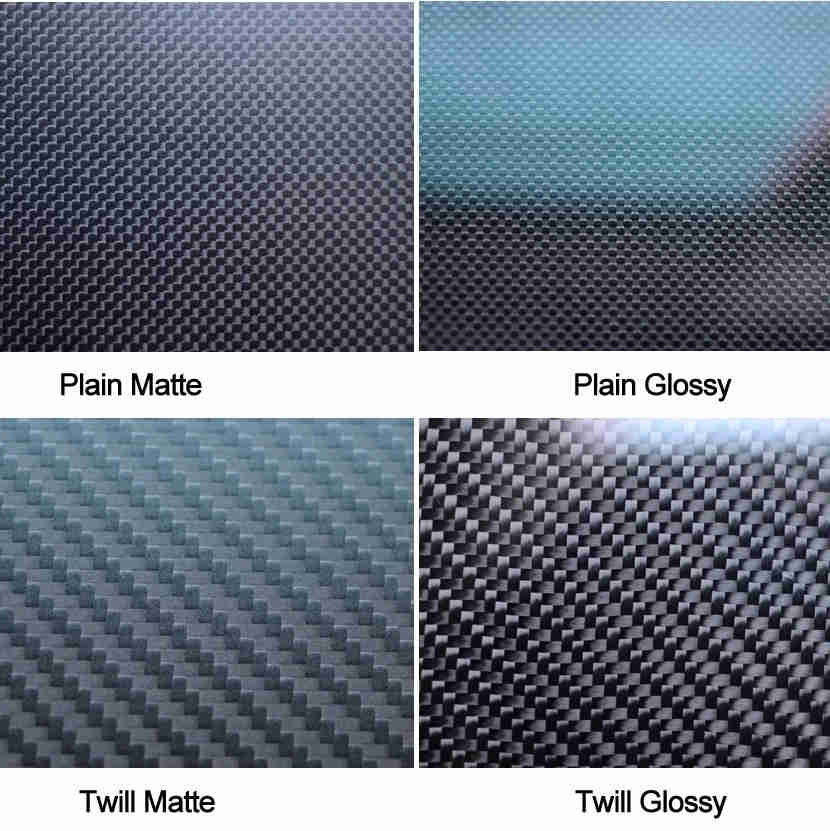
Structural Characteristics: This is the most traditional two-dimensional weave, with fibers interlaced in a "one-up, one-down" pattern. The interweaving points are dense (each fiber is orthogonal to its neighbors). The typical density is the number of warp and weft yarns per centimeter (e.g., 80-200/cm). Typical Parameters: Warp (longitudinal) and weft (transverse) yarns alternate up and down, creating a checkered surface.
3. Twill Weave
Structural Characteristics: Fibers interweave diagonally, in a pattern such as "2 up, 1 down" or "3 up, 1 down." The interweaving points are widely spaced, resulting in a distinct diagonal pattern (e.g., 45° or 30°).
Advantages: Softer than plain weave, with reduced fiber slip resistance, making it suitable for forming complex curved surfaces.
4. Satin Weave
Structural Characteristics: Fibers interweave in a more complex pattern (e.g., 5-weave satin and 8-weave satin). Each fiber intersects only with a few other fibers (e.g., in 5-weave satin, the warp yarn crosses only once every five weft yarns), resulting in very few interweaving points.
Features: Smooth surface, high fiber continuity, but slightly lower structural stability.
5. 3D Weaving (less commonly used for flat panels)
Structural Features: Multiple layers of fibers are interwoven throughout the thickness of the fabric, forming a three-dimensional network (e.g., orthogonal and angle-lock structures).
Application Limitations: Complex process and high cost. Primarily used for high-performance structural components (e.g., aviation load-bearing components), not ordinary plastic sheets.
II. The Impact of Weaving Method on Carbon Fiber Plastic Sheets
The weaving method directly determines the mechanical properties, processability, and functionality of the carbonfiber sheet. The specific impacts are as follows:
1. Mechanical Properties
Unidirectional weave: The strength and modulus in the fiber direction (longitudinal) are extremely high, but the performance in the transverse direction (perpendicular to the fiber direction) is weak (relying on resin bonding). Multi-directional lamination (such as 0°/90°) is required to balance anisotropy.
Plain weave: The orthogonal crossing limits the fiber length (due to weaving process limitations), resulting in a lower fiber volume fraction (approximately 40-50%). Overall strength is lower than unidirectional fabric, but the transverse performance is better and the anisotropy is less.
Twill weave: The fibers slide more freely, making it easier to fit the mold during molding. However, the interlacing points cause localized stress concentrations, resulting in slightly lower strength than plain weave. The diagonal weave distributes some of the load, resulting in slightly better overall toughness.
Satin Weave: Fiber continuity is excellent (fewer interlacing points), and longitudinal strength is similar to unidirectional. While the transverse direction is still weaker due to the lack of dense cross-linking, the surface is smoother, making it suitable for applications requiring a high aesthetic.
2. Processing and Formability
Unidirectional: Flexible layering (can be stacked at any angle), suitable for customized designs of complex load-bearing structures, but requires precise control of interlayer angles to avoid delamination.
Plain/Twill: Excellent overall rigidity and resistance to deformation during molding, making it suitable for mass production of regular shapes (such as flat panels and shells). However, complex curved surfaces require pre-forming.
Satin: Highly flexible, suitable for wrapping complex curved surfaces, but with weak interlayer bonding, requiring additional resin impregnation or surface treatment.
3. Appearance and Functionality
Plain Weave: Surface texture is pronounced (checkered), giving it a strong industrial look.
Twill: Softer diagonal texture is common in consumer products (such as electronics housings).
Satin: Mirror-like smoothness makes it suitable for high-end decorative parts (such as automotive interiors and jewelry).
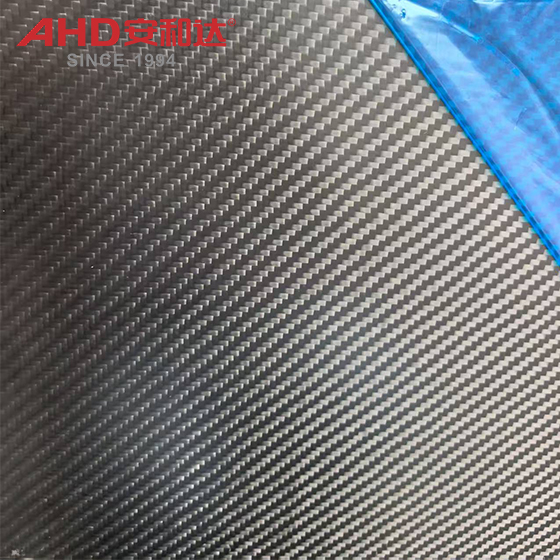
AHD carbon fiber reinforced plastic (CFRP) sheet also call carbon fiber reinforced polymer sheet
III. Most Common Weaving Methods
Unidirectional weave (especially unidirectional prepreg) is the most popular choice for carbon fiber plastic sheets for the following reasons:
Performance Designability: Through multidirectional lamination (such as 0°/90°/±45° combinations), it can precisely match load requirements in different directions (e.g., longitudinal strength for wind turbine blades, multidirectional impact resistance for automotive chassis).
High Fiber Utilization: The carbon fibers in unidirectional fabrics exhibit virtually no bending (minimizing fiber damage during weaving), and the fiber volume fraction can reach 60-70% (higher than the 40-50% in plain/twill weaves). Mechanical properties are closer to the intrinsic values of carbon fibers.
Cost-Efficiency Balance: Unidirectional fabrics have a simple production process (requiring only longitudinal fiber alignment) and can be cut to size during lamination, making them suitable for large-scale industrial production.
The next most common weave is plain/twill weave, primarily used for applications requiring high aesthetics or overall toughness. Due to its high cost, 3D weaves are only used in extreme load-bearing applications.
Summary: Carbon fiber plastic sheeting is primarily available in unidirectional, plain, and twill weaves. Unidirectional weave is the most commonly used due to its designability and high fiber utilization. When choosing a weave, consider the advantages and disadvantages of each structure based on your specific needs (such as strength, direction, appearance, and cost).
AHD black carbon fiber sheet