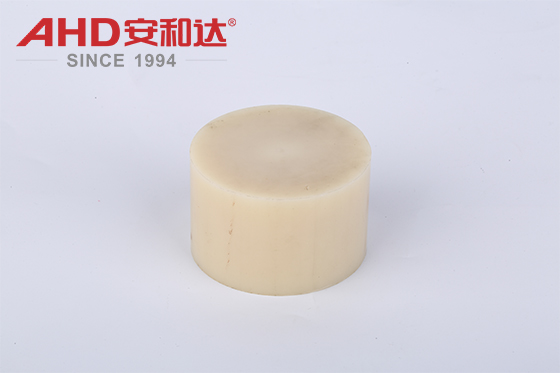
ABS (Acrylonitrile-Butadiene-Styrene) is a thermoplastic engineering plastic, a terpolymer of acrylonitrile, butadiene, and styrene. It is synthesized from three monomers via copolymerization. The functions of each component are as follows:
Acrylonitrile (A): Provides chemical resistance, rigidity, and surface hardness;
Butadiene (B): Contributes high toughness and impact resistance (especially low-temperature toughness);
Styrene (S): Improves processing flowability, surface gloss, and electrical insulation.
ABS combines the advantages of all three monomers, featuring easy processing, impact resistance, and easy electroplating/coating. It is widely used in automotive parts, electronic housings, and building materials (such as ABS sheet/ABS Rod).
Ⅰ.How to Select High-Quality ABS Raw Materials?
High-quality ABS needs to balance performance, appearance, and stability. It can be selected based on the following dimensions:
1. Core Performance Indicators
Melt Flow Rate (MFR): Reflects processing fluidity (unit: g/10min, ASTM D1238). Selection should be based on product complexity: high MFR is required for thin-walled parts, while low MFR is suitable for thick-walled or simple structures.
Impact Strength: Measures toughness (unnotched impact strength is typically >15 kJ/m², high-impact grades can reach over 50 kJ/m²).
Tensile Strength: Generally >40 MPa, ensuring the product's load-bearing capacity.
Heat Deflection Temperature (HDT): Unreinforced grades are approximately 70-98℃. For high-temperature applications, modified ABS with an HDT >100℃ should be selected.
2. Appearance and Impurity Control
Uniform Particle Size: No separation of large and small particles to avoid uneven melting during processing;
Free of Impurities: No black spots, metal shavings, or other plastic contaminants (can be detected by visual inspection or magnetic separator);
Pure Color: Natural ABS should be translucent or milky white; dyes must have high color fastness and be evenly dispersed.
3. Raw Material Source and Qualification
Choose reputable petrochemical plants or modification plants, avoiding recycled materials from small workshops (which may have unstable performance and contain impurities);
Require a Certificate of Analysis (COA) to confirm that the Material Flow Rate (MFR), impact strength, and heavy metals (such as lead and cadmium) meet standards;
Prioritize suppliers with "batch stability" commitments, such as AHD Polymer.

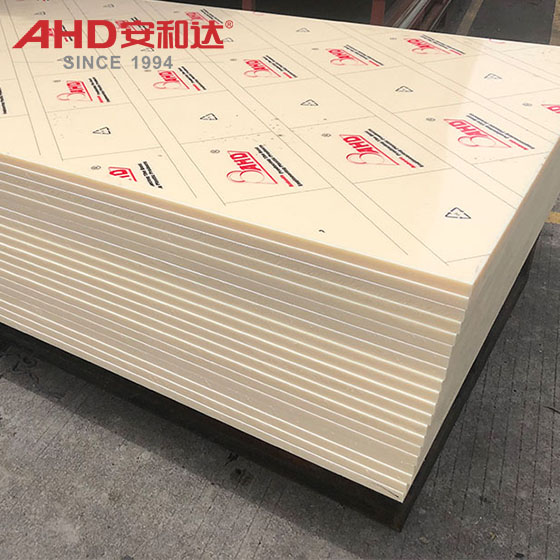
AHD ABS Sheets White
Ⅱ. Storage Methods for ABS Raw Materials
ABS is highly hygroscopic (equilibrium moisture absorption rate approximately 0.3%-0.5%) and easily affected by high temperatures and light aging, requiring strict storage:
Moisture Prevention: Store in a sealed, moisture-proof cabinet or original packaging (PE bag + cardboard box). Unused raw materials after unpacking should be sealed promptly or temporarily stored in a dehumidifying drying hopper (dew point ≤ -40℃);
Temperature: Storage temperature ≤ 25℃ (optimal 15-20℃), avoid high temperatures (>30℃ will accelerate oxidative degradation);
Light Protection: Keep away from ultraviolet rays (such as windows, direct light) to prevent polymer chain breakage and yellowing;
Ventilation: Keep the warehouse dry and well-ventilated to avoid condensation of humid air.
Ⅲ. How to Process ABS into High-Quality Sheets and Rods?
ABS Plastic Sheet/ABS Plastic Rod are typically produced through extrusion molding or compression molding. The key is controlling raw material pretreatment, process parameters, and post-processing.
1. Pretreatment Before Processing
Drying ABS absorbs moisture, which can cause bubbles, silver streaks, and a rough surface in the finished product. Thorough drying is essential:
Drying Temperature: 80-90℃ (Avoid temperatures above 100℃ as this can cause yellowing);
Drying Time: 4-6 hours (A dehumidifying dryer is more effective; 2-3 hours is sufficient if the dew point is ≤-40℃);
Testing: The moisture content of the raw material after drying should be <0.1% (detectable using a rapid moisture analyzer).
2. Extrusion Molding (Mainstream Process for Sheets/Bars)
Equipment Selection: Single-screw or twin-screw extruder (twin-screw is more suitable for high-filler or modified ABS);
Temperature Control:
Barrel: Rear section 180-200℃ → Middle section 210-230℃ → Front section 220-240℃ → Die head 230-250℃ (avoid localized overheating and degradation);
Die: Sheet die temperature 50-70℃ (uniform cooling to prevent warping), bar die temperature 40-60℃;
Screw Parameters: Rotation speed 20-40 rpm (low speed reduces shear heat generation), back pressure 0.5-1.5 MPa (improves plasticization uniformity);
Shaping and Traction: Sheets are cooled by vacuum shaping rollers (water temperature 15-25℃), traction speed is matched with extrusion speed (avoid overstretching).
3. Compression Molding (Suitable for small batches or thick plates)
Filling: Evenly spread dried ABS granules into a preheated mold (120-150℃);
Pressure: Close the mold and hold under pressure at 5-10 MPa for 5-10 minutes (ensuring the melt fills the mold cavity);
Cooling: Slowly cool to below 50℃ before demolding (to avoid warping caused by internal stress).
4. Post-treatment
Annealing: Sheets/bars can be placed in a 70-80℃ oven for 2-4 hours to eliminate internal stress and improve dimensional stability;
Surface Treatment: For a smooth surface, polishing or flame treatment can be performed (to improve adhesion of subsequent coatings).
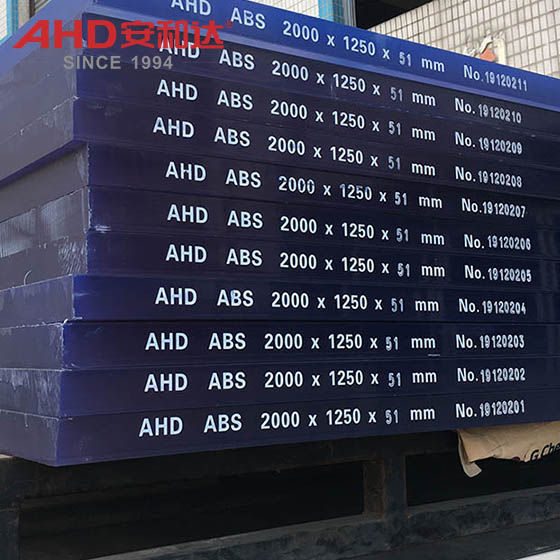
AHD ABS Plate Clear
Ⅳ. Storage Methods for ABS Sheets/ABS Rods
1. Storage Environment
Temperature and Humidity: Temperature 15-25℃, relative humidity <50% (Moisture prevention is crucial; ABS surfaces are prone to hydrolysis after absorbing moisture, leading to decreased impact strength);
Avoidance of Light: Store in a warehouse without direct UV radiation (e.g., covered with cardboard boxes and blackout cloth, or on dedicated storage racks);
Ventilation: Maintain air circulation to prevent condensation on the surface.
2. Stacking Method
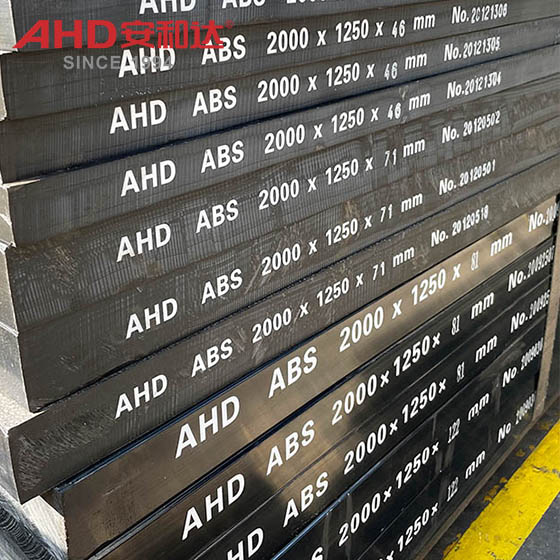
Sheets: Lay flat on dry pallets (thickness ≥10mm), stacking height ≤1.5 meters (to prevent deformation of the bottom layer under pressure), with PE film between layers for moisture protection;
Rods: Place horizontally on dedicated shelves (to prevent bending), or hang vertically (hanging is recommended for rods with a diameter >50mm to prevent deformation under their own weight);
Labeling: Label each batch with production date, raw material grade, and performance parameters for FIFO (First-In, First-Out) processing.
3. Long-term storage (>6 months)
Regular inspection: Check appearance (yellowing, mold) and dimensions (warping) every 3 months. If moisture absorption is found, re-dry (80℃ x 4 hours);
Packaging upgrade: Vacuum packaging can be used for high-precision plates/rods (to reduce contact with air);
Anti-aging: If the storage environment has strong oxidizing conditions (such as high temperature and high humidity), an antioxidant protective film can be added (it must not affect subsequent processing).
High-quality ABS raw materials need to balance performance, appearance, and stability. When selecting them, pay attention to core indicators such as MFR and impact strength, and choose reputable suppliers. During storage, focus on moisture protection and temperature control. When processing into sheets/rods, strict drying, optimized extrusion parameters, and performance enhancement through annealing are essential. Through end-to-end control, it is possible to ensure that ABS products have good toughness, a smooth surface, and dimensional stability.
AHD Beige ABS Rod