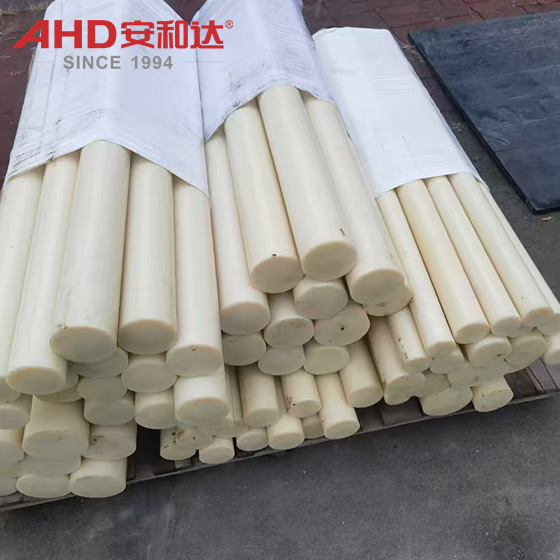
MC Casting Nylon sheets and rods are frequently used in machinery and automation equipment as wear-resistant, self-lubricating functional components due to their ease of machining and excellent overall performance. The following details their applications, core advantages, and usage precautions:
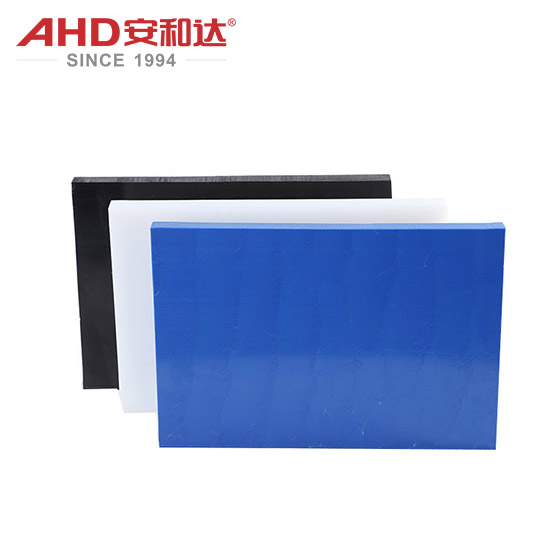
I. Specific Applications in Machinery and Automation Equipment
Cast Nylon Rod and sheet can be machined through turning, milling, drilling, and cutting to produce high-precision parts, replacing metals or traditional plastics. Typical applications include:
1. Bearings and Sliding Components
Self-lubricating Bearings/Sleeves: Thin-walled sleeves (commonly with inner diameters of Φ10-Φ200mm) are machined from rods and directly pressed into a metal matrix as support components for rotational or reciprocating motion (e.g., hydraulic cylinder guide sleeves, machine tool lead screw supports).
Advantages: No additional lubrication required, reducing maintenance costs; compared to copper alloy sleeves, weight is reduced by more than 60%, and cost is 30%-50% lower.
Linear guide slider: The slider base is cut and milled from sheet metal, and MC nylon wear-resistant strips are embedded inside (or it is directly machined as a whole). It works with the guide rail to achieve low-friction sliding (such as linear modules in automated production lines).
2. Gears and Transmission Components
Reduction Gears/Sprockets: Machined from bar stock through turning and hobbing, used in low-speed, medium-load transmission applications (e.g., indexing gears in packaging machinery, conveyor sprockets in logistics sorting machines).
Advantages: Lower noise compared to steel gears, and no surface hardening treatment required, preventing corrosion.
Synchronous Belt Pulleys: Machined from sheet metal rims to fit MC nylon or rubber synchronous belts, reducing belt tensile losses (e.g., feed systems in 3D printers and small CNC machine tools).
3. Structural Supports and Wear-Resistant Pads
Equipment Bases/Brackets: Cut and drilled from thick plates to serve as bases for lightly loaded equipment (e.g., sensor brackets, small motor mounting bases), utilizing their shock-absorbing properties to reduce equipment vibration during operation.
Guide Rail Wear-Resistant Plates: Oil grooves machined on the surface of sheet metal or embedded in metal guide rail grooves, serving as a wear-resistant layer at the bottom of sliding platforms, reducing precision loss caused by direct metal-to-metal friction.
4. Sealing and Connection Components
O-rings/Gaskets: Machined from bar stock into ring-shaped seals for low-pressure sealing in hydraulic systems (pressure ≤10MPa). Oil-resistant and with moderate elasticity (wider temperature range compared to nitrile rubber: -40℃~120℃).
Bolt/Nut Insulating Sleeves: Punched from sheet metal or machined from bar stock into thin-walled sleeves, fitted onto metal bolts to prevent short circuits in equipment circuits (e.g., insulation of grounding bolts in motor junction boxes).
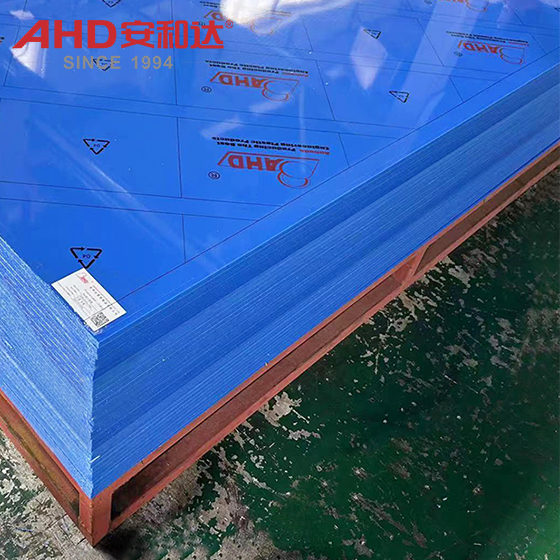
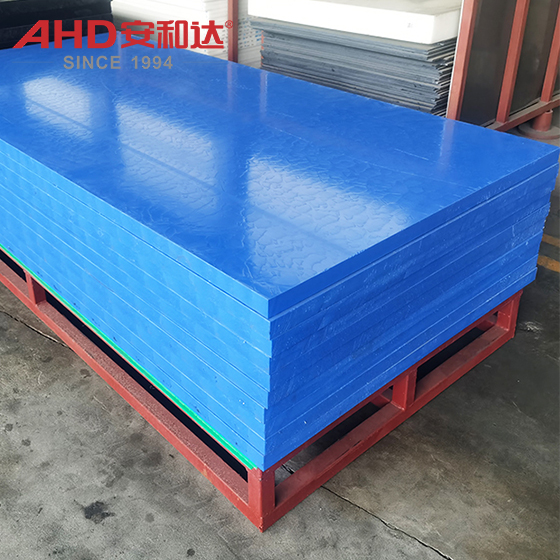
AHD Casting Nylon Sheet
II. Core Advantages and Characteristics (For Mechanical and Automation Scenarios)
The core competitiveness of MC Nylon Rod/Sheet in the above applications stems from their material properties and processing adaptability:
1. Self-lubricating and Low Coefficient of Friction
The coefficient of friction is as low as 0.1-0.15 (under dry friction conditions), close to that of polytetrafluoroethylene (PTFE), but with higher load-bearing capacity.
No additional lubrication required: Stable operation even in dusty or oil-deficient environments, reducing downtime of automated equipment due to lubrication failures (e.g., food packaging machines, cleanroom equipment).
2. Wear Resistance and Impact Resistance
Outstanding wear resistance: Wear loss ≤ 0.02g/1000 rpm, suitable for long-term reciprocating motion components (e.g., cylinder piston rod guide sleeves).
High impact toughness: Notched impact strength ≥ 6kJ/m² (superior to PA66's 4-5kJ/m²), not easily broken by drops or accidental collisions (e.g., sliding blocks of moving platforms in automated production lines).
3. Dimensional Stability and Machinability
Low Moisture Absorption: Balanced water absorption rate ≤1.5%, minimal impact of ambient humidity on post-processing dimensions, suitable for high-precision fits (e.g., gear module tolerance ±0.02mm).
Easy Machining: Sheet/bar stock can be directly turned, milled, and drilled without heat treatment; machining efficiency is 3-5 times higher than metal (e.g., turning an MC nylon bushing takes only 5 minutes).
4. Lightweight and Corrosion Resistance
Density 1.15-1.2g/cm³, reducing equipment load and energy consumption (e.g., reducing the weight of robot arm joint components allows for reduced servo motor power).
Oil and Weak Acid/Alkali Resistance: Can be used long-term in hydraulic oil, lubricating oil, and coolant without swelling or deformation (e.g., nylon pipe fittings in injection molding machine hydraulic systems).

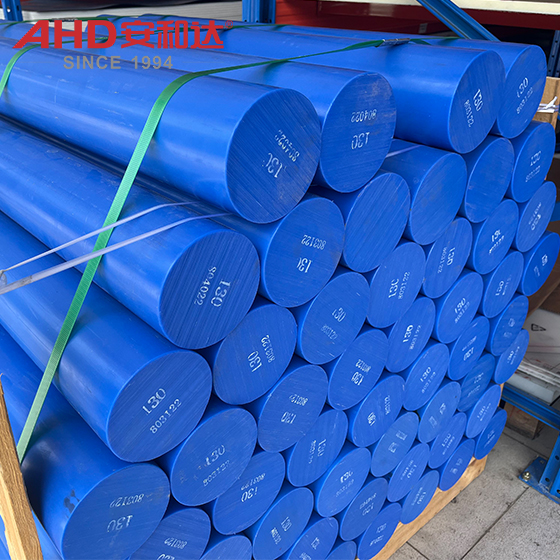
Blue Cast Nylon Rod
III. Precautions for Use
Although MC nylon has excellent performance, the following limitations should be noted in mechanical and automated equipment to avoid failure:
1. Temperature and Heat Resistance
Long-term operating temperature ≤120℃, short-term peak temperature ≤150℃ (mechanical properties will decrease after exceeding this temperature).
Avoidance Tip: Components near heat sources (such as motor heat dissipation vents, molten plastic flow channels) should be made of high-temperature resistant materials such as metal or PPS, or heat insulation plates should be installed next to MC nylon components.
2. Hygroscopicity and Dimensional Compensation
Dimensional expansion is approximately 1%-2% (along the length direction) after absorbing water. Tolerances should be allowed for high-precision fits (such as bearing clearance ≤0.05mm).
3. Strength and Load Limitations
Tensile strength ≤75MPa. Avoid bearing concentrated impact loads or high torque:
Prohibited Scenarios: Replacing gearbox drive shafts (requiring bending torque), and lifting hooks of heavy equipment (requiring static tension).
Applicable Scenarios: Suitable for bearing loads subjected to uniform pressure (such as radial pressure ≤50MPa).
4. Chemical Corrosion and Aging
It is not resistant to strong oxidizing acids (such as concentrated nitric acid and concentrated sulfuric acid) and polar solvents (such as phenol and formic acid). Contact with these solvents will cause swelling or cracking.
Tips for Avoiding Problems: Components in chemical equipment should have their media compatibility confirmed, or modified MC nylon should be selected.
5. Surface Hardness and Wear Resistance Optimization
Unmodified MC nylon has a low surface hardness (Rockwell hardness M80-90), making it easily scratched by abrasive particles in dusty environments.
Solutions: Inlay graphite pillars or PTFE fibers on the surface to improve dry friction wear resistance; or use glass fiber reinforced MC nylon.
The Value of MC Rod/Sheet in Mechanical Automation
Its core value in machinery and automation equipment lies in "replacing steel with plastic" to reduce costs and increase efficiency: through its self-lubricating, wear-resistant, and lightweight properties, it reduces maintenance frequency, lowers energy consumption, and extends equipment life. When using it, it is crucial to focus on three key factors: temperature, moisture absorption, and maximum load capacity. Reasonable design of tolerances and environmental compatibility will maximize its performance advantages.