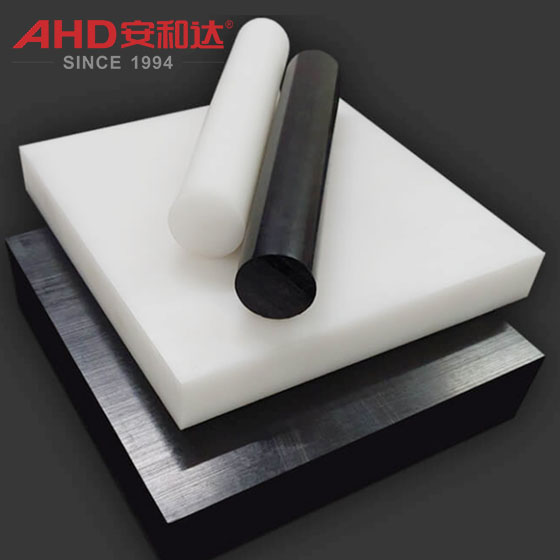
Thinnest POM Sheet for Industrial Use
POM (Polyoxymethylene) sheets are widely used in industrial fields due to their high crystallinity, excellent mechanical strength, and abrasion resistance. Production processes, equipment precision, and application requirements mainly limit their minimum processable thickness. Common thinnest specifications and limits in the industry are as follows.
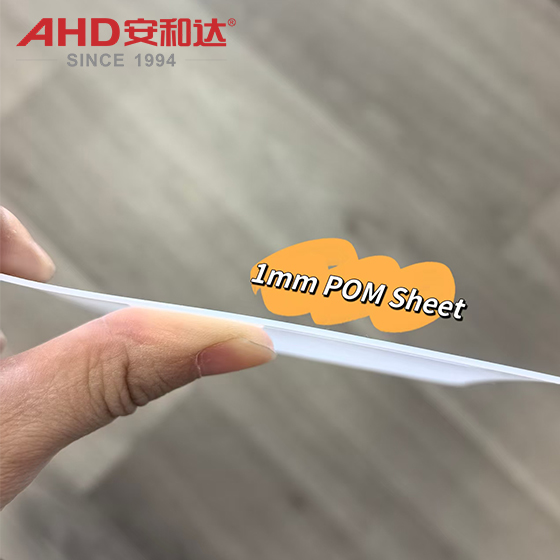
AHD 1mm POM Sheet (Polyoxymethylene Sheet)
1. Standard Industrial Thickness for Mass Production
POM sheets produced through extrusion molding have good thickness uniformity due to the continuous extrusion process. The thinnest that can be stably produced in industry is 0.5mm (some high-quality suppliers can provide sheets of 0.3-0.5mm). These thin sheets are mainly used in precision applications requiring high thickness and dimensional accuracy.
2. Limiting Processable Thickness (Non-Mass Production):
Theoretically, the original sheet (e.g., 5mm) can be cut to even thinner thicknesses (e.g., 0.2-0.3mm) using machining. However, due to the brittleness of the material and the difficulty of processing (easily deformed, edge burrs), such ultra-thin sheets are difficult to produce stably in mass production and are costly, only suitable for special customized applications.
Key Influencing Factors
Production Process: Extrusion is more suitable for thin sheets, while compression molding, due to die closing pressure limitations, typically limits thickness to ≥2mm.
Dimensional Stability: Thin sheets are susceptible to shrinkage due to temperature and humidity, requiring strict control of raw material crystallinity (e.g., homopolymer POM shrinks more easily than copolymer POM).
Surface Quality: Ultra-thin sheets are prone to scratches and warping, requiring high-precision extrusion equipment and post-processing.

Why make such a thin POM board?
The core driving force behind the pursuit of thinner POM sheets (e.g., 0.5mm or even thinner) in industry is essentially a two-way push from market demand and technological progress, which can be understood from the following six perspectives:
1. Lightweight Demand: Reducing overall weight to suit portable/energy-saving scenarios
With the extreme pursuit of "lightweight" in fields such as electronic devices (mobile phones, drones), automotive parts (lightweight structural components), and medical devices (handheld instruments), thin POM sheets can significantly reduce component weight without sacrificing key performance characteristics (such as strength and wear resistance).
2. Space Constraints: Meeting the Compact Design Needs of Precision Equipment
The internal space of modern industrial equipment (such as robots, precision instruments, and micro-transmission systems) is becoming increasingly limited. Thin POM sheets can serve as "space-filling materials," achieving functionality without occupying additional volume.

3. Functional Substitution: Replacing Steel with Plastic, Avoiding Metal Defects
While metals boast high strength, they exhibit significant shortcomings in certain applications. Thin POM sheets offer targeted alternatives:
Corrosion Resistance: In humid and chemically corrosive environments (such as medical sterilization equipment and chemical instruments), metals are prone to rust, while POM is resistant to acids, alkalis, and solvents. Thin sheets are also easier to mold into sealing structures.
Self-Lubricating Properties: Metal friction requires additional lubrication, while POM itself has low friction (COF≈0.1-0.3). Thin sheets, used as sliding parts, directly reduce lubrication maintenance.
Non-Magnetic: Medical MRI equipment, electronic sensors, and other applications requiring protection from metal interference make thin POM sheets an ideal choice due to their non-magnetic nature.
4. Cost Optimization: Balancing Material Usage and Performance
Although thin POM sheets are more difficult to produce (e.g., prone to breakage during extrusion, and difficult to control dimensional stability), they can actually reduce overall costs in some scenarios:
Material Savings: When replacing thick plates or metal parts, thin POM sheets use less material per unit area;
Simplified Processing: Thin sheets can be directly stamped and cut into shape, eliminating the need for complex metal processing (e.g., milling, heat treatment), thus shortening delivery time;
Assembly Efficiency: The thinness of the sheets reduces the number of fixing steps during assembly (e.g., reducing the use of screws and adhesives).
5. Performance Adaptation: Leveraging the "Lightweight, Thin, and High-Strength" Characteristics of POM
POM itself possesses high crystallinity (homogeneous POM crystallinity ≈75%, copolymer ≈70%), giving it advantages such as high rigidity and high wear resistance. Thin POM sheets achieve a balance between "lightweight and thin" and "high performance":
While the heat dissipation of thin sheets is not as good as metal, POM's low thermal conductivity is actually an advantage in certain heat-sensitive applications (such as optical equipment) (reducing heat conduction interference).
6. Technological Breakthrough: Advances in Production Processes Support Thinning
The widespread adoption of thin POM sheets is inseparable from the upgrading of extrusion equipment and processes: High-precision extruders can achieve uniform melt distribution, reducing "thickness fluctuations" in thin sheet production;
Online thickness gauges and closed-loop control systems (such as laser thickness measurement + automatic die head clearance adjustment) control tolerances; Post-processing technologies (such as heat setting and surface hardening) solve the problems of warping and edge burrs in thin sheets, improving yield.

1mm Delrin Sheet
Industrial-grade 1mm POM sheet, due to their thinness, lightness, and high strength, are widely used in sliding, supporting, and transmission components in precision machinery, electronics, and automotive industries. When selecting POM sheets, it's essential to discuss specific operating conditions (such as load, temperature, and precision) with the supplier to ensure the dimensional stability and lifespan of the thin sheet.
The emergence of thin POM sheets is a result of both demand-driven and technology-supported development: market demands for lightweighting, compactness, and the replacement of steel with plastics are forcing materials to become thinner, while advancements in extrusion processes and precision control technologies are making this demand a reality. In the future, with the further development of 5G, robotics, wearable devices, and other fields, the thinning (and even ultra-thinning) of POM sheets will remain an important trend.