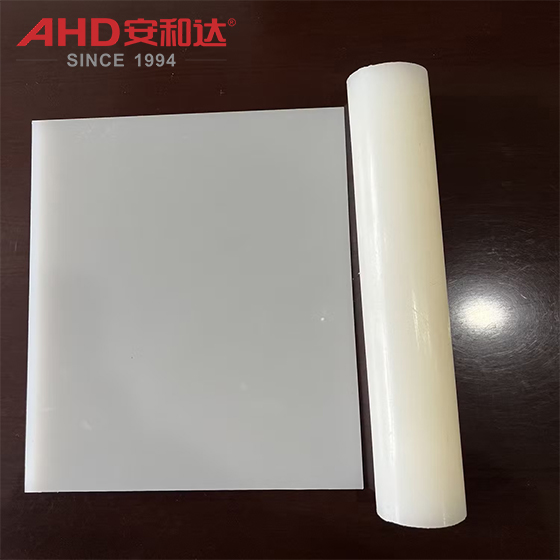
Both PTFE (polytetrafluoroethylene) and PVDF (polyvinylidene fluoride) are fluoropolymers, possessing excellent chemical corrosion resistance due to the fluorine atoms in their molecular structure. However, their corrosion resistance differs significantly, primarily due to differences in molecular structure, fluorine content, and physical properties. The following compares their corrosion resistance from multiple dimensions:
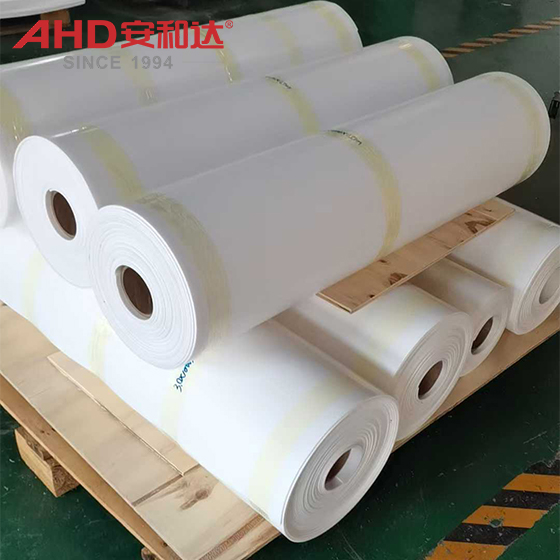
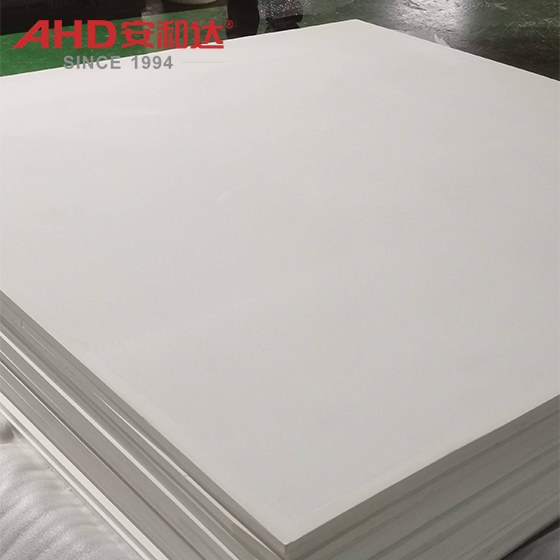
AHD PTFE Roll Sheet
I. Molecular Structure and Basic Properties
PTFE: The main molecular chain is composed of pure carbon-carbon bonds (-C-C-), with each carbon atom connected to two fluorine atoms (-CF₂-CF₂-), forming a highly symmetrical helical structure. Fluorine atoms completely enclose the carbon chain, forming a "fluorine shell" for protection. It has a high fluorine content, almost no exposed polar groups, and extremely high chemical stability. It also has high crystallinity.
PVDF: The main molecular chain contains alternating -CH₂- and -CF₂- groups (structure: -(-CH₂-CF₂-)ₙ-). It has a low fluorine content and lower crystallinity. Some hydrogen atoms are exposed, exhibiting weak polarity, resulting in slightly inferior corrosion resistance.

II. Comparison of Resistance to Common Corrosive Media
1. Strong Acids (e.g., hydrochloric acid, sulfuric acid, nitric acid)
PTFE Sheet: Stable to all concentrations and temperatures (including boiling point) of hydrochloric acid, dilute/concentrated sulfuric acid (≤98%), and fuming nitric acid (≤90%), without swelling or corrosion, and can be used long-term at temperatures above 200℃.
PVDF Sheet: Good resistance to dilute acids (e.g., ≤37% hydrochloric acid, ≤98% sulfuric acid) and room-temperature nitric acid (≤65%); however, it may slowly swell under concentrated acids (e.g., ≥90% nitric acid) or high temperatures (>100℃), and its mechanical properties will decrease with prolonged contact (e.g., concentrated hydrochloric acid at 150℃).
2. Strong Bases (e.g., sodium hydroxide, potassium hydroxide)
PTFE: Completely stable to all concentrations and temperatures (including molten state) of strong bases (e.g., 50% NaOH, KOH), without reaction.
PVDF: It has good resistance to dilute alkalis (such as ≤50% NaOH) and concentrated alkalis at room temperature (such as 98% KOH); however, it may suffer from stress corrosion cracking (SCC) in high-temperature (>120℃) and high-concentration alkalis (such as 30% NaOH), and is particularly prone to embrittlement under tensile stress.
3. Organic Solvents
PTFE: Almost insoluble in any organic solvent (including aromatics, halogenated hydrocarbons, ketones, etc.), only slightly soluble with a very few substances such as perfluoroethers at high temperatures (>300℃).
PVDF: Good resistance to non-polar solvents (such as alkanes and oils); however, it is easily swollen or dissolved by polar organic solvents, for example: At room temperature: acetone (slight swelling), dichloromethane (limited swelling); At high temperatures (>80℃): dimethyl sulfoxide (DMSO) and N-methylpyrrolidone (NMP) can dissolve it.
4. Oxidizing Agents and Halogens
PTFE: Stable to strong oxidizing agents (such as concentrated nitric acid and hydrogen peroxide) and halogens at high temperatures, reacting violently only with molten alkali metals (such as Na and K) or fluorine gas.
PVDF is easily oxidized and degraded in strong oxidizing environments (such as high-temperature concentrated nitric acid and ozone), resulting in surface cracks; it reacts with halogens (Cl₂, Br₂) at high temperatures to form halides.
III. Effects of Temperature
PTFE Rod: Long-term operating temperature -200~260℃. It begins to decompose at temperatures exceeding 300℃, but retains its corrosion resistance until decomposition.
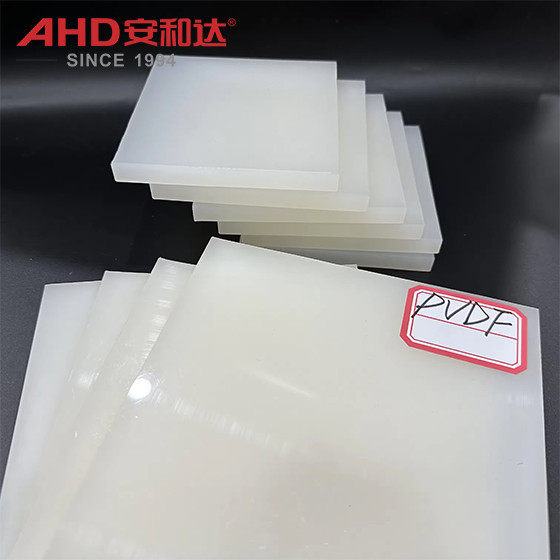
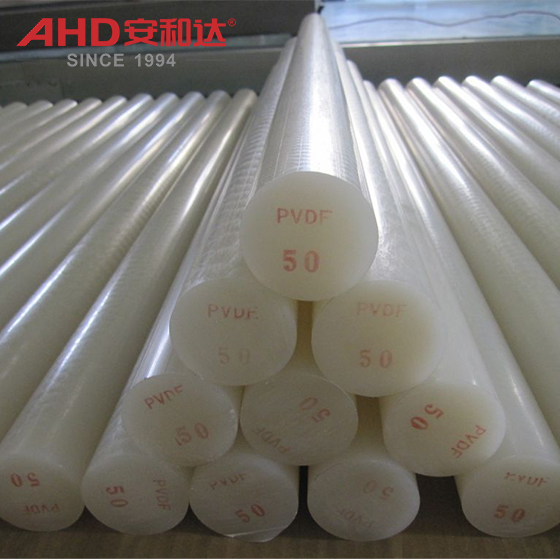
PVDF Rod: Long-term operating temperature -40~150℃ (some modified grades can reach 170℃). At high temperatures, molecular chain movement intensifies, significantly reducing corrosion resistance.
IV. Differences in Practical Application Scenarios
PTFE: Suitable for extreme corrosive environments, such as chemical reactor linings, high-temperature strong acid pipelines, semiconductor high-purity reagent containers, and radiation- and corrosion-resistant components in the nuclear industry.
PVDF: Used in general corrosive environments, such as ordinary chemical storage tanks, corrosion-resistant valve seals, electroplating tank linings, and photovoltaic backsheet films (weather-resistant and electrolyte-resistant), while also considering mechanical strength and processability (melt-forming capability).
Summary
PTFE offers more comprehensive and extreme corrosion resistance, especially excelling in high-temperature, strong acid and alkali, organic solvent, and oxidizing environments, earning it the title of "King of Plastics." PVDF, on the other hand, is sufficiently reliable in conventional corrosive environments and offers superior mechanical properties, processability, and cost.
When choosing, it is necessary to weigh the type of corrosive medium, temperature, mechanical requirements, and cost: choose PTFE for extreme conditions, and PVDF for general applications.