

In industrial environments such as electronics, chemical, oil and gas, and dusty workshops, the generation and accumulation of static electricity can cause various hazards, varying depending on the industry. These primarily involve fire/explosion risks, equipment damage, product quality degradation, and threats to personnel safety. The following details the hazards by industry:
I. Electronics Workshops:
Fatal Damage to Precision Components from Static Electricity The core risk in the electronics industry is the damage caused by electrostatic discharge (ESD) to precision electronic components, specifically including:
Component Breakdown or Failure: The gate oxide layer of semiconductor devices (such as IC chips and transistors) and integrated circuits is extremely thin. Static voltage can easily break down the insulating layer, leading to short circuits or open circuits, causing permanent damage. For example, CMOS circuits are extremely sensitive to ESD; even a small charge can cause them to fail.
Potential Damage: Some components may not fail immediately after being subjected to electrostatic shock, but their performance may degrade (e.g., increased leakage current, shortened lifespan), potentially leading to malfunctions during later use and increasing after-sales costs.
Adsorption of Contaminants: Static electricity can attract dust particles (such as metal ions and organic matter) from the air, adhering to the surface of wafers and circuit boards, causing short circuits or decreased insulation, reducing product yield.
II. Chemical Workshops:
Ignition Sources and Process Interference of Flammable Media Chemical production often involves flammable liquids, gases, or highly reactive materials. The main hazards of static electricity are fire/explosion and process abnormalities:
Ignition Source Risk: During material transportation, mixing, filtration, or spraying, static electricity is generated due to friction (liquid-solid, liquid-liquid) or contact separation (e.g., valve switching). If the charge accumulation rate exceeds the leakage rate (e.g., in low humidity environments), it may form a voltage of tens of thousands of volts. The discharge spark can directly ignite a flammable vapor/gas mixture (within the explosion limits), leading to an explosion or fire.
Process Interference: Static electricity may adsorb light powders or droplets, altering material distribution (e.g., in spray drying), affecting reaction uniformity. Strong electric fields may also interfere with instrument sensors (e.g., pH meters, flow meters), leading to measurement errors or control failures.
III. Oil and Gas Workshops:
"Hidden Bombs" of Flammable and Explosive Media Static electricity hazards are particularly prominent in the storage, transportation, and processing of oil and gas (petroleum, natural gas, and refined oil products), with explosions and fires being the core risks:
Storage and Transportation: During the loading and unloading of oil tankers, static electricity is generated through friction between the oil and pipelines/tank walls. When oil tankers dock for unloading, the high-speed flow of crude oil rubbing against the air can also generate static electricity. If grounding is poor (e.g., excessive grounding resistance), the charge cannot be conducted away in time, and when it accumulates to a certain level, it may discharge and ignite oil and gas vapors (the minimum ignition energy of gasoline vapor is only 0.2 mJ, and even a very small amount of static electricity can trigger it).
Processing: In the distillation towers and reactors of oil refineries, high-speed flow of oil and gas or friction with catalyst particles can also generate static electricity. If the flange connections of natural gas pipelines are not insulated (e.g., the gasket material), potential differences may be created due to induction, igniting sparks.
Secondary Disasters: Fires caused by static electricity can spread throughout the entire oil and gas storage area, causing large-scale leaks, environmental pollution, and casualties.
IV. Dust-Rich Workshops:
When combustible dust (such as coal powder, aluminum powder, flour, and plastic powder) is suspended in a workshop, static electricity is a key trigger for dust explosions:
Explosion Triggering Conditions: Friction between dust particles and collisions between particles and equipment generate static electricity. When the dust cloud concentration reaches the lower explosive limit, and the electrostatic discharge energy is greater than the minimum ignition energy (e.g., only 10 mJ for magnesium powder), an explosion can occur.
Secondary Explosion Risk: The deposited dust raised by the initial explosion can form a larger dust cloud, multiplying the power of subsequent explosions and potentially causing factory collapse (e.g., the 2014 aluminum dust explosion in Kunshan, Jiangsu).
Other Impacts:
Electrostatic adsorption causes dust to accumulate on equipment (e.g., clogged dust collectors), affecting ventilation efficiency; strong electric fields can also cause dust agglomeration, altering its flowability and interfering with production processes.
Common Hazards: Personnel Safety and Equipment Damage
In addition to the industry-specific problems mentioned above, static electricity can also:
Electric Shock: When operators come into contact with static-laden equipment or materials, they may experience a brief stinging sensation. While usually not fatal, this can lead to misoperation (such as touching high-temperature equipment or switches), indirectly causing accidents.
Accelerated Equipment Aging: Static fields can induce charge migration within insulating materials, accelerating their aging (e.g., cable insulation layers); high-voltage static electricity can also damage electronic instruments (e.g., PLC controllers), causing shutdowns.
The main hazards of static electricity in different workshops can be summarized as follows: in the electronics industry, it primarily damages components; in chemical/oil/gas/dust workshops, it primarily causes fires and explosions, while also generally leading to decreased product quality and equipment interference. Therefore, these environments require strict control of static electricity accumulation through grounding, humidification, antistatic materials, and ion neutralization to ensure safe production. Our AHD Antistatic Polyoxymethylene Sheet and rods are a commonly used antistatic material.

Core Concepts: Combining ESD and POM
POM (Polyoxymethylene): A high-performance semi-crystalline thermoplastic engineering plastic with excellent mechanical strength, abrasion resistance, chemical resistance, and dimensional stability. It is widely used in gears, bearings, precision molds, and electronic component housings. However, ordinary POM is a strong insulator and easily accumulates static electricity, potentially damaging sensitive electronic components or causing dust explosions.
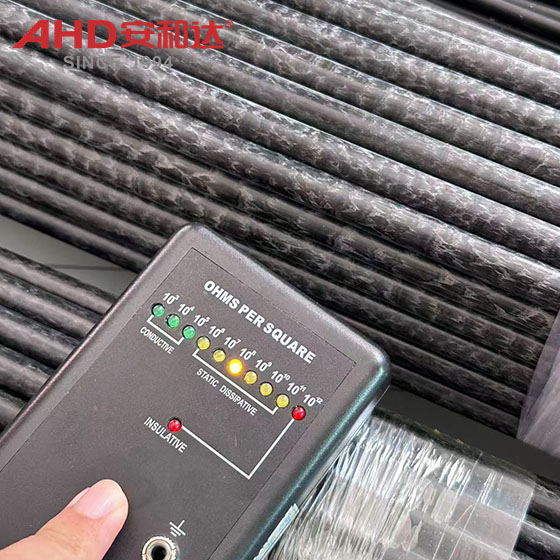
ESD (Electrostatic Discharge) Protection: This refers to materials that reduce surface/volume resistivity to allow static charges to be quickly conducted away (rather than accumulated), preventing damage to electronic devices, precision instruments, or flammable environments caused by electrostatic discharge (ESD). The surface resistivity of ESD materials is generally controlled between 10⁶ and 10¹¹ Ω (between conductors and insulators).
AHD ESD POM Sheet: By adding antistatic agents, conductive fillers, or modifying the surface of the POM matrix, ESD protection is imparted while retaining the original mechanical and thermal properties of POM.
Advantages of AHD ESD POM
From a mechanical performance perspective, ESD POM inherits the inherent advantages of POM: it possesses high strength and rigidity, with tensile strength exceeding 60 MPa and flexural strength surpassing 90 MPa, enabling it to withstand repeated loads in precision equipment; its wear resistance is particularly outstanding, with a friction coefficient as low as approximately 0.3, approaching the self-lubricating effect of metals, making it suitable for high-friction applications such as guide rails and gears; it exhibits excellent dimensional stability, with a shrinkage rate of only 0.4%~0.8% and a low coefficient of linear expansion, maintaining the dimensional accuracy of precision components even in environments with varying temperature and humidity, which is crucial for applications such as chip carriers and optical instrument supports.
Regarding ESD protection characteristics, ESD POM has achieved controllable electrostatic dissipation capabilities through modification: its surface resistivity is precisely controlled at 10⁶~10¹¹Ω (volume resistivity 10⁸~10¹²Ω·cm), falling between conductor and insulator, allowing for rapid conduction of static charge while preventing excessive charge release and associated risks, fully complying with international standards. This protection doesn't sacrifice other properties—compared to ordinary POM (a strong insulator with a resistivity > 10¹⁴Ω), it completely solves the problems of static electricity buildup damaging electronic components, attracting dust, or causing sparks. Compared to antistatic materials that rely solely on coatings, its built-in conductive network (such as carbon black or metal fiber fillers) makes the protection more stable and unaffected by coating wear or environmental humidity.
Thermal performance and chemical stability are also significant characteristics of ESD POM. It retains the temperature resistance of POM, with a long-term operating temperature range of -40℃ to 120℃ and a heat distortion temperature (1.8MPa) exceeding 110℃, enabling it to adapt to the high-temperature conditions of automated equipment. It also exhibits good chemical resistance, resisting corrosion from alcohols, hydrocarbons, and other organic solvents, only being susceptible to strong acids and alkalis. This characteristic makes it reliable in cleanroom cleaning and chemical equipment components.
Its advantages lie in its "irreplaceable comprehensive performance": compared to ordinary POM, it fills the gap in anti-static properties, allowing POM to enter sensitive fields such as electronics and semiconductors; compared to other ESD materials (such as PS and ABS), it is superior in mechanical strength, wear resistance, and temperature resistance, and has a longer service life; compared to metal anti-static components, it is lightweight, easy to process (can be cut and bent into plates/bars), and has no risk of electrochemical corrosion. Furthermore, by selecting different modification methods (such as carbon black filling to adjust resistivity, and ionomers to improve stability), ESD POM can also be customized to meet specific performance requirements, adapting to diverse scenarios from low-static storage pallets to high-precision chip fixtures.
In short, ESD POM, with its "hard power of mechanical performance" and "soft power of ESD protection," synergizes to meet the stringent strength and precision requirements of precision equipment while eliminating the hidden threat of static electricity. It has become an ideal solution for scenarios in industries such as electronics, medical, and automation that require both high performance and anti-static protection, and its value becomes increasingly prominent with the miniaturization and precision of electronic devices.