

Both silicone solid sheets and PU (polyurethane) sheets are polymer materials widely used in industry, construction, and medical fields, but they differ significantly in performance and application. The following comparative analysis focuses on their similarities, differences, and performance in shock absorption, corrosion resistance, and sealing:
I. Similarities
Elasticity and Cushioning: Both possess a certain degree of elasticity and can be used as cushioning materials (such as shock-absorbing pads and liner) to absorb some impact energy.
Processability: Both can be processed into desired shapes (such as sheets and gaskets) through molding, cutting, and bonding.
Basic Weather Resistance: Under normal temperature and dry conditions, both maintain basic performance stability (short-term aging resistance).
II. Differences
| Item | Solid Silicone Rubber Sheet | PU Sheet |
| Chemical Composition | It has a polysiloxane main chain (-Si-O-Si-) and contains silicon. | It is polymerized from polyols (soft segments) and polyisocyanates (hard segments) (-NHCOO-) and contains no silicon. |
| Temperature range | Extremely wide (-50℃~250℃, special models can reach over 300℃), does not decompose at high temperatures, and remains soft at low temperatures. | Narrower range (-40℃~80℃, slightly wider to 100℃ for soft PU), easily softens at high temperatures and becomes brittle at low temperatures. |
| Elasticity and Hardness | High elasticity (elongation at break >300%), low hardness (Shore A 10~80), more flexible. | Adjustable elasticity (elongation at break 100%~600%), wide hardness range (Shore A 10~D 80), rigid PU is close to plastic. |
| Mechanical Strength | Low tensile strength (typically 5~15MPa), but good tear resistance. | High strength (tensile strength 10~60MPa), with superior abrasion and scratch resistance (close to rubber). |
| Chemical Resistance | Resistant to most solvents (except strong alkalis and concentrated acids), ozone, and ultraviolet light; good hydrophobicity, does not easily absorb water. | Resistant to oils and aliphatic hydrocarbons, but susceptible to corrosion from strong acids/alkalis, ketones, esters, and hot water (>60℃); easily hydrolyzed. |
| Density | Low (1.1~1.3 g/cm³), lightweight. | High (1.0~1.3 g/cm³, rigid PU can reach 1.4 g/cm³). |
| Typical Applications | High-temperature seals, medical catheters, electronic potting compounds, food-grade gaskets, shock absorption in extreme environments. | Abrasion-resistant linings, shoe soles, automotive interiors, industrial cushioning pads, sound insulation materials, non-high-temperature seals. |
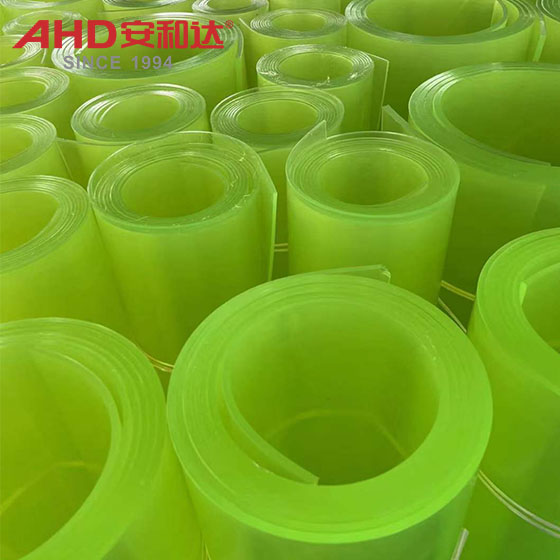
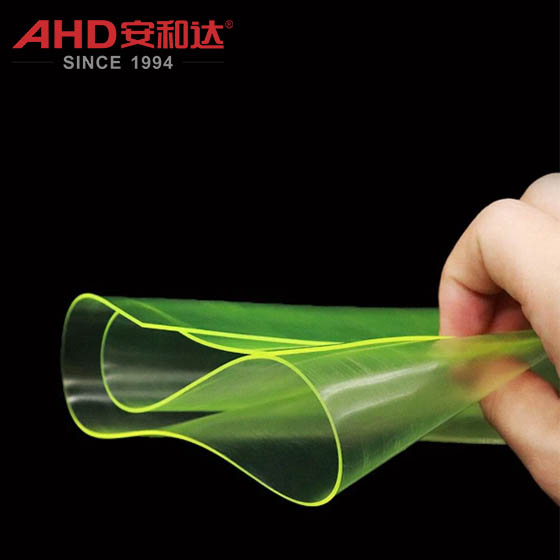 Clear Polyurethane Sheet
III. Key Performance Comparison
1. Vibration Damping Performance
Solid silicone sheets are superior (especially in wide temperature range and dynamic scenarios): Silicone's high resilience (low hysteresis loss) and wide temperature range stability allow it to maintain good energy absorption at different temperatures, making it suitable for vibration damping in high-frequency vibrations or extreme temperatures (such as around engines).
PU sheets' vibration damping depends on hardness: Soft PU (Shore A 30~70) provides good vibration damping at room temperature, but it softens at high temperatures and hardens at low temperatures, resulting in a significant decrease in dynamic performance; rigid PU has weaker vibration damping.
2. Corrosion Resistance
Silicone is generally stronger: Silicone has better resistance to ozone, ultraviolet light, oxidizing environments, and most chemical reagents (such as acids, alkalis, and salt solutions), only slightly swelling in strongly alkaline environments (pH>12) or some polar solvents (such as carbon tetrachloride).
PU Polyurethane Sheet is easily corroded by strong acids and alkalis, ketone/ester solvents, and hot water (>60℃). Long-term humid environments will cause hydrolysis (especially polyester-type PU), leading to performance degradation.
3. Sealing Performance
Silicone is superior (especially for long-term dynamic sealing): Silicone's low compression set (<10%, premium products <5%) allows it to effectively rebound and maintain a seal even under continuous pressure; it is also resistant to high temperatures and aging, making it suitable for dynamic sealing applications such as high-temperature pipelines and engines.
PU Plastic Sheet has a higher compression set (typically 15%~30%), is prone to loosening under long-term pressure, and ages faster in high-temperature or humid environments, making it more suitable for static, room-temperature sealing (such as filling gaps in ordinary machinery).

Summary
Silicone: Requires high temperature resistance (-50℃~250℃), strong corrosion resistance, long-term dynamic sealing, or shock absorption in extreme environments (e.g., aerospace, medical, high-temperature equipment).
PU: Requires high wear resistance, oil resistance, low cost, or cushioning and sound insulation in normal temperature/non-corrosive environments (e.g., automotive, shoe materials, industrial linings).
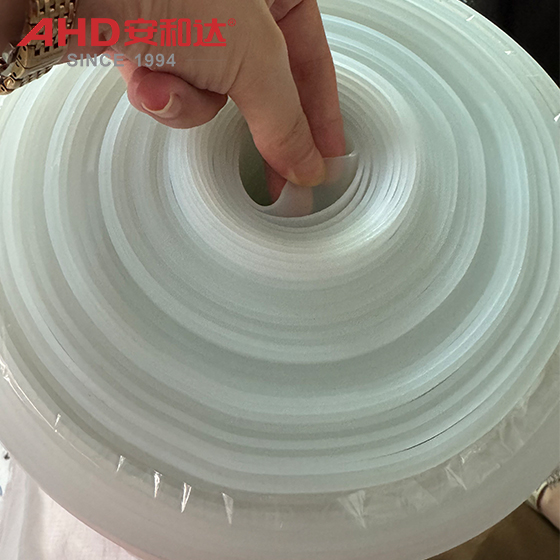
AHD Roll of Silicone Sheet
