

In the field of industrial materials, a high-performance polymer known as the "King of Plastics" is polytetrafluoroethylene (PTFE). With its exceptional temperature resistance, chemical stability, and extremely low coefficient of friction, it has become an irreplaceable engineering material in extreme environments. From extreme cold of -200°C to high temperatures of 260°C, from the corrosive effects of aqua regia to the insulation of high-frequency currents, PTFE consistently demonstrates astonishing stability. This near-omnipotent characteristic makes it widely used in cutting-edge fields such as aerospace, semiconductors, and chemical pharmaceuticals. However, transforming these microscopic molecular structures into practically applicable sheet and rod products requires an extreme pursuit of raw material quality and rigorous control over precision processing.
As a leading PTFE Sheet and Rod solutions provider, AHD Polymer deeply understands the essence of this conversion process: We insist on starting from the source, carefully selecting PTFE monomer raw materials, and ensuring that every resin particle has a perfect molecular weight and particle size distribution through precise process control. In the sheet and rod molding stage, we use advanced molding equipment and intelligent temperature-controlled sintering systems, combined with our independently developed filler formulation technology, which not only preserves the inherent advantages of PTFE, but also allows for the addition of fillers with different functions to meet customer needs. It is this rigorous selection of raw materials and pursuit of excellence in processes that enables AHD Polymer's PTFE sheets and rods to provide customers with full-scenario customized services from laboratory samples to industrial mass production, allowing the true value of the "King of Plastics" to be fully released in every application scenario.
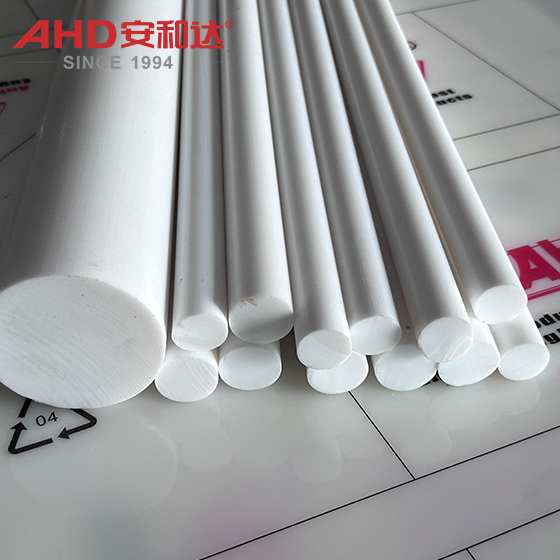
AHD PTFE Rod
Ⅰ.Raw Materials for PTFE Sheets and Rods
PTFE is made from tetrafluoroethylene monomer (CF₂=CF₂), which is polymerized via free radical polymerization to form a high molecular weight polymer (-(CF₂-CF₂)-n). Two main polymerization processes are used in industrial production:
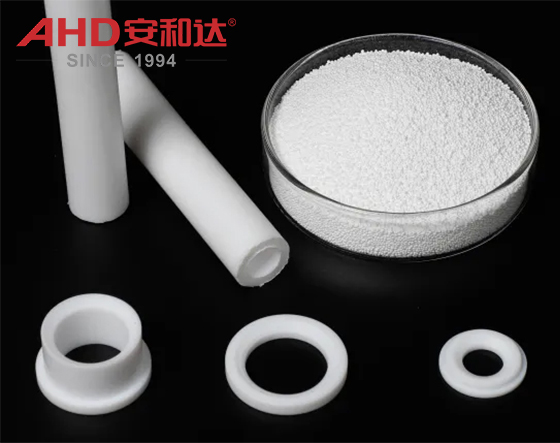
Suspension polymerization: produces granular resin (particle size approximately 100-500 μm), used for molding and sintering (e.g., the base material for sheets and rods).
Dispersion polymerization: produces fine powder resin (particle size 0.1-0.3 μm), used for paste extrusion or coatings.
Some modified PTFE may contain fillers (such as glass fiber, graphite, carbon fiber, etc.) to improve wear resistance, strength, or thermal conductivity.
Ⅱ. How to Select PTFE Plate and Rods?
When selecting PTFE sheets and rods, pay attention to the following key indicators:
Raw Material Purity: Prioritize raw materials from major manufacturers (such as DuPont, Daikin, and domestic companies like AHD Polymer), avoiding recycled materials (high impurities, poor performance).
Appearance Quality: The surface should be smooth and uniform, free of bubbles, cracks, delamination, or obvious impurities; the color is usually milky white or translucent (modified materials may be gray, black, etc.).
Physical Properties:
Density: Pure PTFE is approximately 2.1-2.3 g/cm³ (too low may indicate adulteration);
Tensile Strength: ≥15 MPa (pure material), higher for modified materials;
Elongation at Break: ≥150% (pure material);
Heat Deflection Temperature: ≥250℃ (long-term operating temperature -200~260℃).
Certifications and Testing: Check if it meets food-grade, medical-grade, or flame-retardant certifications (select as needed).
Tips to avoid pitfalls: Low-priced products may contain recycled materials or excessive fillers. You need to use a combustion test (pure PTFE is self-extinguishing after being removed from the flame and emits white smoke) or density measurement to help determine this.
Ⅲ. Processing Flow of PTFE Sheets and PTFE Round Bar
Due to its high melting point (330℃) and high viscosity, PTFE cannot be processed using conventional thermoplastic injection/extrusion processes. A molding-sintering-machining route is required:
Raw Material Pretreatment:
Suspension Resin: Sieve to remove large particles; some needs to be mixed with extrusion aids (for push molding).
Dispersed Resin: Mix with solvent to form a paste (for paste extrusion).
Molding (Preform Preparation):
Molding Method (Bonds and Rods): Powder is loaded into a mold and cold-pressed into a preform.
Push Molding Method (Mainly Rods): Paste resin is continuously extruded into rods using a push press.
Extrusion Method (Mainly Tubes): Similar to push molding, used for tubular materials.
Sintering (Key Step): The preform is placed in a sintering furnace, heated to 360-380℃ (above the melting point), held at this temperature for 2-4 hours to allow the molecular chains to fully align, and then slowly cooled (≤5℃/min) to room temperature to eliminate internal stress.
Machining: The sintered blank is machined into the required dimensions (plate/bar) using lathes, milling machines, etc.; complex shapes can be engraved using CNC machining.
Note: Modified PTFE (e.g., with fillers) requires adjustment of the sintering temperature to avoid filler oxidation.
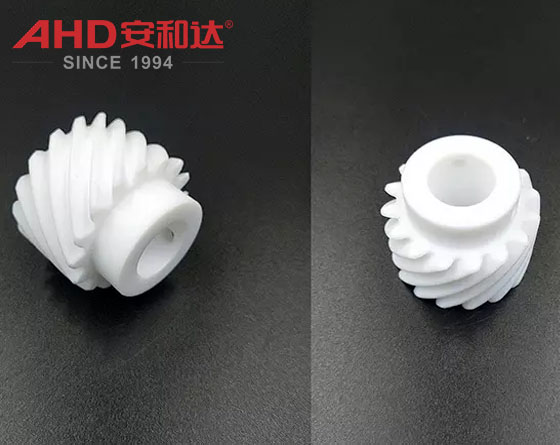
PTFE Parts make from Teflon Bar
Ⅳ. Core Characteristics of PTFE
Excellent Temperature Resistance
Long-term operating temperature -200~260℃ (short-term 280℃), does not become brittle at low temperatures, and does not melt at high temperatures (only decomposes).
Extremely Strong Corrosion Resistance
Resistant to almost all strong acids (aqua regia), strong alkalis, and organic solvents (except molten alkali metals, chlorine trifluoride, etc.).
Ultra-Low Friction
Coefficient of friction 0.04 (lowest among solid materials), excellent self-lubricating properties (no additional lubricant required).
Electrical Insulation
Dielectric constant 2.1 (stable at high frequencies), volume resistivity >10¹⁸Ω·cm, arc resistance >300s.
Non-stick Properties
Extremely low surface energy (18mN/m), almost no substances (including adhesives) can adhere to it.
Weather Resistance
Resistant to UV radiation and ozone, performance shows no significant decline after 20 years of outdoor use.
Biocompatibility
Non-toxic and non-allergenic, suitable for medical implants (such as artificial blood vessels).
Disadvantages:
Low mechanical strength (tensile strength < 30 MPa), prone to creep (deformation under long-term stress), and poor thermal conductivity (0.25 W/(m·K)).
Ⅴ. Common Applications of PTFE Sheets and Rods
Chemical Industry: Reactor linings, pipe/valve seals, corrosion-resistant gaskets (acid and alkali resistant).
Electronics and Electrical Engineering: High-frequency cable insulation, capacitor films, PCB substrates (high-frequency circuits).
Machinery: Bearings, piston rings, guide rail strips (self-lubricating and friction-reducing).
Medical Industry: Artificial joint coatings, pharmaceutical packaging films (non-toxic).
Food Industry: Baking mold release sheets, conveyor belt anti-stick layers (FDA compliant).
Aerospace: Rocket fuel pipe seals, satellite insulation components (resistant to extreme environments).
Ⅵ. Precautions for Use
Processing Safety: If the temperature is too high during sintering (>400℃), it will decompose and produce highly toxic gases (such as perfluoroisobutylene). Operation must be carried out in a well-ventilated environment.
Machining: PTFE is relatively soft (Shore hardness D50-65). Use sharp tools when turning to avoid chipping; use low-speed feed when drilling.
Installation and Protection: Avoid scratching the surface with sharp tools; clean before contact with metals to prevent particle embedding.
Special Media: Avoid contact with molten alkali metals (such as sodium, potassium), elemental fluorine (F₂), chlorine trifluoride (ClF₃), and other strong oxidizing agents.

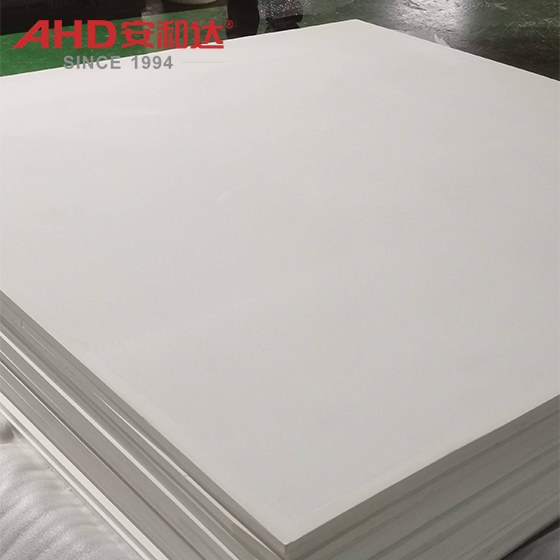
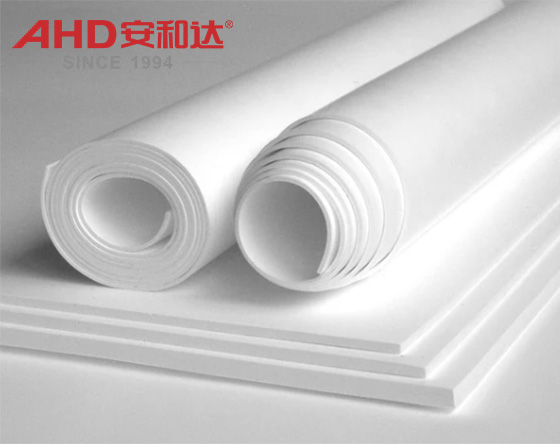
AHD PTFE Roll Sheet
Ⅶ. Storage Methods
Environmental Requirements: Store in a dry, well-ventilated indoor environment free from corrosive gases (such as chlorine or acidic fumes), avoiding direct sunlight (to prevent aging).
Temperature Control: Long-term storage temperature <60℃ (high temperatures accelerate creep), avoid freezing (can still be stored at -200℃, but must be protected from brittleness).
Packaging Protection: Unused sheets and rods should retain their original packaging (e.g., PE film) to prevent dust contamination; when stacking, p
ad with soft materials (e.g., cardboard) to avoid indentations.
Regular Inspection: After long-term storage, check for discoloration and cracking. Minor deformation can be corrected by re-sintering (pure PTFE only).
PTFE sheets and rods are representative of high-performance engineering plastics. AHD prioritizes raw material purity and physical properties during selection, and strictly controls the sintering process to produce high-quality PTFE sheets and rods for you. In applications, utilize their temperature resistance, corrosion resistance, and low friction properties, while also paying attention to safe handling and proper storage.

