

POM – The Ultimate Choice for Precision Machinery Parts: Anheda's 31 Years of Craftsmanship Builds a Foundation for Quality
In today's world, swept by the Industry 4.0 wave, precision machinery parts, as the core "joints" of high-end equipment, directly determine the accuracy, efficiency, and lifespan of equipment operation. From high-precision transmission systems in aerospace to micro-drive components in medical equipment, and precision transmission units in automated production lines, every gear engagement, every bearing rotation, and every screw fixation requires materials with unconventional and stringent properties. Among many engineering plastics, polyoxymethylene (POM) has become the "golden material" in the field of precision machinery parts due to its unique comprehensive performance.
Anheda, with 31 years of experience in the engineering plastics field, has always been committed to "empowering precision manufacturing," focusing on the research and development and production of POM sheet and POM Rod. With stable quality, excellent performance, and high cost-effectiveness, it has become a long-term partner of thousands of precision machinery companies both domestically and internationally. Today, let's explore the world of POM and analyze why it has become the "top choice" for precision machinery parts.

I. Precision Mechanical Parts: A "Performance Litmus Test" in Harsh Environments
Precision mechanical parts differ from ordinary structural components. They often operate under conditions of high-speed operation, high-frequency friction, complex stress, or extreme environments, placing near-extreme demands on materials.
1. High-Precision Dimensional Stability
The dimensional tolerances of precision parts are typically controlled within ±0.01mm, or even at the micrometer level (such as miniature gears in medical devices). Materials must maintain extremely low coefficients of thermal expansion and contraction rates under temperature changes (-40℃ to 120℃), humidity fluctuations, or long-term use to avoid changes in fit clearance and decreased transmission accuracy due to deformation.
2. Excellent Mechanical Strength and Wear Resistance
The contact stress during gear meshing can reach hundreds of megapascals; the coefficient of friction between the rolling elements and raceways of bearings must be less than 0.1; and precision screws must withstand repeated tightening/loosening shear forces. The material must have high tensile strength (≥60MPa), high modulus (≥2.5GPa) and low wear rate to ensure that it does not deform or fail under long-term load.
3. Excellent Self-Lubricating Properties and Low Coefficient of Friction
Precision transmission components (such as gears and bearings) need to minimize reliance on lubricating oil and avoid oil contamination (e.g., in food machinery and electronic cleanrooms), or operate stably even without oil lubrication. The coefficient of friction of the material needs to be controlled between 0.1 and 0.3, and it should possess "self-healing" lubrication properties.
4. Stable Chemical Resistance
In chemical, pharmaceutical, and food processing industries, parts need to come into contact with acidic or alkaline solutions, organic solvents, or high-temperature steam. Materials must resist corrosion from common chemicals to avoid swelling, embrittlement, or performance degradation.
5. Machinability and Surface Finish
Precision parts often require machining, milling, drilling, and other processes to achieve complex structures (e.g., helical gears, miniature bearing housings). The material must possess good machinability, with a surface roughness Ra ≤ 0.8 μm after machining, free from burrs, cracks, and other defects.
These characteristics intertwine to constitute the "performance threshold" for precision mechanical parts. The emergence of POM (Polymer Oxide Material) fills this gap perfectly.

II. POM: An "All-Round Performer" Born for Precision Mechanical Parts
Polyoxymethylene (POM) is a linear polymer with a large number of -O-CH₂- repeating units in its molecular chain. Due to the high regularity of its molecular structure, it possesses near-metallic rigidity and plastic-like lightweight properties. In the field of precision machinery, POM's performance advantages can be summarized as "three highs, two lows, and one excellent": high strength, high rigidity, high wear resistance, low coefficient of friction, low water absorption, and excellent dimensional stability.
1. High Strength and High Rigidity: The "Skeleton Support" of Precision Parts
POM boasts a tensile strength of 70-80 MPa, a flexural strength of 100-110 MPa, and an elastic modulus of 2.8-3.5 GPa, yet weighing only 1/5 the weight of steel. This characteristic makes it exceptionally well-suited for high-load applications:
Gear Applications: In the gearboxes of power tools and robot joints, POM gears can withstand high-speed meshing at thousands of revolutions per minute, with tooth surface contact stresses reaching up to 500 MPa without risk of breakage;
Bearing Applications: Replacing traditional copper bushing bearings, POM bearings in the high-speed shaft systems of textile machinery can operate continuously for long time without wear;
Precision Screws: In semiconductor packaging equipment, POM screws are used to secure vacuum chambers, capable of withstanding repeated disassembly and assembly without stripping, with a torque retention rate >95%.
2. High Wear Resistance: The "Never-Fatigued" Transmission Core
POM's molecular structure contains no easily hydrolyzed amide or ester bonds, and its high crystallinity of 75%-85% endows it with excellent resistance to abrasive wear. Its wear rate is only 1/3 that of nylon (PA66). In precision transmission systems, this means:
Extended Gear Life: Replacing nylon gears with POM gears in automotive components reduces noise by 15dB and significantly extends service life;
Extended Maintenance-Free Bearing Cycle: In roller bearings of logistics sorting equipment, POM bearings do not require regular grease filling, effectively reducing maintenance costs;
Scratch Resistance in Precision Guides: In linear guides of optical inspection equipment, POM sliders can resist scratches from metal debris, maintaining positioning accuracy.
3. Low Coefficient of Friction and Self-Lubricating Properties: An Ideal Solution for Oil-Free Lubrication
POM has a static coefficient of friction of 0.15-0.25 and a dynamic coefficient of friction of 0.1-0.2. Even under dry friction conditions, it can form a uniform transfer film, achieving self-lubrication. This characteristic makes it the preferred choice for oil-free lubrication applications:
Food Machinery: In the mixing gearbox of bread machines, POM gears operate in an oil-free state, avoiding the risk of grease contamination of food and meeting FDA food contact standards;
Cleanrooms: In the precision moving platform of semiconductor lithography machines, POM sliders slide in a dust-free environment without particle shedding, ensuring the cleanliness of wafer processing;
Medical Devices: In the micro-gear assembly of insulin pumps, POM material has good biocompatibility and eliminates the risk of lubricant leakage, ensuring medication safety.
4. Low Water Absorption and Dimensional Stability: Guardian of Millimeter-Level Precision
POM has a water absorption rate of only 0.2%-0.25% (23℃, 24h), far lower than nylon, and its coefficient of thermal expansion is only 11×10⁻⁶/℃. This is crucial for precision parts:
Miniature Bearing Housings: In the miniature bearing mounting housings of drone gimbals, the thermal deformation of POM material is <0.01mm, ensuring that the concentricity error between the inner and outer rings of the bearing does not exceed the standard;
Precision Fixtures: In workpiece fixtures of CNC machine tools, the clamping force of POM positioning blocks fluctuates little under different seasons (temperature difference of 30℃), preventing workpiece loosening;
Optical Supports: In the optical component supports of laser rangefinders, the low hygroscopicity of POM material prevents lens shift due to changes in ambient humidity, maintaining measurement accuracy.
5. Machinability and Surface Finish: Quality Assurance of "One-Step Molding"
POM has excellent machinability, allowing for the creation of complex structures through turning, milling, drilling, tapping, and other processes. The resulting surface roughness can reach Ra0.4-0.8μm, eliminating the need for secondary polishing.
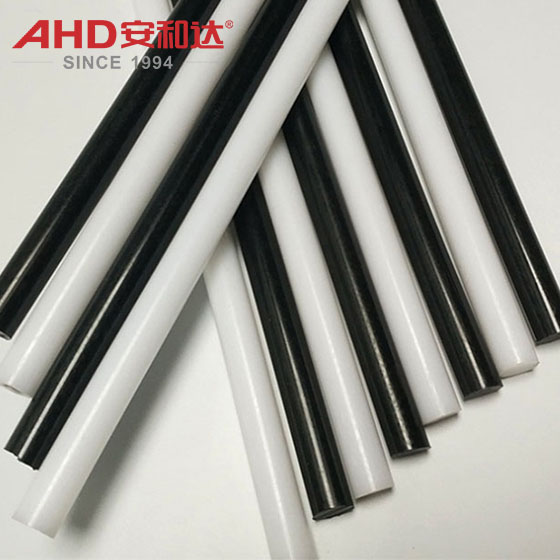
III. Anheda POM Sheets and Rods: 31 Years of Craftsmanship, Achieving a "Hidden Champion" in Precision Manufacturing
Anheda has consistently made POM sheets and rods as one of core products since its establishment in 1994. It has served over 5,000 customers, covering ten major precision manufacturing fields including automotive, electronics, medical, and aerospace. Our consistently high customer satisfaction over the years is inseparable from the following advantages:
1. Superior Raw Materials: Quality Control from the Source
Anheda uses 100% virgin materials to produce POM sheets and rods, rejecting the mixing of recycled materials, eliminating performance fluctuations from the source.
2. Exquisite Craftsmanship: 31 Years of Accumulated Production Wisdom
Relying on its independently developed integrated molding-extrusion production line, Anheda's POM sheets and rods have precise thickness and diameter tolerance control. A unique cooling process significantly reduces internal stress in the sheets, preventing warping and deformation after processing; the surface is smooth.
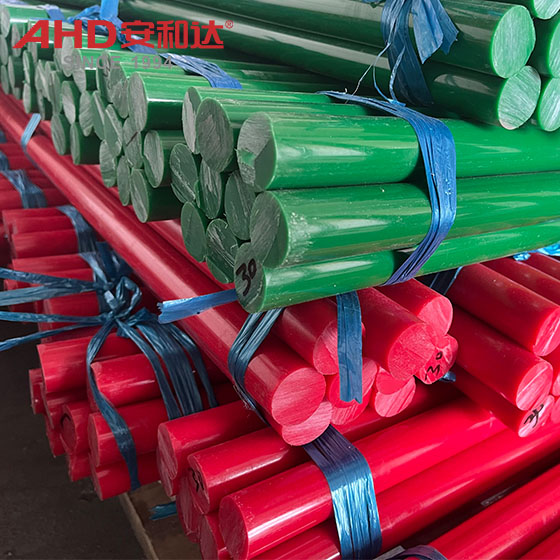
3. Service First: Full-cycle support from product to solution. Anheda not only provides standardized POM sheets and bars (thickness 1-250mm; diameter 8-500mm), but also customizes special specifications according to customer needs (such as anti-static POM, conductive POM). Our technical team has many years of industry experience and can provide comprehensive technical support. This has earned the satisfaction and repeat purchases of many buyers, and has led to the development of numerous distributors.
IV. Choosing POM is Choosing the "Future" of Precision Manufacturing
From the precise meshing of micro-gears to the silent rotation of bearings and the secure fixing of screws, POM, with its "all-around" performance, is reshaping the design logic of precision mechanical parts. It not only reduces the weight and cost of parts but also improves the reliability and lifespan of equipment, becoming an indispensable "basic material" in the era of intelligent manufacturing.
For 31 years, Anheda has firmly believed that high-quality materials are the starting point of precision manufacturing. We are committed to "making every POM sheet and bar carry trust," continuously investing in R&D and optimizing processes, all to provide customers with products that are "stable in performance, reasonably priced, and delivered on time." Whether it's prototype development for startups or mass production needs for industry leaders, Anheda is your trustworthy partner.
Choose POM, choose Anheda, and let's work together to drive the infinite possibilities of precision manufacturing through material innovation!
Anheda—31 Years of Focus on POM, Injecting "Strong and Resilient Genes" into Precision Machinery
