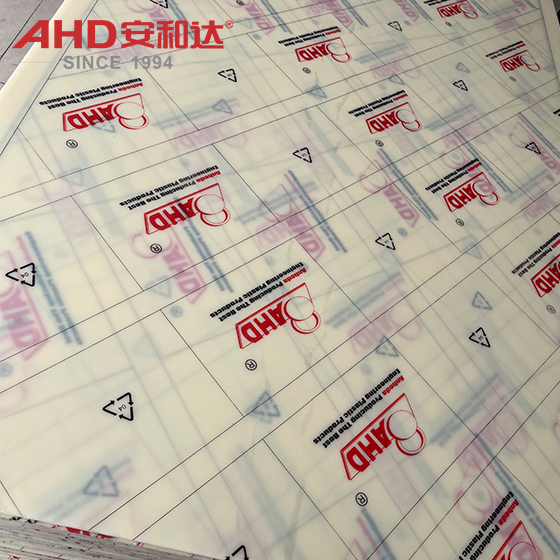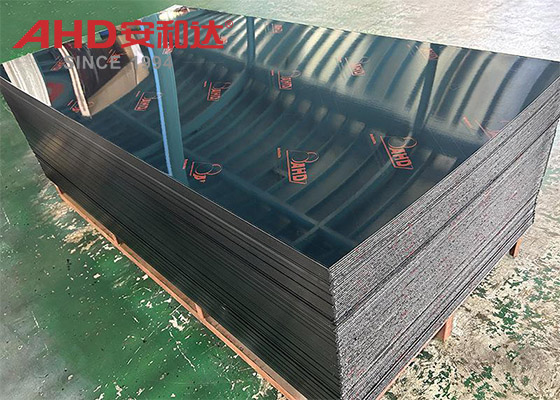
Ⅰ. Thinnest Thickness of ABS Sheets for Industrial Use
The thinnest industrially produced ABS (acrylonitrile-butadiene-styrene copolymer) sheet is typically 0.5mm. Some special processes (such as high-precision calendering) can achieve ultra-thin specifications of 0.3mm, but these products are only used in specific high-end applications (such as support layers for flexible electronic components) due to their high cost and susceptibility to deformation.
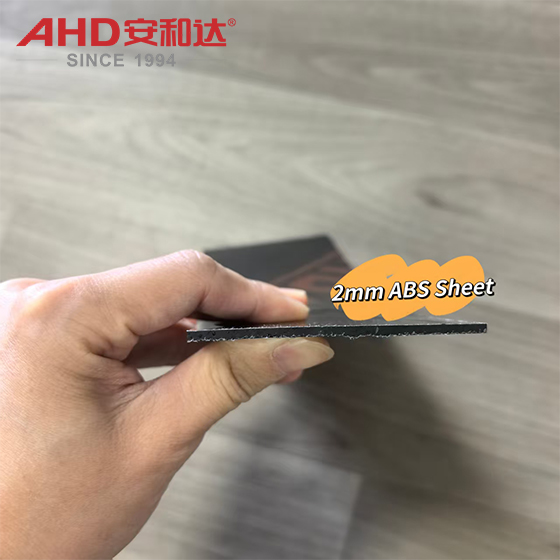
AHD 2mm ABS Sheet
1. Core Factors Influencing Thickness Limits
The thinnest thickness of ABS sheets is constrained by both the production process and material properties:
Production Processes:
Mainstream Extrusion (Continuous Production): Due to limitations in melt flow stability, the minimum mass-produced thickness is approximately 1mm (thicker thicknesses are prone to unevenness and surface ripples);
Calendar (Sheet Forming): Roll calendering can overcome extrusion limitations, achieving ultra-thin sheets of 0.5mm and below, but production volume is low and equipment investment is high;
Material Properties: The rigidity and impact resistance of ABS decrease significantly with decreasing thickness—0.3mm sheets are easily bent and deformed, suitable only for non-stressful applications.
2. The “Practical Thinnest Wire” for Industrial Applications
Although it is technically possible to achieve 0.3mm, the “effective thinnest wire” for industrial mass production is 0.8mm (balancing strength and processability).

Ⅱ. Why make thin ABS sheets? — Core driving force and value logic
The essence of producing ultra-thin ABS Plastic Sheet (mass-production grade ≤0.5mm) is to exchange "thickness reduction" for "increased application scenarios": by pushing the limits of materials and processes, it meets the extreme demands of specific fields for "lightness, thinness, flexibility, and precision," while simultaneously expanding the application boundaries of ABS sheets.
1. The "Essential Need" of Lightweighting and Space Constraints: The Inevitable Choice for Portable/Miniature Devices The primary value of ultra-thin ABS sheets lies in pushing "strength" and "lightweighting" to the extreme, making them suitable for scenarios sensitive to weight and volume.
Portable electronic devices: such as temporary support layers for flexible screen phones, miniature watch frames for smartwatches;
Aerospace miniature components: lightweight structural components for satellites or drones;
Medical auxiliary components: such as miniature sensor housings.
2. A Precision-Miniaturized "Functional Carrier": A Bridge Between Prototype and Mass Production The high flatness and ease of processing of ultra-thin ABS sheets (laser cutting/hot bending without cracks) make them a "testing ground" for miniature precision structures.
Electronic Prototype Development: Mobile phone manufacturers use ultra-thin ABS sheets to create prototype components for foldable screen hinges, verifying their opening and closing lifespan. Thicker sheets cannot simulate the stress distribution in real-world scenarios.
Models and Figurines: Joint connectors for anime figurines, achieving "movement without loosening."
3. "Extended Capabilities" of Special Processes: Matching Calendering with High-End Scenarios The mass production of ultra-thin ABS sheets relies on calendering. A "byproduct" of this process is superior surface quality (no extrusion marks) and more uniform thickness.
High-end decorative scenarios: such as 3D logo panels in luxury stores, where the surface can be "mirror-polished"; Flexible display components: Bendable lightbox panels in shopping malls, requiring shape adjustment to fit the curvature of the display stand, can be bent without creases thanks to calendering's ultra-thin sheets; Transparent electronic components: such as flexible display windows (0.5mm) made from transparent ABS sheets, used for status indicator panels in smart home appliances, maintaining transparency while bending to fit curved surfaces.

Ⅲ. The "Boundaries" of Ultra-Thin ABS Sheets: Thinner is not always better, but "suitability is key"
It should be clarified that the value of ultra-thin ABS Plate only holds true in "specific scenarios"—when the thickness is <0.8mm, the rigidity drops sharply, therefore it is only suitable for "non-stress/lightly stressed" scenarios.
Ⅳ. Common Industrial Applications of 2mm ABS Sheets
2mm is a medium-thickness ABS sheet, combining sufficient rigidity (resistance to bending deformation), lightweight (density approximately 1.05g/cm³), and ease of processing (can be cut, bent, bonded, and painted), making it the "most cost-effective general-purpose specification" in industry. Its typical applications can be divided into six categories:
1. Electronic Equipment: Prototypes and Lightweight Housings
Application Scenarios: Temporary protective cases for mobile phones/tablets, prototype instrument control panels, and the frame of small smart devices;
Advantages: 2mm thickness can withstand everyday scratches, is more than 50% lighter than metal housings, and can be quickly prototyped using CNC engraving.
2. Mechanical Manufacturing: Fixtures and Auxiliary Parts
Application Scenarios: Small positioning fixtures (such as temporary jigs for machine tool parts), gears/brackets (low-speed transmission scenarios), equipment operation signs;
Advantages: ABS' oil resistance and impact resistance are suitable for workshop environments, and 2mm thickness is sufficient to withstand light loads.
3. Advertising and Display: Low-Cost Molding Components
Application Scenarios: Decorative panels for shopping mall display stands, 3D lettering of company logos (back support), temporary partitions for exhibitions;
Advantages: Compared to acrylic (fragile), ABS' impact resistance is more suitable for outdoor/high-traffic areas, and a 2mm thickness allows for simple curved surface shaping through heat bending.
4. Models and Figurines: High-Precision Prototype Production
Application Scenarios: Shells for model airplanes/cars, joint connectors for anime figurines, detailed components for architectural models;
Advantages: The smooth surface of 2mm sheets is suitable for painting, and complex patterns (such as hollowed-out designs) can be achieved through laser cutting.
5. Automotive Interiors: Small Components and Trim Pieces
Application Scenarios: Door storage box covers, dashboard auxiliary panels, air vent deflectors;
Advantages: ABS's weather resistance meets automotive interior environmental requirements, and the 2mm thickness balances tactile feel and ease of assembly.
6. Protection and Isolation: Small Safety Devices
Application Scenarios: Small protective covers for machines (e.g., partial shielding for punch presses), observation windows for electrical cabinets (requires transparent ABS), reagent bottle holders in laboratories;
Advantages: The insulation properties of 2mm sheets (volume resistivity > 10¹⁶ Ω·cm) are suitable for electrical applications, and they can effectively block impacts from objects with a diameter > 5mm.
Ⅴ. Key Summary
2mm Core Value: A balance between strength, weight, and cost, representing a "universal" sheet specification in industry.
For further information on specific thickness tolerances of AHD ABS sheets or any data regarding the process parameters of 2mm sheets, please contact us.
AHD ABS Thin Sheet