The Essential Positioning of Two High-Performance Polymers
Polyetheretherketone (PEEK) and ultra-high molecular weight polyethylene (UHMWPE) are both specialty polymers that surpass ordinary plastics. However, due to differences in molecular design and performance characteristics, they have diverged into two distinct categories: "high-temperature toughness" and "ultra-wear-resistant and lightweight."
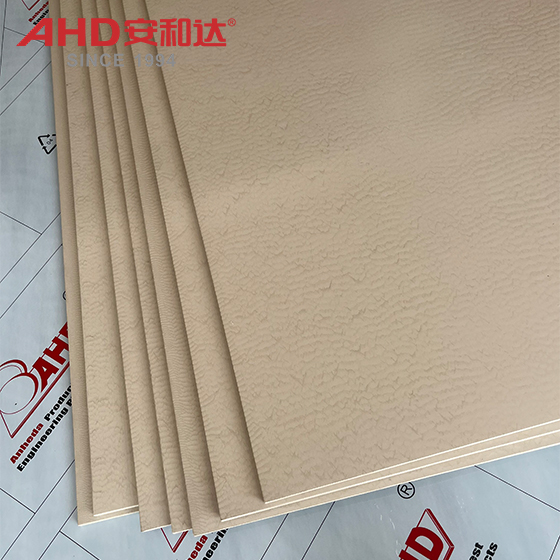
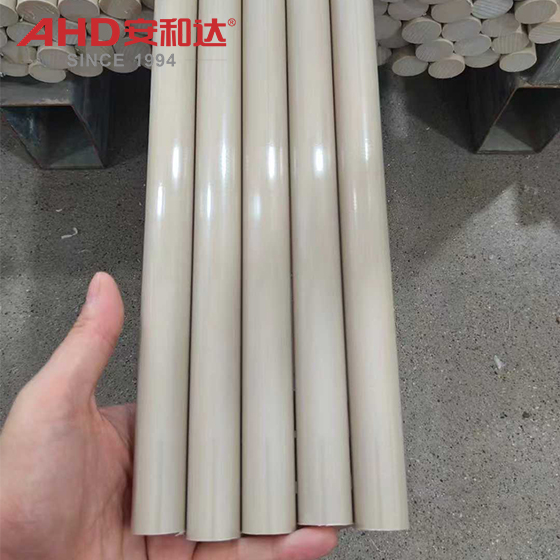
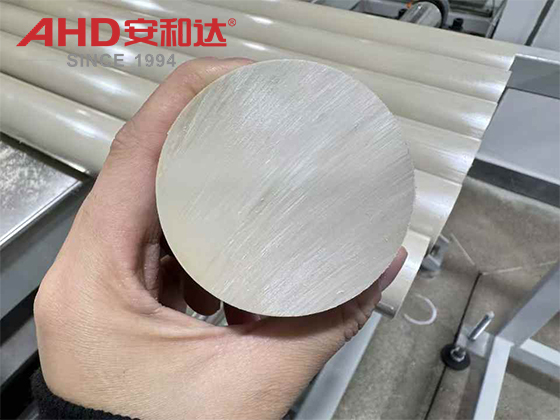
PEEK, with its melting point of 343℃, long-term temperature resistance of 250℃, and tensile strength of 150MPa, serves as the "structural framework" for extreme environments. AHD offers PEEK Sheet and PEEK Rod.
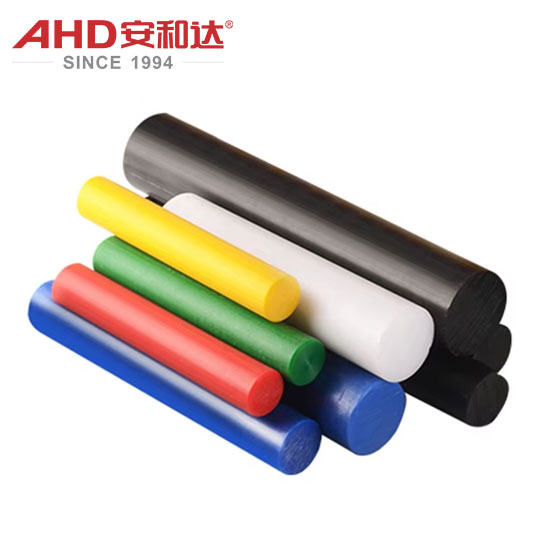
UHMWPE, with its molecular weight of 3-6 million, ultra-low coefficient of friction of 0.05, and wear rate of 10⁻⁸, occupies the "functional high ground" in wear resistance and biomedical applications. AHD offers UHMWPE Sheet and UHMWPE Rod.
Although both are "high-end materials," their complementary core properties allow them to jointly cover the needs of extreme scenarios ranging from aerospace to human implantation.

Basic Definition: The Essential Difference from Molecular to Attribute
(I) PEEK: Polyetheretherketone
Molecular Structure: An aromatic semi-crystalline polymer, the main chain is composed of alternating ether bonds (-O-), ketone bonds (-CO-), and benzene rings (repeating unit: -C₆H₄-O-C₆H₄-O-C₆H₄-CO-). The rigid aromatic rings impart high-temperature resistance, while the ether bonds provide toughness.
Basic Properties: Density 1.30-1.45 g/cm³ (slightly heavier than water), crystallinity 30%-40% (controllable by heat treatment), belonging to High Performance Engineering Plastics.
Commercial Background: First synthesized by Imperial Chemical Industries (ICI) in the UK in 1978, industrialized in the 1980s, and listed as a "strategic new material" in the 1990s due to the explosive demand from the aerospace industry.
(II) UHMWPE: Ultra-High Molecular Weight Polyethylene
Molecular Structure: A linear saturated hydrocarbon polymer with a molecular weight of 3 million to 6 million (compared to 50,000 to 300,000 for ordinary PE). Long molecular chains intertwine to form "physical cross-links," imparting ultra-high wear resistance and toughness.
Basic Properties: Density 0.92-0.94 g/cm³ (lighter than water, one of the lightest engineering plastics), crystallinity 50%-70% (high crystallinity improves rigidity), belonging to the ultra-high molecular weight polymer (UHMW Polymer).
Commercial Background: Developed by Karl Ziegler's team in Germany in the 1950s, and introduced into artificial joints by DePuy in the United States in the 1970s, initiating a revolution in biomedical applications.
Similarities: Common Characteristics of High-Performance Polymers
Although PEEK and UHMWPE are positioned differently, as "high-end materials that surpass ordinary plastics," they share the following core characteristics:
1. Excellent Biocompatibility
Both are non-toxic and non-allergenic, meeting the ISO 10993 biocompatibility standard:
PEEK is used in permanent implants (bone screws, etc.) because it is X-ray transparent (facilitating postoperative monitoring);
UHMWPE is used in artificial joint liners (hip/knee) because its low friction reduces bone wear.
2. Significant Lightweight Advantages
Their density is much lower than metals:
PEEK (1.3-1.45 g/cm³) is 40% lighter than aluminum;
UHMWPE (0.92-0.94 g/cm³) is 65% lighter than aluminum.
Replacing metals can achieve significant weight reduction and is widely used in aerospace and automotive industries.
3. Excellent Wear Resistance
Both are far superior to ordinary plastics (PP, ABS): PEEK wear rate 10⁻⁶ mm³/N·m (moderate); UHMWPE wear rate 10⁻⁸ mm³/N·m (extremely low, superior to ceramics), both capable of withstanding long-term friction scenarios (bearings, liners).
4. Good Chemical Stability
Both are resistant to acid and alkali corrosion: PEEK is resistant to almost all organic solvents except concentrated sulfuric acid and concentrated nitric acid (fuel oil, hydraulic oil); UHMWPE is resistant to strong acids and alkalis such as hydrochloric acid and sodium hydroxide, suitable for chemical pipeline linings.
5. Customization Potential
Both support machining (turning, milling, planing, grinding) and molding processes: PEEK can be injection molded and extruded; UHMWPE can be compression molded, sintered, and gel spun (for bulletproof fibers), meeting complex shape requirements (3D printed skull prostheses).
Interchangeable Scenarios and Limitations
PEEK and UHMWPE are not completely mutually exclusive. They can be used interchangeably to a limited extent under low load, normal temperature, and non-extreme environments. However, differences in core performance determine the limitations of substitution:
(I) Interchangeable Scenarios
Low-load, wear-resistant parts at normal temperature: Such as textile yarn guides and food conveyor rollers. Both meet low-friction requirements, but UHMWPE is more commonly used due to its lower cost.
Lightweight non-load-bearing structures: Such as electronic device housings and furniture accessories. Both can replace metal to reduce weight, but PEEK is more suitable for scenarios requiring strength due to its higher rigidity.
Unreplaceable core limitations
| Scenario Types | PEEK Advantages | UHMWPE Advantages | Reasons for Irreplaceability |
| High temperature environment (>150℃) | Long-term use: 250℃ (short-term: 300℃) | Only 80-100℃ (short-term: 120℃) | UHMWPE will soften and fail. |
| High load/high strength | Tensile strength 150-200MPa (carbon fiber reinforced) | Only 20-40MPa (pure resin) | UHMWPE cannot bear loads. |
| Ultra-wear resistant/low-friction | Friction coefficient 0.3-0.4 | Friction coefficient 0.05-0.1 (close to Teflon) | PEEK wear rate is 100 times that of UHMWPE |
| Biomedical-specific needs | Permanent implants (X-ray transparent) | Joint pads (low friction) | Irreplaceable function |
 AHD Ultra High Molecular Weight Polyethylene Sheet with Colors
Differences: Fundamental Differences from Properties to Applications
(I) Molecular Structure and Basic Properties
Molecular Structure
PEEK: Aromatic semi-crystalline (ether bond + ketone bond + benzene ring)
UHMWPE: Linear saturated hydrocarbon (molecular weight 3 million-6 million)
The aromatic rings of PEEK determine its high-temperature resistance, while the long molecular chains of UHMWPE determine its super toughness.
Key physical and mechanical properties
| Performance Metrics | PEEK | UHMWPE | Core Differences |
| Tensile Strength | High | Lower than PEEK | PEEK has high rigidity and is suitable for load-bearing; UHMWPE has priority in toughness. |
| Elongation at break | 30%-50% | 300%-500% | UHMWPE's impact resistance is 2-3 times that of PEEK. |
| Flexural modulus | 3.6-4.0 GPa | 0.7-1.5 GPa | PEEK is close to aluminum alloy (70 GPa), UHMWPE is close to rubber. |
| Melting Point/Heat Deflection Temperature | Melting point 343℃; Long-term 250℃ | Melting point 135-137℃; Long-term 80-100℃ | PEEK's temperature resistance is 2-3 times that of UHMWPE. |
| Coefficient of friction | 0.3-0.4 (dry); 0.1-0.2 (lubricated) | 0.05-0.1 (dry, similar to Teflon) | UHMWPE is the "King of Self-Lubricating Materials" |
| Wear Rate | 10⁻⁶ mm³/N·m (Medium) | 10⁻⁸ mm³/N·m (Extremely Low, Superior to Ceramic) | UHMWPE's wear resistance is more than 10 times that of steel. |
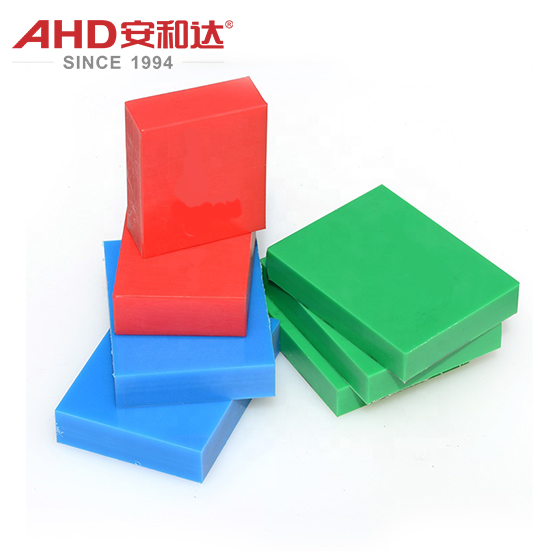
AHD UPE Sheet
Application Scenarios
1. PEEK: Dominant Applications of "High Temperature and Toughness"
Aerospace: Engine bearing cages (resistant to 250℃ fuel), aircraft seat supports;
Medical & Healthcare: Spinal fusion devices (X-ray transparent), surgical instruments (resistant to 134℃ steam sterilization);
Electronics & Electrical: 5G high-frequency connectors (low dielectric loss), semiconductor wafer clamps (resistant to plasma corrosion).
2. UHMWPE: Irreplaceable Applications of "Ultra-Wear-Resistant and Lightweight"
Wear-Resistant Transmission: Mining rollers, port grab bucket liners (low friction and wear reduction);
Medical Implants: Artificial joint pads, dental abutments (bio-inert);
Specialty Industries: Bulletproof vest fibers, food freezing films (non-toxic and low-temperature resistant).
Summary: The Core Logic of Selection
The essential difference between PEEK and UHMWPE lies in the "division of performance characteristics":
Choosing PEEK: Requires high temperature (>150℃), high strength, and resistance to chemical corrosion (aerospace, medical implants, electronics);
Choosing UHMWPE: Requires ultra-wear resistance, low friction, and lightweight (artificial joints, mining machinery, bulletproof vests).
The similarity between the two lies in the "common characteristics of high-end materials." Substitutability only exists in peripheral scenarios with non-core needs—true selection is always the result of "performance matching the scenario."
AHD UHMW Polyethylene Rods