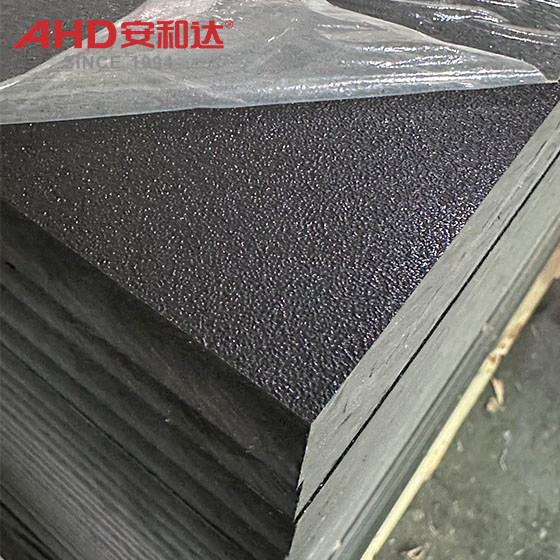
PE embossing is a processing technique that creates three-dimensional textures on the surface of PE sheets through hot pressing. It is widely used in decoration, packaging, and building materials. The following is a detailed introduction to the process, including its principles, equipment composition, process parameters, common problems, and solutions.
Ⅰ. Embossing Process Principle
The core principle of PE embossing is to apply pressure and heat to the surface of the PE Sheet (like HDPE Sheet) using heated embossing rollers. This softens the PE material, causing it to form a raised or recessed texture that matches the pattern on the roller's surface. PE material has good plasticity within a temperature range of 140-180℃. When it reaches its softening point, it begins to sag. At this point, the pressure from the embossing rollers creates a clear three-dimensional pattern on the surface.
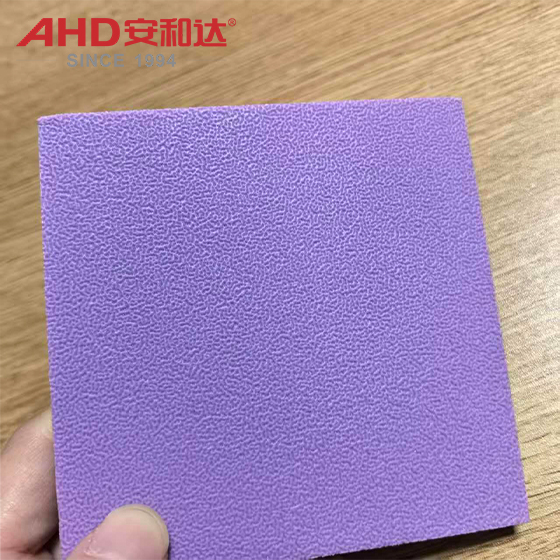
Now we'll look at the traditional embossing process. It's widely used due to its high efficiency and low cost. It's mainly produced through an integrated extrusion and embossing process. The core is that during the Polyethylene Sheet extrusion molding process, textured rollers are used to directly imprint the pattern onto the sheet surface. Here are the detailed process steps:
Ⅱ. Core Process: Extrusion + Online Embossing
The texture on the PE sheet(like HDPE Plastic Sheet) is directly imprinted and simultaneously shaped by an embossing roller assembly after the sheet has melted and extruded but before it has completely cooled and solidified. This is a "continuous online processing" process, commonly seen in HDPE (high-density polyethylene) textured sheets, anti-slip PE sheets, and other products.
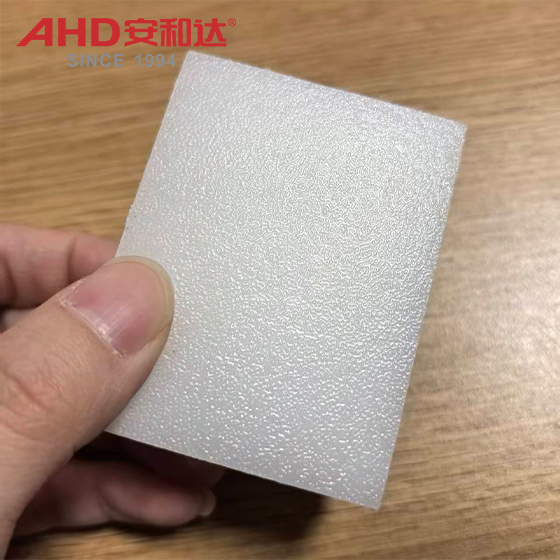
Ⅲ. Detailed Process Steps
1. Raw Material Preparation and Extrusion Plasticization
Raw Material Mixing: Mix PE granules (such as HDPE) with masterbatch, antioxidants, and other additives in a specific ratio until homogeneous.
Melt Extrusion: Feed the mixed raw materials into the extruder barrel. Through external heating of the barrel (temperature 160-190℃) and screw shearing, the PE(or HDPE) is completely melted and plasticized, forming a homogeneous melt. The melt is then extruded through a die (such as a flat die) into a continuous sheet shape (at this point, the sheet is in a semi-molten, plastic state).
2. Online Embossing (Core Step)
After extrusion of the PE sheet, before it fully cools (temperature approximately 60-80℃, cell structure initially stable but still malleable), the embossing rollers imprint the pattern:
Embossing Roller Design:
Driven Roller: A metal roller with an engraved pattern, typically 0.1-0.5mm deep;
Driven Roller: An elastic roller made of silicone/rubber (hardness 60-70 Shore A), used to apply pressure in conjunction with the driven roller.
Embossing Process: The PE sheet passes between the two rollers at a stable speed (synchronized with the extrusion/traction speed). The pressure between the rollers is adjusted (0.3-0.8MPa) via a pneumatic/hydraulic system, imprinting the pattern from the driven roller onto the PE sheet surface.
Precise pressure control is crucial: too low a pressure results in a blurred pattern, while too high a pressure will crush the PE structure, causing the sheet to harden or crack.
3. Cooling and Shaping
The embossed sheet immediately enters a cooling system (such as cooling rollers/cooling water tank) to rapidly cool the PE (to room temperature), fixing the embossed pattern and preventing it from springing back and disappearing.
4. Cutting and Post-processing
The cooled continuous sheet is cut and trimmed to the required dimensions, ultimately obtaining a PE sheet with surface texture.
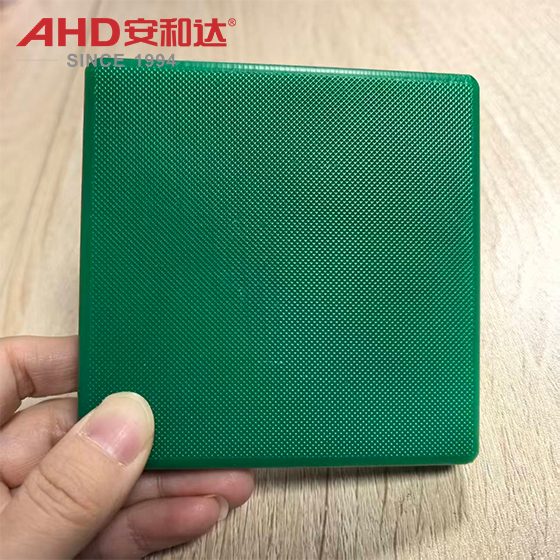
AHD PE Sheet Rouhg Suface
Ⅲ. Process Characteristics
High Efficiency: Extrusion and embossing are completed simultaneously, requiring no additional steps;
Stable Texture: Imprinting is done directly on the semi-molten PE surface, resulting in a tight bond between the texture and the sheet material, preventing it from easily falling off;
Low Cost: Continuous production, suitable for large-scale manufacturing.
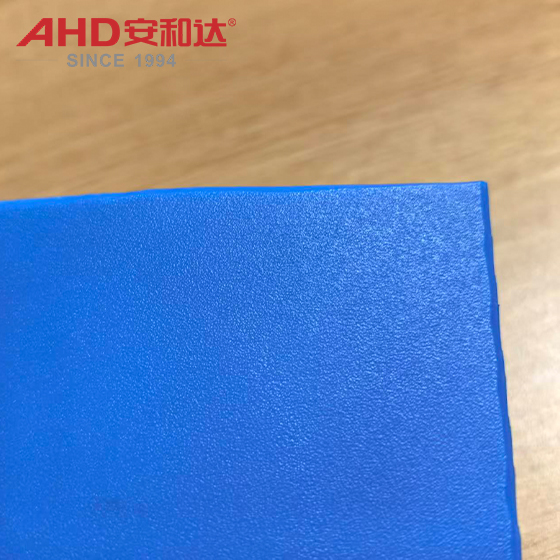
Ⅳ. Does the embossing process affect the performance of PE boards?
There's absolutely no need to worry.
1. Changes in Physical Properties
Slight Increase in Surface Hardness
During the embossing process, the molecular chains on the surface of the PE sheet are "compacted" under the pressure of the rollers (especially in the recessed areas of the texture), resulting in a slightly higher surface density than the unembossed areas. Therefore, the surface hardness increases (but the overall hardness/rigidity of the sheet remains essentially unchanged).
Stable Tensile Strength/Elongation at Break
Embossing is a form of "surface deformation," which does not alter the overall molecular chain arrangement of the PE sheet. Therefore, the longitudinal/transverse tensile strength, elongation at break, and other mechanical properties of the sheet remain almost unchanged.
Increased Surface Roughness and Increased Coefficient of Friction
After embossing, the surface changes from smooth to textured, and the surface roughness Ra value increases from approximately 0.2μm to 1-5μm (depending on the texture depth). This corresponds to increase the static/dynamic coefficient of friction, making it more suitable for anti-slip applications.
2. Impact on Performance
Enhanced Slip Resistance
The textured surface increases the "interlocking" effect of the contact surface, especially in wet/oily environments, where the slip resistance is significantly improved compared to smooth PE boards (commonly used for pallets and work surfaces).
Improved Scratch Resistance
The compacted textured areas are more wear-resistant than smooth PE, and minor scratches (such as from small stones or tool friction) are less likely to leave noticeable marks; however, if the texture is too deep, the recessed areas are more prone to accumulating dust/dirt, making cleaning slightly more difficult.
Optimized Impact Resistance (Local Surface)
The textured "undulating structure" can disperse localized impact force, improving the surface's resistance to point impacts (such as small heavy objects falling); however, the overall impact resistance of the board (such as bending or large-area impacts) remains unchanged.
3. Impact on Appearance and Processing Performance
Improved Appearance and Texture
Texture adds visual depth to the board (avoiding the plasticky feel of smooth PE). The texture style can be adjusted (e.g., lychee texture, frosted texture) to suit different aesthetic needs.
Subsequent Processing (e.g., Bonding) Requires Pre-treatment
If subsequent bonding of PE boards is required, the "unevenness" of the textured surface increases the adhesive contact area, resulting in a 10%-30% higher bonding strength compared to smooth boards. However, for hot-melt welding, the texture has no significant impact on welding strength.
Overall, embossing primarily optimizes the surface functionality of PE boards (anti-slip, wear-resistant) with almost no negative impact on core mechanical properties. It is a commonly used process to enhance the practical value of PE boards.
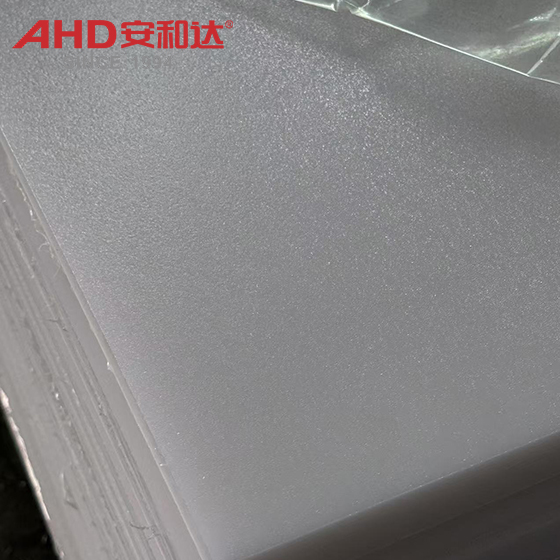
AHD PE Sheet Rough Surface
PE embossing is a key processing method to enhance the functionality and appearance of PE boards. Mainstream processes include online extrusion embossing, hot embossing, and compression molding. Among these, the integrated extrusion + embossing process has become the core solution for mass-producing textured PE boards due to its continuous efficiency and low cost. Embossing primarily optimizes the anti-slip properties and surface abrasion resistance of PE boards, with minimal impact on the core mechanical properties of the board. It is a mature technology that balances practical value and production efficiency.
With 31 years of experience in plastic sheet manufacturing and mature extrusion embossing technology, AHD can reliably produce PE sheets of various thicknesses, colors, and uniform, fine textures. While maintaining the original corrosion resistance and impact resistance of PE sheets, surface embossing enhances their anti-slip and wear resistance. AHD offers reliable quality and efficient delivery.Contact us now!