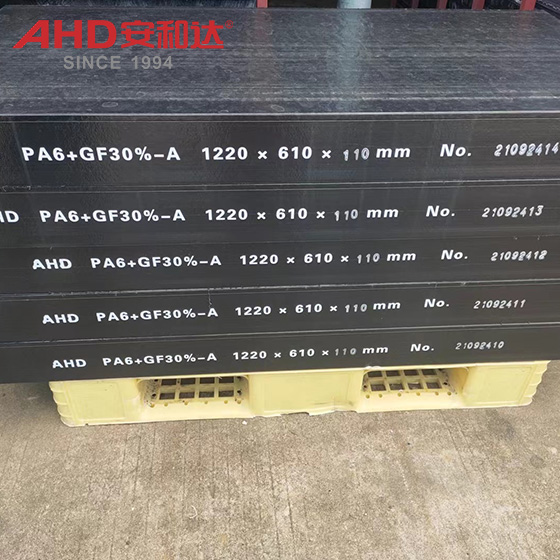
PA6 nylon + 30% glass fiber (often referred to in the industry as PA6+30%GF) is a glass fiber reinforced modified engineering plastic made by melt blending and extrusion granulation of polyamide 6 (PA6, also known as nylon 6) resin with 30% glass fiber as a reinforcing filler. It is one of the most widely used specifications among nylon modified materials. The core is to use glass fiber reinforcement to make up for the shortcomings of pure PA6 in terms of insufficient mechanical properties and poor dimensional stability, while retaining the basic characteristics of nylon 6 itself.
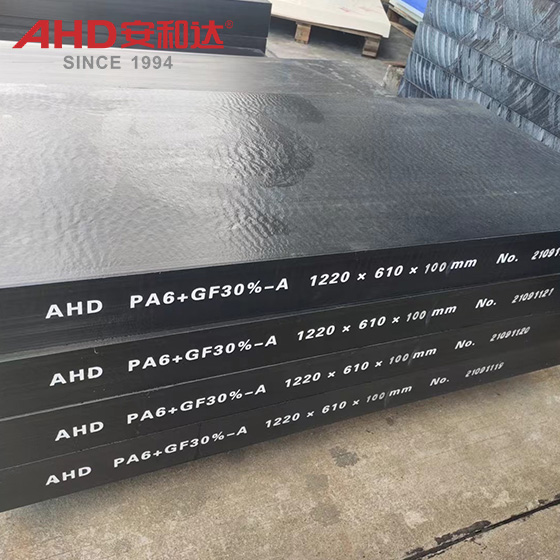
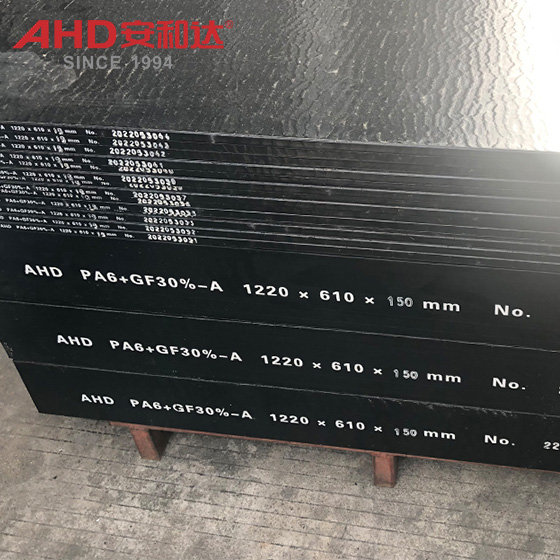
AHD 30% Glass Fiber + PA6 Sheet
Core Components and Modification
Matrix Material: PA6 Nylon
Pure PA6 is a crystalline polyamide engineering plastic with good inherent toughness, oil resistance, wear resistance, and processability. However, it suffers from low rigidity, moderate tensile/flexural strength, easy deformation at high temperatures, and poor dimensional stability after water absorption, limiting its application in structural and load-bearing components.
Reinforcing Filler: 30% Glass Fiber
The selected glass fibers are mostly chopped glass fibers, which, after treatment with a coupling agent, can tightly bond with the PA6 resin, preventing the glass fibers from delaminating from the matrix. 30% is the industry's golden ratio—below this ratio, the reinforcing effect is not significant; above this ratio, it leads to decreased material toughness, wear on the mold during processing, and increased molding difficulty.
Core Modification: Glass fiber forms a "network support structure" in the PA6 matrix, bearing the main load-bearing load, thereby significantly improving the material's mechanical and thermal properties, while reducing water absorption and molding shrinkage, and optimizing dimensional stability.
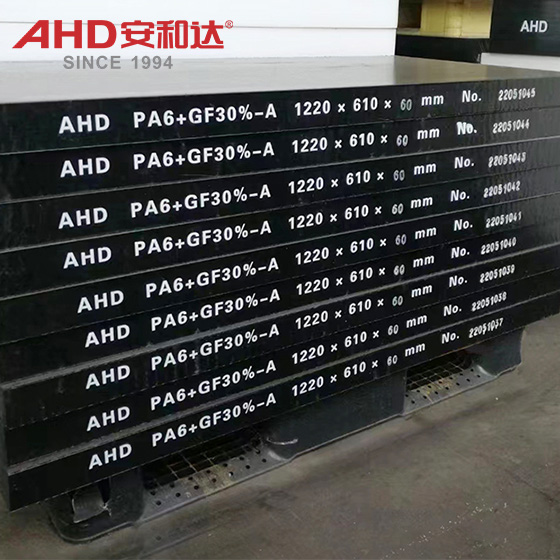
PA6+30% GF: Core Performance Improvement Compared to Pure PA6
This is the core value of this modified material and the key to its mainstream status. Below is a direct comparison of its core performance (common grades):
| Performance Indicators | Pure PA6 | PA6 + 30%GF | Change |
| Tensile strength: | ≈60-70MPa | ≈150-170MPa | Increase |
| Bending strength | ≈90-100MPa | ≈220-250MPa | Increase |
| Heat distortion temperature (HDT) | ≈60-70℃ (unannealed) | ≈210-220℃ | Increase |
| Molding shrinkage rate: | ≈1.5-2.5% | ≈0.3-0.8% | Reduced |
| Elastic modulus | ≈2.5GPa | ≈7-8GPa | Increase |
| Water absorption rate (24h) | ≈3.5% | ≈1.8% | Decrease |
Note: Toughness is slightly reduced (notched impact strength decreases from approximately 50 kJ/m² to approximately 10-15 kJ/m² for pure PA6), but it can still meet the impact resistance requirements of most structural components. Some grades can compensate for the toughness loss through toughening modification.
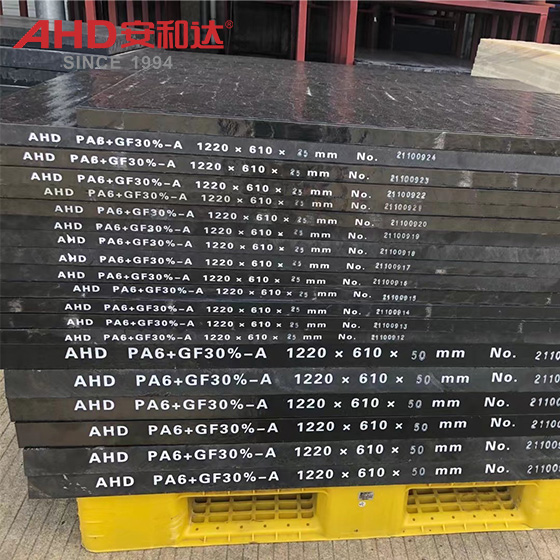
Retained Core Properties
PA6+GF30 Nylon Plate retains the core advantages of Nylon 6 despite glass fiber reinforcement, still possessing:
Good oil resistance and chemical corrosion resistance (resistant to alcohols, esters, and hydrocarbons, but not resistant to strong acids and alkalis);
Excellent wear resistance and self-lubricating properties, capable of replacing some metals in wear-resistant bushings and gears;
Good injection molding processability, capable of molding complex structural parts, with good demolding properties;
Decent low-temperature resistance (ordinary grades maintain toughness at -20℃, modified grades can reach -40℃).
Key Processing and Usage Precautions PA6+GF30 Nylon Plastic Sheet
Drying Before Processing is Essential: Although the water absorption rate is reduced, it is still a hygroscopic material and needs to be dried at 80-90℃ for 4-6 hours. Otherwise, bubbles, silver streaks, and cracks may occur during molding.
Mold and Equipment Requirements: Fiberglass will wear down the screw, barrel, and mold. Wear-resistant alloy materials must be used for processing parts. The mold gate should be designed to be short and thick to reduce fiberglass shear breakage.
Post-Molding Characteristics: The product exhibits fiberglass orientation, with higher strength along the flow direction and slightly weaker in the perpendicular direction. The direction of force must be considered during design. "Exposed fiberglass" (floating fibers) may appear on the surface, which can be improved by polishing the mold and adjusting processing parameters.
Post-Processing: Slight dimensional changes may still occur after water absorption. Precision parts require humidification treatment in the usage environment to ensure dimensional stability.
Typical Application Areas
Due to its comprehensive properties of high rigidity, high strength, high temperature resistance, and dimensional stability, PA6+30% GF is widely used in structural load-bearing components in industries such as automotive, electronics, machinery manufacturing, and rail transportation. It is a preferred material to replace cast iron, die-cast aluminum, and ordinary plastics. Typical products include:
Automotive: Engine peripheral components (intake manifold, oil pan guard), chassis components (suspension brackets, control arms), interior structural components (seat frames, door panel brackets);
Electronics: Connector housings, relay bases, motor end covers, charging pile structural components;
Machinery Manufacturing: Gears, racks, bearing housings, conveyor belt scrapers, fasteners;
Others: Power tool housings/accessories, drone frames, bathroom hardware structural components.
Simple Distinction from Other Glass Fiber Reinforced Nylons
Often compared with PA66+30% GF, these two are the two mainstream glass fiber reinforced nylons. The core differences are:
PA6+30% GF: Lower melting point (around 220℃), better processing fluidity, slightly better toughness, lower cost, suitable for parts with medium to low temperatures and moderate stress;
PA66+30% GF: Higher melting point (around 260℃), better thermal stability, temperature resistance, and rigidity, lower water absorption, suitable for harsh working conditions with high temperature and high stress, slightly higher cost.