AHD Professional Guide: Compliance Assessment Methods for PA Nylon Sheets
To determine whether the mechanical properties of PA nylon sheets meet usage requirements, the core principle follows a three-tiered assessment logic: first, check standard parameters; second, conduct testing and verification; and finally, combine this with real-world scenario testing. Based on Anheda's 31 years of production and quality control experience, this approach covers three aspects: verification of factory documentation, professional laboratory testing, and on-site practical verification. It allows for quick initial assessment using official data provided by the manufacturer, as well as precise verification through professional testing or simple practical exercises. This method is suitable for all stages, including procurement acceptance, incoming material inspection, and scenario-based trials, ensuring that the mechanical properties of the nylon sheets match actual working conditions.
The following assessment methods cover the core mechanical properties of PA Nylon Plastic Sheet (tensile, impact, bending, hardness, and abrasion resistance), balancing professionalism and practicality. Ordinary industrial enterprises without specialized equipment can complete basic verification. For high-precision scenarios, third-party testing can be used for authoritative assessment.
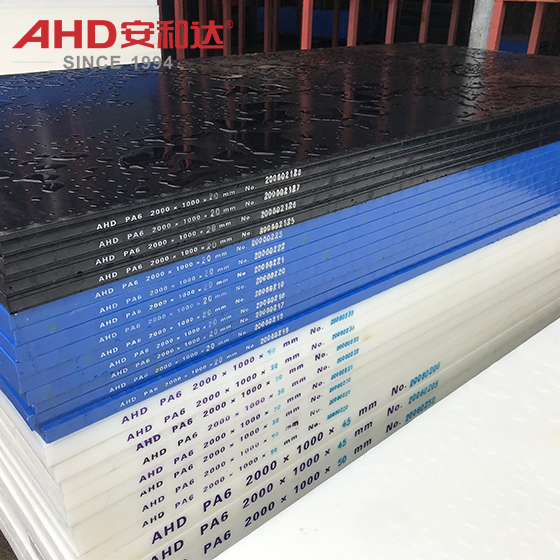
AHD PA6 Nylon Plat
Initial Assessment: Verifying Manufacturer's Documentation and Matching Standards with Requirements
The procurement and acceptance phase requires no complex procedures. An initial assessment of mechanical properties can be completed using the manufacturer's quality inspection report, material certificate, and product specifications. Three key points are crucial for this assessment:
1. Verify the performance parameters' compliance with national/industry standards.
| Performance Indicators | Testing Standards | Nylon PA6 Sheet (National Standard Compliance Value) | PA Nylon66 Sheet (National Standard Compliance Value) |
| Tensile Strength | GB/T 1040.2 | ≥60MPa | ≥70MPa |
| Elongation at break | GB/T 1040.2 | ≥200% | ≥150% |
| Bending strength | GB/T 9341 | ≥90MPa | ≥100MPa |
| Impact strength of cantilever beam (unnotched) | GB/T 1843 | ≥50kJ/m² | ≥40kJ/m² |
| Rockwell Hardness (R grade) | GB/T 9342 | ≥100 | ≥110 |
Note: Modified versions (such as those with added glass fiber or MoS2) will have different properties. For example, the tensile/flexural strength of glass fiber (GF30) PA6/PA66 will increase by 50%-80%, but the impact strength and elongation at break will decrease slightly. Manufacturers need to provide test reports specific to modified versions, not data for general versions.
2. Verify the compatibility of parameters with your usage needs.
National standards are only basic compliance lines. Actual judgment should be based on the specific operating conditions, not simply on whether the national standard is met:
Impact and vibration scenarios (e.g., buffer blocks, gears): Focus on the cantilever beam impact strength (without notches), which should be ≥45kJ/m² (PA6)/≥35kJ/m² (PA66). Higher values indicate better toughness.
High-pressure load-bearing scenarios (e.g., guide rails, load-bearing components): Focus on tensile strength and flexural strength. PA6 should be ≥65MPa/≥95MPa, and PA66 should be ≥75MPa/≥105MPa. Glass fiber reinforced versions require even higher strength.
Sliding friction scenarios (e.g., bushings, gaskets): In addition to wear resistance, hardness must meet standards (PA6 ≥100HRR, PA66 ≥110HRR). Insufficient hardness can lead to deformation and premature wear.
3. Verify the authenticity and validity of the report
The report must indicate the production batch, product specifications (thickness/material/modification type), and testing date, and must be consistent with the information of the purchased product to avoid "one report for all batches";
Reputable manufacturers (such as AHD) will provide testing reports for each batch, not just a single general report, and the report must be signed by the testing personnel and reviewers, as well as the manufacturer's quality inspection stamp;
For high-requirement scenarios, manufacturers can be requested to provide third-party testing reports (such as those issued by SGS or CNAS certification bodies), which provide more authoritative data.
Precise Assessment: Professional Laboratory Testing for Quantitative Performance Measurement (Essential for High-Precision Applications)
1. For high-precision machinery, high-load operating conditions, and bulk purchases, precise assessment of mechanical properties is required through professional laboratory testing. The core testing covers five key mechanical properties of PA nylon sheets. During testing, attention must be paid to sample preparation specifications (cut according to national standards to avoid data distortion due to sample deviation).
2. Specialized Testing for Modified Versions
Modified PA nylon sheets require additional testing of the modified component content to prevent manufacturers from falsely labeling the modification ratio (e.g., labeling GF30 but actually only containing GF20), leading to substandard mechanical properties:
Glass Fiber Reinforced Versions: Glass fiber content is tested using the ignition method. A deviation of ≤3% between the measured content and the labeled value is considered合格 (qualified).
MoS2/Graphite Reinforced Versions: The distribution of modified components is tested using energy dispersive spectroscopy (EDS). Uniformity and absence of agglomeration are required; otherwise, local performance imbalances may occur (e.g., poor local wear resistance, easy cracking).
3. Environmental Simulation Testing (Adapted to Special Working Conditions)
If the nylon sheet is used in high-temperature, low-temperature, or humid environments, environmental simulation testing is required to determine its mechanical properties and performance stability:
High-temperature environment (>80℃): Place the sample in a high-temperature chamber for 24 hours, and then test the tensile/impact strength after cooling.
Low-temperature environment (<-20℃): Place the sample in a low-temperature chamber for 24 hours and test the impact strength.
Humid environment: Immerse the sample in distilled water at 23℃ for 24 hours, and then test the dimensional change rate and tensile strength.
Practical Judgment: Simple On-Site Testing for Rapid Verification
For ordinary industrial enterprises lacking laboratory testing equipment, simple on-site practical tests can quickly verify whether the mechanical properties of PA nylon sheets meet the requirements of the application scenario. Although numerical values cannot be quantified, core properties such as toughness, rigidity, and hardness can be intuitively assessed. This method is suitable for initial material inspection and small-batch trial use. Core testing methods:
1. Toughness/Impact Resistance Test
Simple Impact Test: Gently tap the nylon sheet sample (thickness ≥ 10mm) with a hammer. No cracking or chipping, only slight dent, indicates a passing grade. Cracks or chipping indicate insufficient impact strength and poor toughness.
Bending Test: Manually bend a thin nylon sheet (thickness ≤ 5mm) to 90°. No cracking or whitening indicates a passing grade. Severe whitening or cracking indicates low elongation at break and insufficient toughness (glass fiber reinforced sheets should not be bent as they are brittle and prone to cracking).
2. Rigidity/Compression Test
Hand Pressure Test: Press the center of the nylon sheet (length and width ≥ 100mm, thickness ≥ 10mm) with your hand. No obvious deformation and rapid rebound are expected. If a significant dent appears and the sheet does not rebound, it indicates low bending strength and insufficient rigidity.
Heavy Load Test: Place a heavy object equivalent to the operating load on the nylon sheet. After 24 hours, no obvious deformation is expected. Large deformation indicates poor compression resistance and unsuitability for load-bearing applications.
3. Hardness/Abrasion Resistance Test
Hardness Comparison: Lightly scratch the surface of the nylon sheet with a metal part of known hardness (e.g., a screwdriver). No obvious scratches are expected. Deep scratches indicate insufficient hardness and easy wear.
Simple Abrasion Resistance Test: Rub the nylon sheet against a metal part 100 times. No obvious abrasion marks or powder are expected on the nylon sheet surface. Deep abrasion marks and severe powdering indicate poor abrasion resistance.
4. Appearance-Based Judgment
Appearance defects directly affect mechanical properties. On-site visual inspection can indirectly determine these defects. If the following defects are present, the mechanical properties are highly likely to be substandard:
Surface bubbles, pinholes, or delamination: These will cause a significant decrease in localized tensile/impact strength, making the material prone to cracking at stress points;
Uneven color or obvious grain: This indicates uneven mixing of raw materials or poor processing techniques, leading to uneven performance distribution;
Edge chipping or missing corners: This indicates high brittleness and insufficient impact strength of the board.
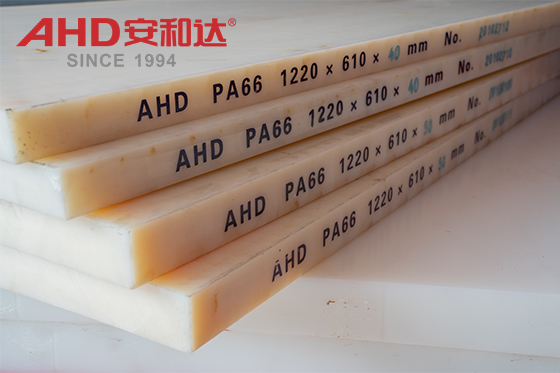
Anheda PA Nylon Sheet Quality Control Assurance
Anheda has been deeply involved in PA nylon sheet production for 31 years, establishing a comprehensive quality control system to ensure that the mechanical properties of every batch of products meet standards and remain stable:
Raw Material Side: We use only pure virgin materials, rejecting recycled materials to guarantee the fundamental mechanical properties from the source;
Production Side: We employ precise extrusion/casting processes, strictly controlling processing temperature and speed to avoid performance degradation due to process defects;
Testing Side: Equipped with a professional laboratory, each batch of products undergoes core performance tests such as tensile strength, impact resistance, and hardness, providing test reports. For high-requirement scenarios, third-party testing reports are available.