

In the selection process of plastic materials, we often see two sets of parallel data—ISO and ASTM—which come from different testing standards: the International Organization for Standardization (ISO) and the American Society for Testing and Materials (ASTM).
Many engineers, when comparing material property tables, most frequently ask: "Both measure tensile strength; which is better, ISO's 50 MPa or ASTM's 55 MPa?" The answer is, unfortunately, that they cannot be directly compared, and sometimes conversion is impossible.

Why can't data that "look similar" be compared?
Although ISO and ASTM measure properties with the same names, such as impact strength and flexural modulus, the different "variables" in the measurement process make the final results seem like measuring with a "metric ruler" and a "stretched imperial ruler"—the values cannot be simply compared.
Key differences:
Specimen shape and size: Even with the same material, a long strip and a dumbbell shape will exhibit completely different strengths under stress. ISO standard specimens are usually thicker or longer than ASTM specimens.
Testing speed: Polymer materials are viscoelastic. If you stretch them quickly, they become more brittle and stronger; if you stretch them slowly, they become more resilient. There are often subtle differences in the "tensile speed" specifications between ISO and ASTM.
Environmental pretreatment: Should the material be placed at 23°C and 50% humidity for 24 hours or 48 hours? How much temperature deviation is allowed during testing? These subtle environmental differences can significantly change the test results.
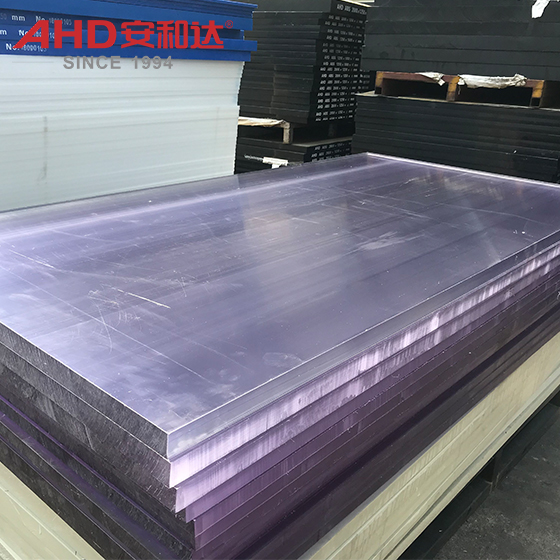

Highly impact-resistant PC Sheet
Typical Cases
Case 1: Cantilever Beam Impact Strength (LZOD Impact)
This is the test most prone to misunderstanding.
Izod impact strength Test
| Difference Items | ASTM D256 | ISO 180 |
| Specimen Thickness | Typically 3.2 mm (1/8 inch) | Typically 4mm |
| Notch Shape | Relatively fixed | Available in Type A and Type B |
| Result Units | J/m (energy/sample width) | k/m² (energy/cross-sectional area) |
ASTM measures energy per unit width, while ISO measures energy per unit area. Although the units can be converted mathematically, the resulting values still lack academic equivalence due to the different internal stress states caused by the sample thickness.
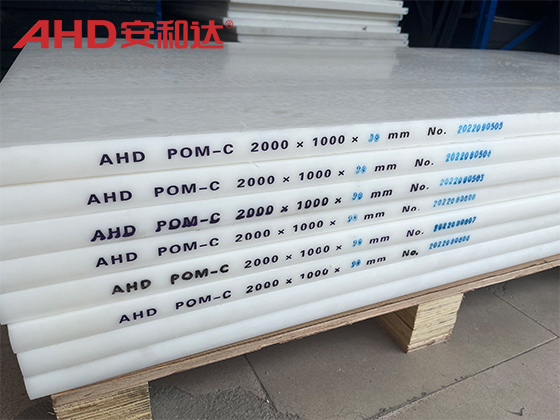
POM Sheet that perform well in "Elongation at break" tests
Case 2: Tensile Properties
You might think that "breaking force" is comparable, right? Actually, no.
Difference: Testing Speed
ASTM D638: Allows a wider range of testing speeds and has specific recommended speeds for materials with different moduli.
ISO 527 specifies extremely stringent speed requirements. Particularly when measuring "tensile modulus," ISO requires measurement via an extensometer at extremely low speeds (typically 1 mm/min).
Because plastics exhibit significant strain rate sensitivity, if you use a faster ASTM speed, the obtained strength data will generally be higher than the slower ISO data.
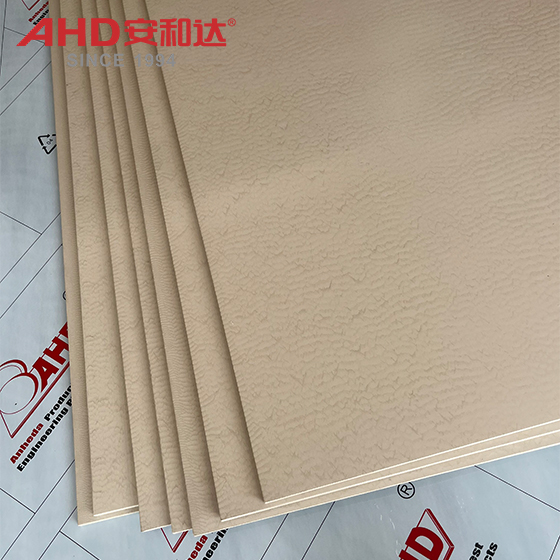
PEEK sheet, an excellent heat-resistant material
A Guide to Avoiding Pitfalls for Engineers
If you are selecting materials or exploring alternatives, please follow these principles:
1. Compare within the same system: Always prioritize comparisons within the same standard system, such as comparing ISO values with other ISO values.
2. Look for "dual-standard" property tables: Many large international manufacturers (such as DuPont and BASF) will list both test results; this is the safest reference.
3. Focus on trends, not absolute values: If material A is 20% stronger than material B under ASTM standards, then material A is usually better under ISO standards as well. Although numerical values cannot be directly converted, the ranking of performance superiority is usually consistent.
4. Pay attention to units: Especially for impact strength and heat distortion temperature, be sure to check whether the suffix is kJ/m² or J/m.
In summary,
ISO and ASTM represent two different sets of "rules of the game." While both describe material properties, differences in testing tools, specimen sizes, and stress logic create gaps in the data.
In research and development and design, forcibly substituting ASTM data into simulation calculations requiring ISO standards may lead to over-design or premature failure of the product structure.