

Beyond 180°C: Are there other substrate materials for magnetic components besides PPS?
The Cornerstone of Magnetic Performance: Key Parameters and Material Selection Logic
Understanding material selection requires starting with the core parameters of magnetic properties.
Coercivity, especially intrinsic coercivity (Hcj), is crucial for measuring the demagnetization resistance of permanent magnet materials. This parameter directly affects the stability of the material at high temperatures or in reverse magnetic fields. Generally, coercivity decreases with increasing temperature.
Magnetic energy product (BH), especially the maximum magnetic energy product (BHmax), represents the magnetic energy density stored per unit volume of the magnet and is one of the core indicators for measuring the strength of a material's magnetic properties. As shown in the figure below, the range of magnetic energy products varies significantly among different permanent magnet materials; the magnetic energy product of injection-molded magnets is typically lower than that of sintered magnets.
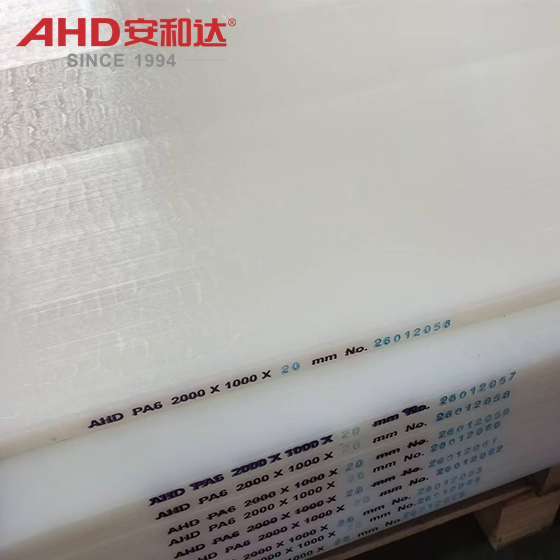
AHD PA6 Sheet White
In the field of magnetic plastics (bonded magnets), three main thermoplastic resin matrices are commonly used: PA6, PA12, and PPS. The choice between them depends primarily on the operating temperature and environment:
PA6: Lower cost, but long-term operating temperature is typically below 150°C.
PA12: Improves the low-temperature toughness of PA6, with a maximum operating temperature of approximately 120°C. It solves the low-temperature brittleness problem.
PPS: When the operating temperature exceeds 180°C, its flow properties are excellent. Besides PPS, only LCP is suitable, but LCP has poor adhesion and encapsulation with inorganic materials, and its rapid cooling and curing rate makes it unsuitable for magnetic materials. Therefore, PPS is the only thermoplastic magnetic plastic option with a temperature resistance of 180°C.
Therefore, for high-temperature, high-corrosion, or high-precision applications, PPS-based magnetic composite materials are an indispensable technological path.
Tips on Magnetizing Magnetic Plastics
Axial Magnetization: Magnetic lines of force are injected along the axial direction of the injection-molded magnet, creating magnetic poles in that direction. This method is suitable for applications requiring an axial magnetic field, such as motor rotors and magnetic encoders.
Radial Magnetization: Magnetic lines of force are injected along the radial direction of the injection-molded magnet, creating magnetic poles in that direction. Radially magnetized injection-molded magnets are commonly used in applications requiring a radial magnetic field, such as magnetic couplers and magnetic sensors.
Axial Multi-Pole Magnetization: Multiple magnetic poles are formed by repeated magnetization along the axial direction of the injection-molded magnet. This method increases the magnetic field strength and the number of poles, making it suitable for applications requiring high magnetic field strength and multi-pole magnetic fields, such as stepper motors and magnetic encoders.
Radial Multi-Pole Magnetization: Multiple magnetic poles are formed by repeated magnetization along the radial direction of the injection-molded magnet. Radial multipole magnetization in injection-molded magnets can generate complex magnetic field distributions, suitable for applications requiring multipole magnetic fields, such as magnetic sensors and magnetic couplers.
Radial magnetization: Magnetic lines of force radiate outwards from the center of the injection-molded magnet, generating a strong magnetic field in the central region and a weaker field in the peripheral regions. Radial magnetization is commonly used in applications requiring a strong magnetic field in the central region, such as magnetic resonance imaging (MRI) equipment and magnetic sensors.
Local magnetization: Only a specific area of the injection-molded magnet is magnetized, while the rest remains unmagnetized. Locally magnetized injection-molded magnets can meet specific application requirements, such as in some electronic devices where only a specific area needs to be magnetized to achieve a particular function.
 AHD PPS Plastic Sheet
Core Challenges
Successfully applying PPS resin to high-performance magnetic composite materials is not a simple matter of physical mixing; it requires solving a series of material science challenges derived from the application itself.
1. The Contradiction Between High Filler Content and Flowability
To obtain sufficient magnetic properties, the filler content (volume fraction) of magnetic powder (such as NdFeB and ferrite) typically needs to reach over 82%. A high proportion of inorganic fillers drastically increases melt viscosity, worsens processing flowability, and leads to injection molding difficulties, making it challenging to fill complex, thin-walled precision molds.
Solution: Develop PPS resin grades specifically for high-filler systems through molecular structure design and process control. The core lies in optimizing the molecular weight distribution of the resin to significantly improve melt flowability while maintaining basic material properties, ensuring good mold filling and complex structure molding even under high magnetic powder loads.
2. Long-Term Stability at High Temperatures
High-temperature environments are the primary application scenario for PPS materials, but they also pose a severe challenge to the material system.
Prolonged exposure to high temperatures (e.g., >180°C) may lead to:
Thermo-oxidative aging of the polymer matrix and decreased mechanical properties.
The accelerated oxidation of magnetic powder (especially NdFeB) leads to irreversible degradation of magnetic properties.
The interfacial bonding between the resin and the magnetic powder weakens.
Solutions: Address both the resin synthesis and composite processes. On one hand, improve the thermo-oxidative stability and purity of the PPS matrix itself; on the other hand, develop effective magnetic powder surface treatment technologies and compatibilizer systems to enhance the interfacial bonding between the filler and the matrix at high temperatures, forming a robust protective layer and delaying magnetic powder oxidation and performance degradation.
3. Dimensional Precision Control and Anisotropic Shrinkage
Magnetic components, especially magnetic rings used in servo motor encoders and precision sensors, require extremely high dimensional accuracy and shape stability. As a semi-crystalline polymer, PPS's crystallization behavior during injection molding can lead to uneven shrinkage and warping, affecting the precision and magnetization uniformity of the final component.
Solution: By adjusting the resin's crystallization behavior and developing low-warping formulations, efforts are focused on reducing anisotropic shrinkage and improving dimensional stability. This provides a reliable substrate for manufacturing high-precision, multi-pole magnetized (e.g., axial/radial multi-pole magnetization) magnetic components.
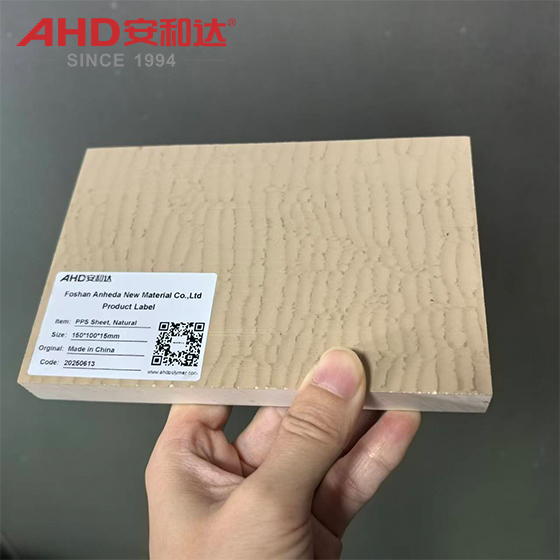 Polyphenylene Sulfide Sheet
Compared to commonly used sintered magnets, injection-molded magnets have the following advantages and disadvantages:
1. Greater flexibility in product design, enabling the production of complex and thin products.
2. Simpler process, allowing for embedded injection molding to embed metal inserts in a single molding process. High dimensional accuracy.
3. Better toughness, less prone to cracking under impact loads.
4. Better corrosion resistance.
5. Lower magnetic energy product than sintered magnets.
Compared to commonly used sintered magnets, injection-molded magnets, represented by PPS, possess unique advantages, which are further amplified by high-performance PPS matrices.
Design and molding flexibility: Complex geometries and thin-walled structures can be integrally molded, achieving designs impossible with sintering processes. PPS's excellent flowability makes this possible.
High dimensional accuracy and integration: High product dimensional accuracy, and the ability to integrate inserts such as metal bushings and sensor elements in a single molding process through embedded molding reduces assembly steps. PPS's low shrinkage characteristics are crucial for this.
Excellent mechanical toughness: Compared to brittle sintered magnets, injection-molded magnets have better impact resistance and are less prone to breakage during assembly and use.
Outstanding corrosion resistance: PPS resin itself has excellent resistance to most acids, alkalis, and solvents, allowing magnetic components to be used in harsh environments without additional electroplating protection.
AHD PPS Rod
