

When you first see PA6 nylon sheets, have you noticed their unique surface texture? Today, let AHD guide you through understanding this unique surface!
For manufacturers and engineers relying on high-performance engineering plastics, the subtle surface textures on PA6 nylon sheets often raise critical questions: What causes these patterns? Do they signal material flaws, and how do they impact part performance? At AHD, a leading producer of nylon sheets and rods with 31 years of expertise, we understand that these textures are not random imperfections but a direct interplay between PA6’s inherent material properties and precision casting/injection molding processes.
PA6 nylon’s high viscosity, hygroscopic nature, and crystalline structure create unique challenges in large-format sheet production. Melt flow unevenness, cooling rate gradients, and residual moisture—all tied to PA6’s core characteristics—manifest as the wavy or “orange peel” textures visible on finished panels. While these patterns are primarily cosmetic, their presence carries implications for functional applications requiring tight sealing, low-friction sliding surfaces, or precision machining. In this article, we break down the science behind PA6 sheet surface textures, their connection to nylon’s material behavior, and how AHD’s advanced production controls minimize these effects to deliver consistent, high-quality components for global industrial clients.

The water ripple/orange peel texture on the surface of blue PA6 nylon sheets is the result of a combination of material properties and molding processes. The following points explain why:
I. How are these textures formed?
These textures are essentially surface flow marks/ripples caused by uneven melt flow and cooling. There are three main reasons:
1. Material properties (primary cause)
PA nylon (especially MC nylon) has high viscosity and poor flowability. When the melt spreads in a large flat mold, it easily causes surface wrinkles.
PA is a highly hygroscopic material. When heated, moisture vaporizes to form bubbles, and when these bubbles burst, they leave water ripple-like marks on the surface.
Differences in the crystallization rate of crystalline nylons can also lead to uneven local shrinkage, amplifying the surface texture.
2. Process-related factors (causes): During casting/injection molding, the melt cools rapidly upon contact with the mold, forming a high-viscosity surface layer. Subsequent melt flow pushes against this "frozen skin," causing it to wrinkle, slip, and eventually solidify into ripples.
Low mold temperature and excessively slow or fast melt flow rates exacerbate this uneven flow.
Poor venting allows air to be drawn into the melt within the cavity, also creating similar textures on the surface.
3. Equipment/Operation-related factors: Low barrel/nozzle temperature leads to poor melt plasticization, further reducing fluidity.
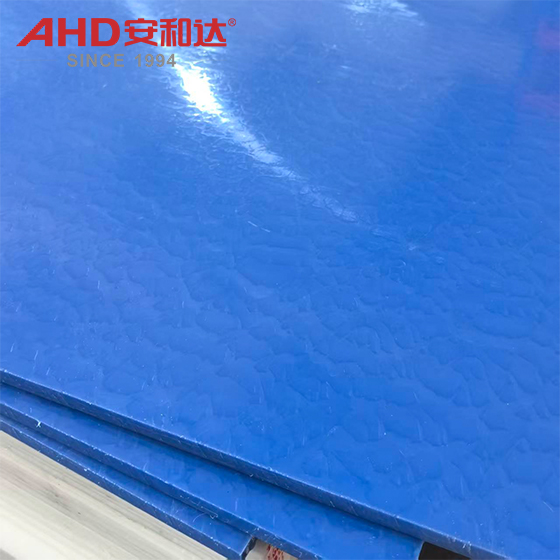
II. Relationship with PA Nylon Material Properties
Directly related. Several core characteristics of PA create a breeding ground for surface texture:
High hygroscopicity: Moisturized PA releases water vapor at high temperatures, a common cause of surface watermarks;
High viscosity/low flowability: MC nylon has a molecular weight three times that of ordinary PA, resulting in greater melt flow resistance and making it easier to form flow ripples;
Crystallinity: Uneven crystallization rates during cooling lead to localized shrinkage differences, amplifying the surface unevenness;
Temperature sensitivity: Slight fluctuations in mold/material temperature can alter melt flowability, inducing texture

AHD Nylon PA6 Sheet Blue
III. The Influence of Texture on Sheet Performance
This type of surface texture primarily affects appearance, with limited impact on core mechanical properties:
| Impact | Specific Manifestations |
| Mechanical Properties | The texture has virtually no impact on core mechanical properties such as tensile, bending, and impact strength; it is an aesthetic defect rather than a structural one. |
| Surface Function | If used for sealing or sliding surfaces, the texture may slightly reduce smoothness and increase the coefficient of friction. |
| Appearance and Machining | It affects aesthetics; subsequent CNC machining/polishing can eliminate the texture, but this increases costs. If used for non-aesthetic parts, it can be used directly. |
| Storage/Stacking | Although there is a texture, the surface remains smooth, and any increase in surface friction is extremely minor. |

Brief Summary
Causes: The high viscosity, hygroscopicity, and crystallinity of PA nylon are the main causes, while uneven cooling during the process is a contributing factor.
Related Factors: Strongly correlated with PA material properties; a typical appearance problem in the molding of large-area nylon sheets.
Impact: Does not affect structural strength; mainly affects appearance and may affect sliding function, but based on long-term use and numerous case studies, there is no specific impact.
