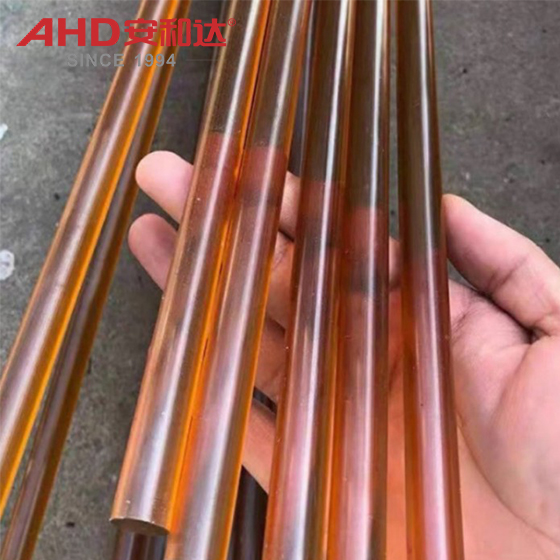
PEI (polyetherimide) amber transparent rods are amorphous thermoplastic engineering plastics characterized by their amber-colored, translucent appearance. Their molecular structure contains rigid polyimide chains and flexible ether bonds, balancing high-temperature resistance and processability.
PI (polyimide) rods, on the other hand, are aromatic heterocyclic polymers containing imide rings. They belong to the thermosetting or thermoplastic engineering plastic category, characterized by strong molecular chains. Most are black or dark brown and are among the engineering plastics with the best temperature resistance.

Ⅰ. Characteristics and Advantages of PEI Rod
The core characteristics of PEI amber transparent rods stem from their amorphous structure and ether bond modification. Their main advantages are as follows:
High Temperature Resistance and Dimensional Stability: Continuous operating temperature up to 170℃, heat distortion temperature 198-210℃, glass transition temperature 215℃. It maintains good strength and dimensional accuracy even at high temperatures (low coefficient of thermal expansion, close to that of metallic aluminum).
Flame Retardancy and Safety: Inherent flame retardancy; UL94-V0 rating can be achieved without adding flame retardants. Low smoke and low toxicity during combustion, suitable for aerospace, electronics, and other fields with high safety requirements.
Comprehensive Mechanical Properties: High tensile strength, flexural strength, and modulus, along with good toughness and creep resistance, making it a suitable replacement for metal in the manufacture of precision parts (such as fiber optic connectors and surgical instrument handles).
Processing Ease: Its thermoplastic properties allow for processing via injection molding, extrusion, CNC machining, etc., resulting in high production efficiency and lower cost than PI rods.
Chemical and biocompatibility: Resistant to hydrolysis, oil, and weak acids and alkalis, meeting FDA and EU food contact standards and USP Class VI biocompatibility, suitable for medical (e.g., sterilization trays, surgical guides) and food applications (e.g., microwave oven trays).
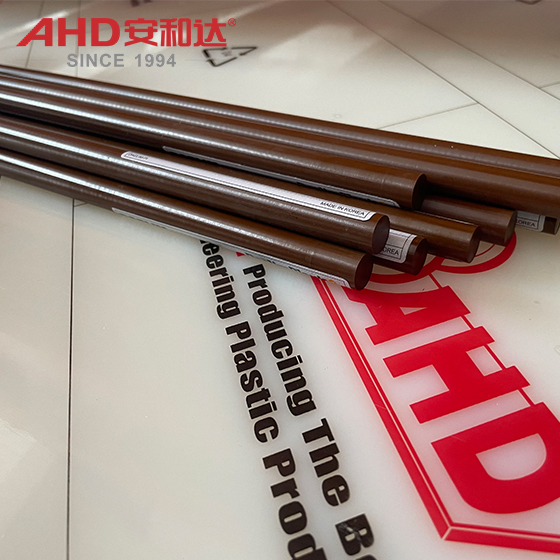
Ⅱ. Characteristics and Advantages of PI Rod
The core advantages of PI rods lie in their exceptional high-temperature resistance and superior mechanical properties, specifically:
Ultra-high temperature resistance: Long-term operating temperature can reach 260℃ (some varieties can reach 450℃ for short periods), and the glass transition temperature exceeds 360℃, making it one of the most temperature-resistant engineering plastics, suitable for extreme environments such as aerospace engines and high-temperature cables.
Excellent mechanical properties: Extremely high tensile strength, flexural strength, and modulus, along with good wear resistance and self-lubricating properties, making it a suitable replacement for metals in the manufacture of high-load parts (such as gears, bushings, and brake pads).
Excellent insulation properties: Low dielectric constant (3.2-3.6), low dielectric loss, and a volume resistivity as high as 10¹⁷Ω·cm, maintaining stability even under high-temperature and high-frequency environments, suitable for insulating components such as aerospace cables and satellite circuit boards.
Radiation and chemical stability: Strong radiation resistance (e.g., 90% strength retention after 5×10⁹rad fast electron irradiation), resistant to organic solvents and weak acids, but susceptible to strong alkali corrosion. Thermosetting processing characteristics: Some PI rods are thermosetting and can be processed by molding, impregnation and other processes, making them suitable for manufacturing parts with complex shapes and high precision (such as aero-engine bushings and spacecraft structural components).
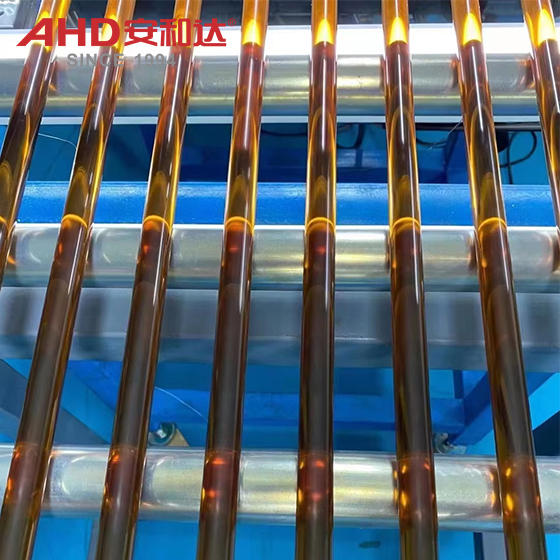
AHD PEI Rod(Ultem 1000 Rod)
Ⅲ. Key differences between PEI rods and PI rods
| PEI Rod | PI Rod | |
| Molecular Structure | Amorphous, containing flexible ether bonds | Aromatic heterocycle (imide ring), highly rigid |
| Appearance | Amber, translucent | Black, brownish-black, or dark brown |
| Temperature Resistance | Continuous use: 170℃, short-term: 210℃ | Continuous use: 260℃, short-term: 450℃ |
| Mechanical Properties | High strength, good toughness | Even higher strength, higher modulus |
| Processing Performance | Thermoplastic, easy to injection mold/extrude | Thermosetting or refractory, difficult to process |
| Cost | Lower (mature thermoplastic processes) | Higher (complex thermosetting processes) |
| Main Application Areas | Electronics (fiber optic connectors), Automotive (sensors), Medical (surgical instruments) | Aerospace (engine components), Microelectronics (FPC substrates), Machinery (high-load parts) |
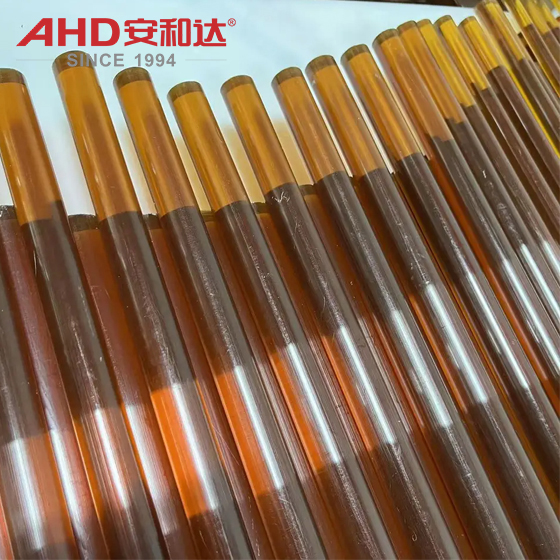
Ultem Rod
Ⅳ. Application Scenarios Comparison
Common Applications of PEI Rod (Polyetherimide Rod)
Electronics: Fiber optic connectors, optical transceiver module optical components, RF connector insulators, 5G base station filter tuning screws (utilizing their high temperature resistance and dimensional stability).
Automotive: High-temperature parts in engine compartments, automotive lighting systems, core modules of new energy vehicle charging piles (utilizing their flame retardant and insulating properties).
Medical: Surgical instrument handles, sterilization trays, ventilator components, laboratory animal cages (utilizing their biocompatibility and sterilization resistance).
Aerospace: Aircraft internal components.
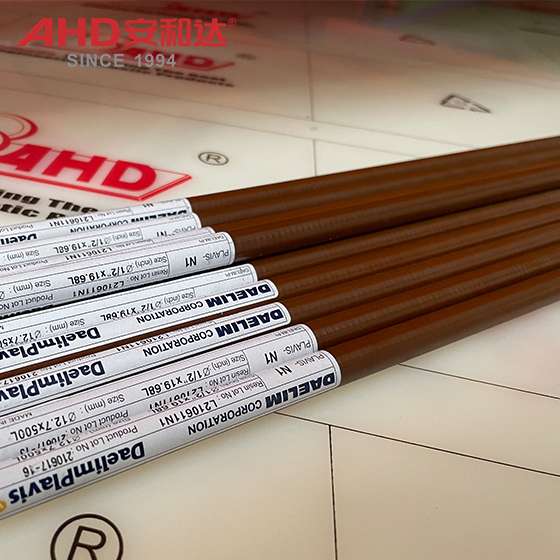
Common Applications of PI Rods
Aerospace: Aircraft engine combustion chamber liners, turbine blade heat shields, spacecraft structural components (utilizing their ultra-high temperature resistance).
Microelectronics: Flexible printed circuit (FPC) substrates, integrated circuit packaging materials, high-frequency circuit boards (utilizing their excellent insulation properties).
Mechanical Industry: High-load gears, bushings, sliders, high-temperature brake pads (utilizing their high strength and self-lubricating properties).
Chemical Industry: Chemical equipment seals, pipe linings, reactor agitators (utilizing their chemical corrosion resistance).
Military Industry: Missile nose cones, radar radomes, radiation-resistant parts for nuclear equipment (utilizing their radiation resistance and high-temperature resistance).

Both PEI amber transparent rods and PI rods are high-performance engineering plastics, but PEI is more suitable for mid-to-high-end applications with easy processing (such as electronics, automotive, and medical), while PI is more suitable for applications in extreme environments and under high loads (such as aerospace, microelectronics, and machinery). The choice should be made based on a comprehensive consideration of factors such as temperature resistance requirements, mechanical load, and processing costs.