

ESD POM Sheet (Antistatic Polyoxymethylene Sheet) is an engineering plastic sheet made from polyoxymethylene (POM) as the base material, modified by adding antistatic agents. It aims to solve the problem of static electricity accumulation in ordinary POM Sheet.
ESD PEEK Sheet (Antistatic Polyetheretherketone Sheet), on the other hand, is a high-performance antistatic material made from polyetheretherketone (PEEK) as the base material, filled with conductive fillers. It combines the inherent properties of PEEK with static dissipation capabilities.

The resistivity of antistatic materials usually falls within the range of 10⁷ to 10¹⁰ ohms. If the performance is consistent, why are different materials required?
1. Differences in adaptability to extreme environments: "Usable" ≠ "Effective".
High-temperature scenarios: If the ambient temperature is >120℃ (e.g., fixtures near semiconductor reflow ovens), ESD POM will soften and deform (heat distortion temperature (HDT) is only 110℃), causing fixture positioning failure; while ESD PEEK maintains rigidity at 260℃ and can work stably for a long time.
Corrosion scenarios: In electrostatic protection components inside chemical reactors (contact with concentrated sulfuric acid), ESD POM will swell and corrode (strength decreases by 50% within 24 hours), while ESD PEEK can withstand concentrated sulfuric acid at 150℃.
Radiation/Vacuum Scenarios: Satellite attitude control bearings require anti-static properties in space radiation (gamma rays) and vacuum environments. ESD POM becomes brittle under 100 kGy radiation, while ESD PEEK can withstand 1000 kGy with a vacuum venting rate of <0.01% (without contaminating optical components).
2. Mechanical Performance Matching: "Sufficient" ≠ "Optimal"
Dynamic Load Scenarios: High-speed gearboxes require materials with both high wear resistance and impact resistance. While ESD POM is wear-resistant, its notched impact strength is only 6-10 kJ/m², making it prone to tooth breakage at high speeds. ESD PEEK has an impact strength of 50-80 kJ/m² and maintains toughness at high temperatures, making it more suitable.
Precision Positioning Scenarios: Precision instruments require materials with extremely low coefficients of thermal expansion. ESD POM has a thermal expansion coefficient of 1.1 × 10⁻⁴/℃ (deformation of 0.11 mm under a 100℃ temperature difference), which can cause mask misalignment; ESD PEEK has a thermal expansion coefficient of 1.5 × 10⁻⁵/℃ (deformation of only 0.015 mm under the same temperature difference), meeting micron-level precision requirements.
3. Processing and Cost Efficiency: "Can be done" ≠ "Cost-effective"
For large-volume, simple parts: PCB test fixtures in electronics factories (simple structure, large quantity), ESD POM injection molding has a short cycle time and low cost, suitable for mass production; using ESD PEEK would extend the injection cycle and increase costs, making it unnecessary.
For small-volume, complex parts: Aircraft engine sealing rings (complex shape, small quantity), ESD PEEK can be precision machined using CNC to meet high-temperature sealing requirements; ESD POM cannot withstand temperatures up to 260℃, and forced use would lead to engine leakage.
4. Special Functional Requirements: Added Value Beyond "Anti-static"
Lightweighting: Drone servo linkages (weight reduction priority), ESD PEEK density is lower than ESD POM, resulting in an 8% weight reduction under the same strength and improved battery life.

AHD Beige and Black ESD POM Sheet (Delrin Sheet)
1. Properties of ESD POM Sheet
Mechanical Properties: High rigidity, high wear resistance, low friction
Strength and Stiffness: Tensile strength 60-75 MPa, flexural modulus 2.8-3.5 GPa (excellent rigidity), hardness HRR 78-82 (Rockwell hardness), suitable for static loads and high-precision positioning.
Wear Resistance: Coefficient of friction only 0.1-0.3 (dry friction), wear resistance is twice that of PA66, commonly used in moving parts such as gears, sliders, and bearings.
Fatigue Resistance: Notched fatigue strength approximately 25 MPa, superior to materials such as ABS and PC, suitable for fixtures with long-term reciprocating motion.
Processability: Easy to mold, low cost, high precision
Thermoplastic Processing: Melting point 163-175℃, can be processed by injection molding, extrusion, CNC milling, turning, drilling, etc., with low molding shrinkage and precise tolerance control.
Machining-friendly: No melting or sticking occurs during cutting; a mirror finish can be achieved when the cutting edge is sharp, suitable for manufacturing complex fixtures.
Temperature and Weather Resistance: Moderate temperature resistance, easily affected by the environment. Long-term operating temperature is -40℃ to 100℃ (short-term 130℃). It gradually softens and its mechanical properties decrease above 100℃.
Weather Resistance: Prone to aging under UV radiation; UV stabilizers are required for outdoor use. Good resistance to water vapor.
Chemical Resistance: Moderate corrosion resistance, incompatible with strong acids and alkalis. Resistant to organic solvents (such as alcohols and oils) and weak acids (such as dilute hydrochloric acid), but not resistant to strong acids (concentrated sulfuric acid, concentrated nitric acid), strong alkalis (concentrated NaOH), and strong oxidizing agents (such as hydrogen peroxide). Contact with these will cause swelling and degradation.
Electrical Properties: Stable Static Dissipation. Surface resistivity 10^6-10^9 Ω (depending on antistatic agent type), volume resistivity 10^5-10^8 Ω·cm, static decay time < 2 seconds (compliant with ANSI/ESD S20.20 standard).
Cost and Environmental Protection: High Cost-Effectiveness, Recyclable. Raw material cost is only 1/5 or even less of ESD PEEK, processing energy consumption is low, and scrap can be recycled (recycled material performance retention rate > 80%).
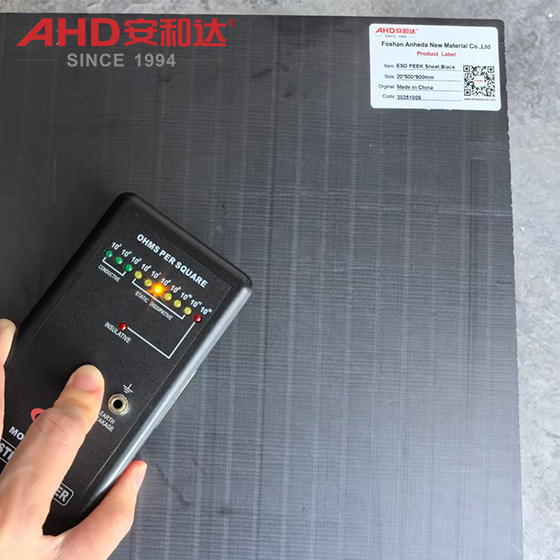 AHD ESD PEEK Plastic Sheet
2. Properties of ESD PEEK Sheet
Mechanical Properties: Ultra-high temperature resistance, high strength, high toughness
Strength and Stiffness: Tensile strength 90-110 MPa, flexural modulus 3.6-4.5 GPa (higher than POM), excellent toughness, notched impact strength 50-80 kJ/m², far greater than POM.
High Temperature Creep Resistance: Under 200℃ and 10 MPa stress, creep strain <0.5% after 1000 hours (POM exhibits significant creep at 100℃), suitable for long-term high-temperature static load bearing.
Fatigue Resistance: Notched fatigue strength 35-45 MPa, maintaining above 25 MPa even at high temperatures (200℃).
Processability: High difficulty, high precision, requires specialized processes.
Narrow Hot Working Window: Melting point 343℃, processing temperature required 360-400℃, requires specialized high-temperature injection molding machines or CNC machine tools (tools must be made of cemented carbide or ceramic coating). High cutting precision: Extremely low coefficient of thermal expansion (only 1/7 that of POM), resulting in excellent dimensional stability after machining, suitable for micron-level positioning fixtures in semiconductor lithography machines.
Welding and bonding: Can be welded by laser or ultrasonic welding; bonding requires PEEK-specific adhesive.
Temperature and weather resistance: Adaptable to extreme environments.
Long-term operating temperature: -60℃~250℃ (short-term 310℃); continuous use in air at 250℃ without decomposition; can reach 300℃ in inert gases, far exceeding POM.
Radiation resistance: Resistant to gamma ray doses >1000 kGy (suitable for nuclear power plants and space environments), while POM becomes brittle at 100 kGy.
Weather resistance: With the addition of UV stabilizers, it can be used outdoors for over 20 years without yellowing or becoming brittle (superior to POM).
Chemical Resistance: Nearly "universal corrosion resistance"
Resistant to almost all chemical media: concentrated sulfuric acid (98%, 150℃), concentrated nitric acid (68%, 100℃), sodium hydroxide (50%, 200℃), organic solvents (acetone, dichloromethane, DMF, etc.), even aqua regia (requires special formulation). Its only weakness is its inability to resist fuming sulfuric acid and concentrated hydrogen peroxide.
Electrical Properties: Wide-band stable antistatic properties
Surface resistivity 10^6-10^9 Ω, volume resistivity 10^6-10^9 Ω·cm, electrostatic decay time <1 second (better than ESD POM), and performance remains unchanged under vacuum and high/low temperature (-196℃~300℃) environments.
Flame Retardancy: Aerospace-grade safety
Flame retardancy: UL94 V-0 rating (0.4 mm thickness), extremely low smoke emission during combustion (smoke density <5), oxygen index 47% (excellent self-extinguishing properties), suitable for aircraft interiors.
Cost and application barriers: High-end positioning, high investment, high return
Raw material costs are 5 times that of ESD POM. Processing requires specialized equipment and technical personnel, making it suitable for high value-added fields (such as semiconductors, aerospace, and medical).
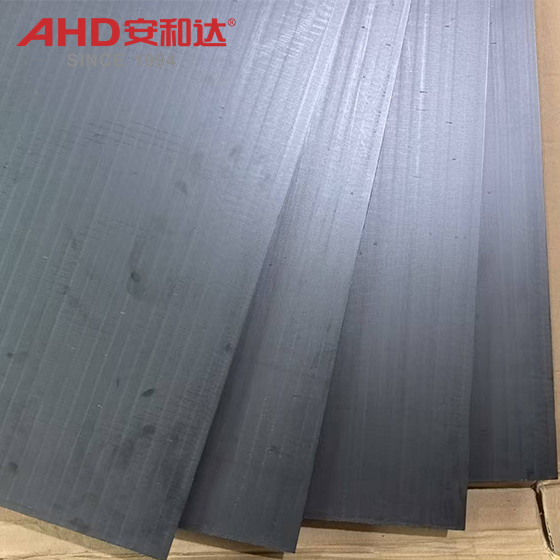
AHD ESD PEEK Plate
Recommendations
1. Scenarios for ESD POM:
Electronic Assembly Lines: Such as PCB test fixtures and SMT placement jigs, requiring anti-static properties and controllable costs.
Precision Mechanical Components: Such as gears, sliders, and bearings, requiring high rigidity and wear resistance.
Cleanroom Equipment: Such as LCD detector fixtures and semiconductor packaging molds, requiring low-dust (carbon-free ESD POM).
2. Scenarios for ESD PEEK:
Semiconductor Manufacturing: Such as wafer handling jigs and photolithography mask holders, requiring high temperature resistance, anti-static properties, and a dust-free environment.
Aerospace: Such as aircraft engine sealing rings and satellite attitude control bearings, requiring high and low temperature stability and radiation resistance.
High-End Medical: Such as MRI gradient coil supports and surgical robot joints, requiring biocompatibility and resistance to disinfection and corrosion.
New Energy: Such as battery module insulating sheets and motor rotor bushings, requiring electrostatic protection under high-voltage environments.
ESD POM is suitable for general anti-static and cost-sensitive applications, while ESD PEEK is suitable for high-precision, high-temperature, and highly corrosive high-end applications. When choosing, factors such as anti-static requirements, environmental conditions (temperature, chemical media), and cost must be considered comprehensively.