

Have you ever noticed that seemingly smooth POM plates appear to have faint, subtle patterns when viewed at certain angles? They feel perfectly flat to the touch yet display a brushed texture when viewed visually. Is this a material flaw or a hidden design element?
These patterns puzzle many customers. Why are there visible 'imperfections' when the surface feels flawless? Some also wonder: Could these affect the sheet's strength?
Today, AHD reveals the mystery behind the elegant patterns on POM thick sheets.
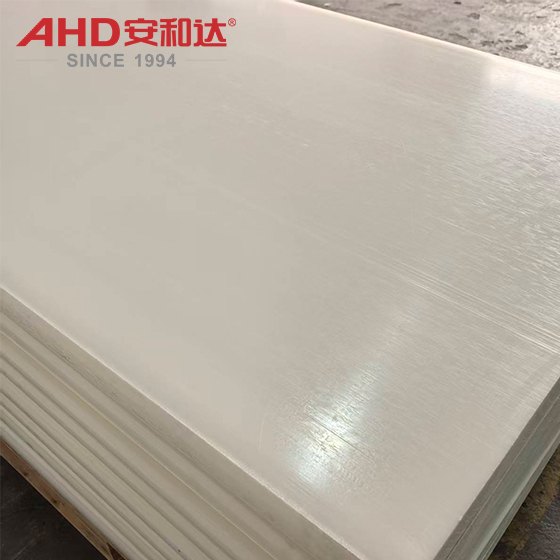
AHD Thick POM Sheet (Polyoxymethylene Sheet)
The phenomenon of "smooth to the touch but visible texture" needs to be analyzed from the perspective of POM material properties and the molding rules of the extrusion process. The core logic is that "microstructure/optical performance ≠ macroscopic tactile feel." The key reasons are broken down as follows:
1. Microstructure and Optical Reflection Dominated by "Crystallization"
POM (Polyoxymethylene) is a highly crystalline polymer. During extrusion molding, the high-temperature melt rapidly passes through the die and undergoes rapid crystallization during cooling:
During crystallization, the molecular chains "spontaneously arrange" to form microcrystalline regions (orderly stacked molecular chains) and amorphous regions (disordered molecular chains). These two regions create differences in density and refractive index at the microscopic level.
When light shines on the surface of the board, the microcrystalline and amorphous regions reflect/scatter light at different angles, and the human eye perceives "alternating light and dark textures"—but this difference is only at the microscopic scale (visible to the naked eye but not perceptible to the touch because the protrusions/depressions are much smaller than the skin's tactile threshold).
2. Surface Stress and Deformation Caused by Cooling Shrinkage
POM extrusion requires rapid cooling for shaping. During this process, anisotropic shrinkage (i.e., inconsistent shrinkage rates/amplitudes along the thickness and length directions of the sheet material) can easily occur. If the mold cooling water channel design is flawed, the cooling medium temperature is uneven, or the sheet material is thick, the difference in cooling rates between the surface and interior can lead to extremely fine shrinkage stresses on the surface. These stresses can cause nanoscale/microscale micro-unevennesses on the surface (textures are barely visible to the naked eye, but feel "smooth" to the touch due to the small degree of unevenness).
3. "Invisible Molding Traces" Left by Melt Flow
Even with an absolutely smooth mold surface, the POM melt, when extruded through the die, will exhibit subtle differences in melt viscosity and runner pressure during extrusion.
These differences result in:
Slight variations in the flow rate and direction of the melt within the die. After cooling and solidification, extremely shallow "flow marks" or "laminar textures" (similar to "faint lines under a silky sheen," essentially "historical traces" of melt flow, not a replication of the mold's texture) left on the surface.
This phenomenon is a "microscopic visual manifestation" resulting from the combined effects of POM's material properties (high crystallinity, strong shrinkage, and melt flowability) and the extrusion process (cooling and solidification). It is neither an "active texture replication" of the mold nor a "macroscopic roughness" directly identifiable by touch, but rather a natural result of the material's "microscopic morphology → optical reflection → perceived as 'texture' by the human brain" during molding.

POM Sheet also called Polyacetal Sheet,Delrin Sheet
Avoidance and Improvement of "Crystallization-Dominated Microstructures"
The core of improvement is to regulate the crystallization process, making the crystals more uniform and the microcrystals finer:
1. Process parameter optimization: Controlling the cooling rate and mold temperature
2. Material modification: Adding crystallization inhibitors or nucleating agents
3. Post-treatment: Annealing to relieve internal stress
Avoidance and Improvement of "Invisible Molding Marks Left by Melt Flow" The core of improvement is to optimize the melt flow state, making the flow smoother:
1. Process parameter optimization: Adjusting screw and traction speed
2. Mold and equipment optimization: Improving runner design
3. Material pretreatment: Drying and adding lubricant

When producing thick POM plates, the subtle surface texture has no impact whatsoever on the core properties of the material, including tensile strength, abrasion resistance and chemical corrosion resistance. The crystallinity and molecular chain structure of the textured areas remain unchanged — they are merely 'optical imprints' of microscopic flow and crystallisation.
Surprisingly, many customers actually prefer this texture. This unexpected acceptance has led manufacturers to realise that the texture is not a 'defect', but rather a 'hidden feature' that can be retained.
For manufacturers, eliminating the texture requires significant investment in optimising mould flow channels, adding crystallisation inhibitors and extending cooling times, while there is no urgent market demand for 'texture-free' materials. Rather than investing in 'correcting' an appearance feature that doesn't affect performance, it is better to focus resources on improving material purity and stabilising supply cycles — core aspects. After all, industrial customers value 'performance compliance + cost control' more than the visual perfection of 'absolute smoothness'.
Therefore, most manufacturers choose to 'go with the flow' — letting the texture become a unique 'identity mark' of POM thick plates and finding the optimal balance between practicality and cost.
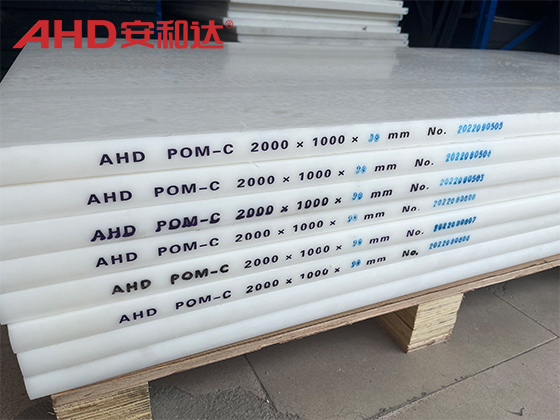
Why do some thin POM sheets lack obvious textures?
The lack of obvious textures in some thin sheets is mainly due to the inherent advantages of thin sheets:
1. Faster and more uniform cooling rate: Thin sheets have a larger surface area to volume ratio (e.g., the surface area of a 3mm thin sheet is much larger than that of a thick sheet). During cooling, the temperature difference between the surface and the interior is smaller, resulting in more uniform crystallization and reducing textures caused by differences in crystallization.
2. More stable melt flow: Thin sheets have lower extrusion pressure (e.g., the extrusion pressure of a 3mm thin sheet is much lower than that of a thick sheet). The shear stress of the melt within the die is lower, and the flow is closer to laminar flow, reducing flow marks.
