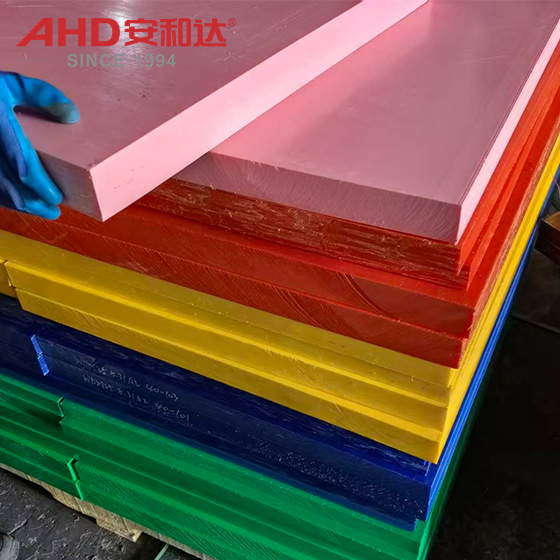
When industrial wear becomes an "invisible killer," how can you dress your equipment in "golden armor"?
Amidst the roar of mining machinery, the precise operation of food production lines, and the corrosion tests of chemical equipment, wear-resistant liners, like the "skeleton" and "skin" of industrial equipment, silently endure the onslaught of friction, impact, and corrosion. Liner failure due to improper material selection often becomes the "culprit" behind production line downtime. Faced with a dazzling array of materials on the market—from the "king of plastics," UHMWPE, to the "metal substitute," MC Nylon, and the "precision transmission expert," POM—how do you scientifically select materials? AHD reveals the ultimate secret to wear-resistant liner selection.
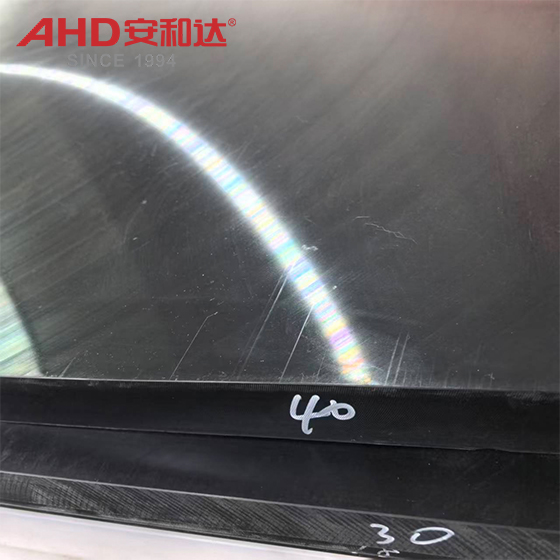
In-depth Decoding of Material Properties: A Comprehensive Comparison from Molecular Chains to Application Scenarios
1. Mechanical Properties: Impact Resistance and Wear Resistance
UHMWPE Sheet (Ultra High Molecular Weight Polyethylene) With its core advantage of ultra-high molecular weight chains exceeding 3 million, its wear resistance is 7 times that of carbon steel, and its impact strength is 5 times that of ABS, exhibiting excellent performance in dynamic wear environments. However, its tensile strength (30-40 MPa) and temperature resistance (-200℃~80℃) are slightly inferior to metals.
Typical Applications: Port conveyor rails, wear-resistant liners in coal mines.
MC Nylon Sheet (Casting Nylon) Achieves high crystallinity through anionic polymerization technology, resulting in high tensile strength far exceeding that of ordinary nylon, and water absorption is less than 0.01%. However, its long-term operating temperature is ≤100℃.
Typical Applications: Automotive gearboxes, chemical pump body seals.
POM (Polyoxymethylene) sheets are known for their high rigidity and low coefficient of friction, but their impact resistance is only 1/5 that of UHMWPE, and they are prone to brittleness at low temperatures. PTFE or molybdenum disulfide needs to be added to improve their self-lubricating properties.
Typical applications: Precision transmission gears, guide rails in automated equipment.
2. Chemical Resistance: The "Ironclad Legion" in the Acid-Alkali Battlefield
UHMWPE: Resistant to 98% concentrated sulfuric acid and weak alkalis, but sensitive to concentrated nitric acid and aqua regia; suitable for neutral to weakly acidic environments such as food processing and wastewater treatment.
MC Nylon: Excellent oil resistance (superior to PA66), but strong acids (such as concentrated sulfuric acid) and organic solvents can cause swelling; glass fiber reinforcement is needed to improve chemical resistance.
POM: Outstanding solvent resistance (such as gasoline and lubricating oil), but strong oxidizing acids (such as chromic acid) can accelerate decomposition; antioxidants need to be added to extend its lifespan.
3. Temperature Adaptability: The Extreme Challenge from Extreme Cold to Extreme Temperature
UHMWPE: Long-term use limit is 80℃, modified models can reach 100-120℃.
MC Nylon: Heat distortion temperature 120℃, suitable for medium temperature conditions, but dimensional stability decreases after moisture absorption.
POM: Continuous use temperature -40℃~100℃, easily decomposes at high temperatures to produce formaldehyde, requiring the addition of stabilizers.
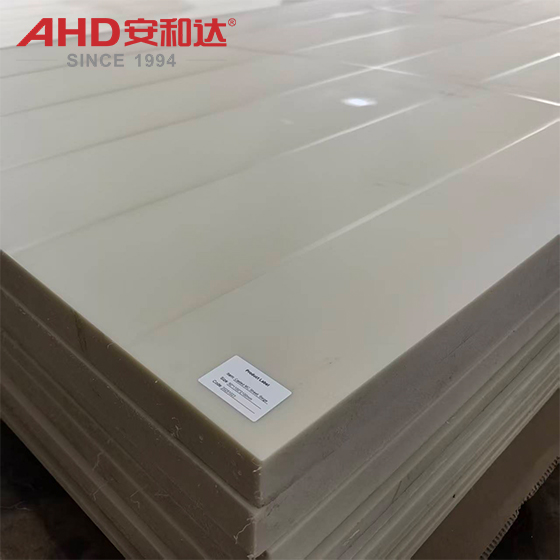
AHD Casting MC Nylon Sheet
Practical Application Guide: From Material Selection to Lifecycle Decision-Making
2.1 High-Wear Environments: UHMWPE's "Softness Overcomes Hardness" Philosophy
In applications such as coal mine conveyor belt guides and port ore chutes, UHMWPE, with its self-lubricating properties (friction coefficient 0.1-0.2) and fatigue resistance, can reduce wear rates to 1/7 that of steel.
2.2 Corrosive Media: MC Nylon's "Offensive and Defensive Balance" Strategy
In chemical storage tank agitators and seawater desalination pumps, MC nylon, through glass fiber reinforcement (such as MC901) and molybdenum disulfide modification, achieves a balance between wear resistance and corrosion resistance.
2.3 Precision Transmission: POM's "Millimeter-by-Millimeter Battle"
In robot joint bearings and 3D printer drive shafts, POM's low creep and high dimensional accuracy are crucial.
Selection Decision Tree: Four Steps to Lock in the Optimal Solution
Is high wear involved?
→ Yes: Prioritize UHMWPE (best life-to-cost ratio)
→ No: Proceed to the next level
Is chemical corrosion resistance required?
→ Yes: UHMWPE (general purpose) or PTFE composite (extreme corrosion)
→ No: Proceed to the next level
Is high load required?
→ Yes: MC nylon (high rigidity) or glass fiber reinforced POM
→ No: Proceed to the next level
Is dimensional precision required?
→ Yes: POM (best processing stability)
→ No: UHMWPE (better economical)
Material Selection is Strategy, Cooperation Wins the Future
In the wave of Industry 4.0 and intelligent manufacturing, the selection of wear-resistant liners is no longer just a technical issue, but a strategic choice for enterprises to reduce costs and increase efficiency. With over 30 years of material R&D experience, 1000+ industry cases, and 48-hour rapid response service, AHD is committed to providing distributors with a high-value-added, low-risk cooperation model. Choosing AHD means choosing not only materials, but also reliable protection throughout the entire lifecycle of your equipment and a competitive edge for sustained profitability!
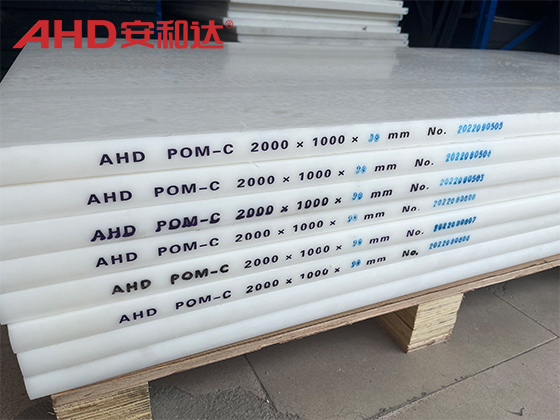
AHD Colorful POM Sheet (Polyacetal Sheet)