From kitchen to factory, how does a single material safeguard global food safety?
In a modern food processing workshop, a high-speed machine precisely completes the demolding process 30 times per minute. Its core component—the sealing gasket that comes into direct contact with food—silently protects food hygiene and safety with a temperature resistance limit ranging from -200℃ to 260℃. This seemingly ordinary white sheet is the "invisible guardian" of the global food industry—food-grade PTFE sheet. This polymer material, made from tetrafluoroethylene, is revolutionizing humanity's understanding of food safety with its revolutionary performance.
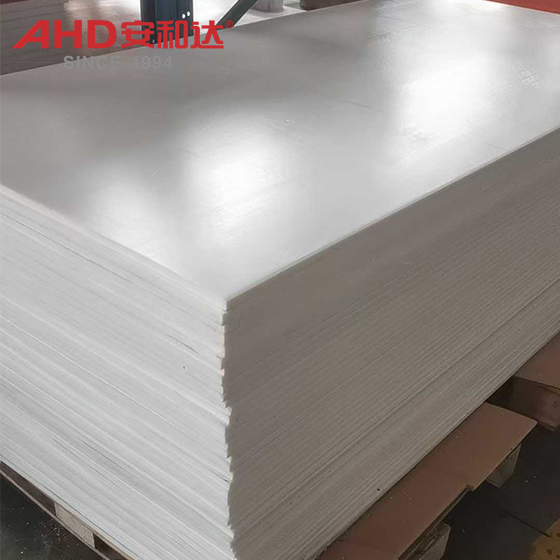
AHD PTFE Sheet
A Revolution in Materials Science: Molecular-Level Safety Guarantee of PTFE
1. Chemical Inertness: Building the First Line of Defense for Food Safety
PTFE (polytetrafluoroethylene) has a molecular structure composed of carbon-fluorine single bonds. These bonds, with an energy as high as 485 kJ/mol, ensure that the material reacts almost entirely with no substances at room temperature. Experimental data shows that even after immersion in strongly acidic or alkaline environments with pH values of 1-14 for 720 hours, the surface morphology change rate of PTFE sheets is less than 0.03%. This characteristic makes it an ideal choice for harsh environments such as those involving acidic fruit juices and alkaline detergents.
In FDA-certified migration tests, after immersion in simulated oily foods for 72 hours, the migration of perfluorinated compounds in PTFE sheets was far below the FDA's limit of 0.01 mg/dm². This "zero migration" characteristic fundamentally eliminates the risk of food contamination.
2. Physical Properties: Stable Performance Under Extreme Conditions
PTFE sheets have a coefficient of friction as low as 0.04 (dry friction state), only one-third that of ice. In bread production lines, this ultra-low friction characteristic improves dough conveying efficiency while reducing the risk of metal debris contamination from equipment wear. Its perfect balance of density and coefficient of thermal expansion ensures dimensional stability across a wide temperature range of -40°C to 200°C, preventing seal failure due to thermal expansion and contraction.
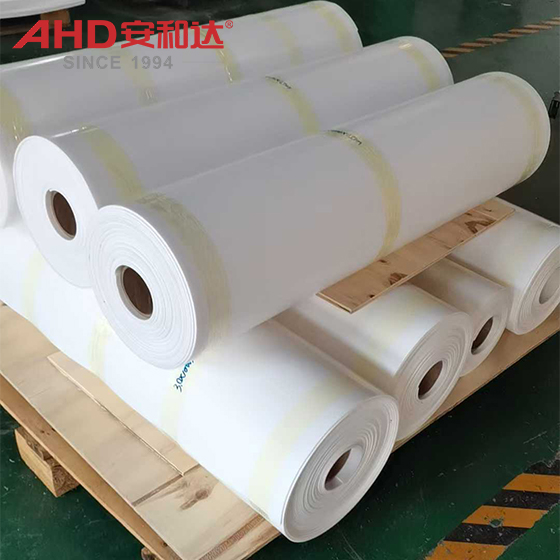

AHD PTFE Roll Sheet
Innovative Application Scenarios in Food Machinery
1. Precision Machining
In chocolate molding production lines, the application of PTFE sheets brings revolutionary breakthroughs:
Improved demolding efficiency: Low surface energy increases demolding integrity from 92% to 99.7%.
Reduced energy consumption: Self-lubricating properties reduce the load on the hydraulic system.
Hygiene guarantee: Can withstand 121℃ steam sterilization; annual maintenance cost is only 1/5 of traditional rubber seals.
2. Packaging and Filling Systems
In aseptic filling lines, the application of PTFE sheets is reflected in:
Seals: Withstands temperature fluctuations from -40℃ to 120℃, with a long service life.
Conveyor belt liners: Anti-stick properties reduce the frequency of downtime for cleaning in candy production lines.
Valve components: Achieves zero residue in jam production lines, reducing raw material waste.
Partnering with AHD to Usher in a New Era of Food Safety
As the global food industry accelerates its transformation towards intelligent and green practices, choosing a truly compliant food-grade PTFE sheet is not only a technical decision but also a reflection of corporate social responsibility. With 30 years of experience in materials engineering, AHD is committed to providing the market with high-quality PTFE sheets and rods.
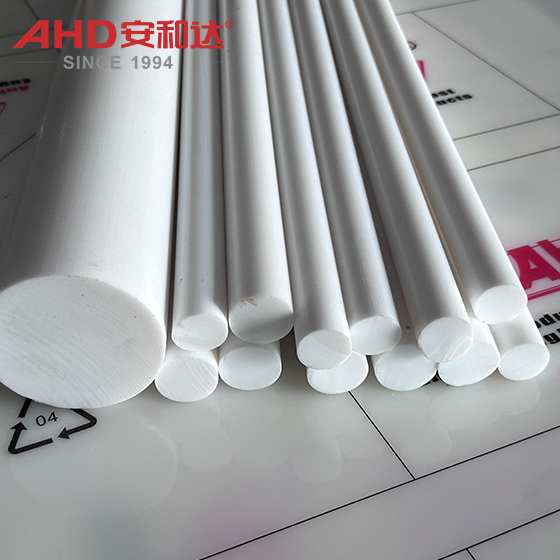
PTFE Rod