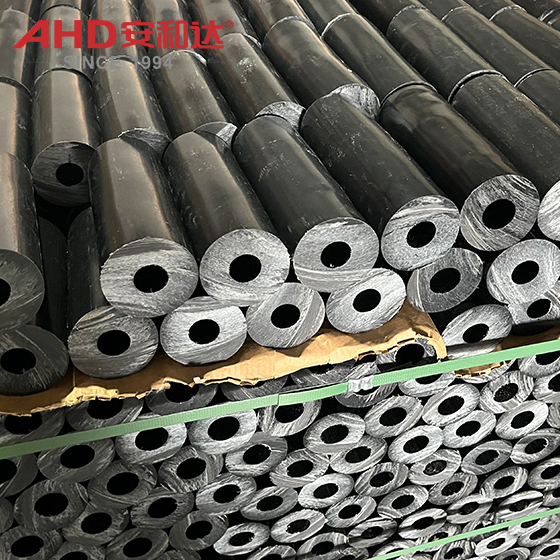
Did you know? Hidden in industrial workshops is a "plastic tough guy"—POM thick-walled tubing. Despite its plastic body, it rivals the rigidity of metal! It's as hard as steel (elastic modulus exceeding 2.5 GPa), yet half the weight of steel; its surface has a built-in "lubricating buff" (friction coefficient as low as 0.1), allowing bearings to remain sturdy even after 100,000 rotations; it doesn't become brittle at -40°C, nor soften at 100°C, and it doesn't expand when soaked in hydraulic oil (water absorption rate <0.2%). Hydraulic system pipelines in factories, robot joint bushings, and guide rail sleeves in precision machine tools all love using it—no lubrication or maintenance required, and its precision remains unchanged for ten years. Today, let's delve into its "hardcore genes"!
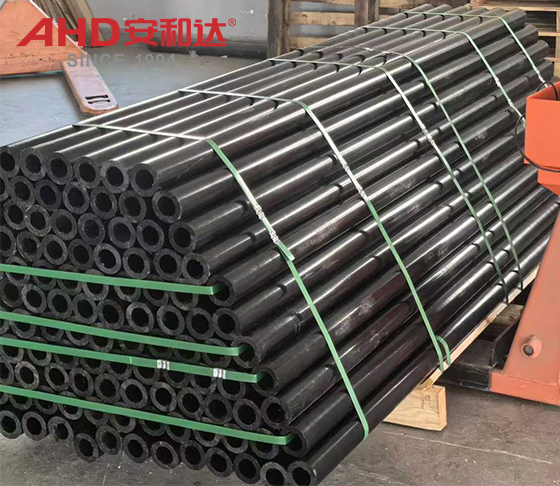
I. Production Method of POM Thick-Walled Pipes
POM (Polyoxymethylene) thick-walled pipes are mainly produced through plastic extrusion molding. The specific process is as follows:
Raw Material Preparation: POM resin (homogeneous or copolymerized polyoxymethylene) is used as the main material, with a small amount of additives (such as antioxidants, lubricants, and release agents) added to improve processing stability and pipe performance.
Melting and Plasticizing: The raw material is added to an extruder and heated by screw rotation and shearing (processing temperature approximately 180-210℃, which needs to be strictly controlled to avoid decomposition), melting it into a homogeneous melt.
Die Forming: The melt is extruded through a die (annular die) to form a pipe blank. Due to the large wall thickness, the die gap and extrusion speed need to be adjusted to ensure uniform melt flow.
Cooling and Shaping: The pipe blank enters a sizing sleeve (vacuum or pressure cooling) and is rapidly solidified by water or air cooling. Thick-walled pipes require extended cooling time or segmented cooling to avoid deformation or internal stress caused by internal and external temperature differences.
Traction Cutting: The pipe is pulled out at a uniform speed by a traction machine and cut into fixed lengths as required.
Note: Compared to thin-walled pipes, thick-walled pipes (usually with a wall thickness > 5mm) require more attention to cooling uniformity and mold design to prevent shrinkage cavities or warping.
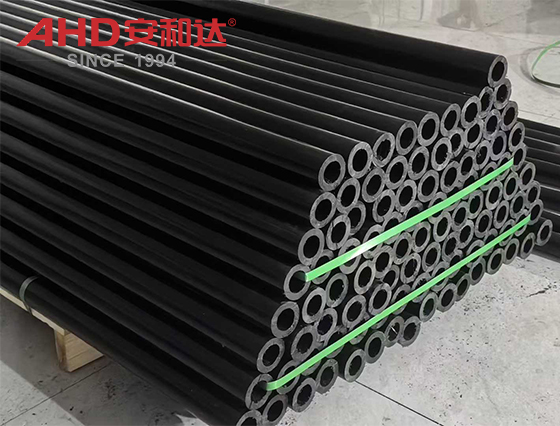
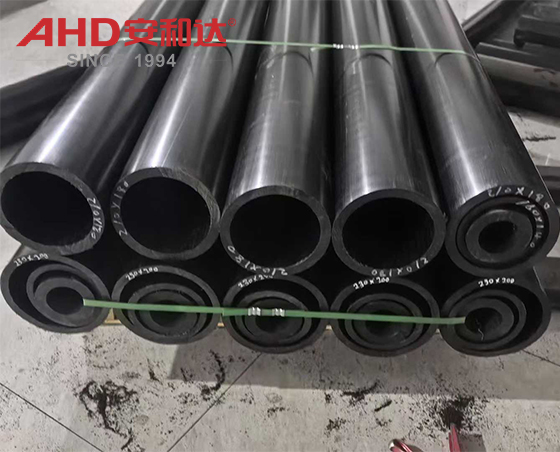
AHD Hollow POM Rod
II. Typical Applications of POM Tube
Due to its high rigidity, friction resistance, and fatigue resistance, POM thick-walled tubes are primarily used in high-precision, high-load mechanical structures, such as:
Mechanical transmission components: bearing cages, gear bushings, guide rail bushings (utilizing its self-lubricating properties to reduce friction loss).
Fluid transport: low-pressure hydraulic/pneumatic pipelines (transporting oils, neutral gases), precision instrument circulating cooling pipes (temperature resistant and dimensionally stable).
Automotive industry: fuel pump brackets, wiper linkage sleeves, seat adjustment mechanism guide rods (oil resistant, aging resistant).
Electronics and electrical appliances: insulating sleeves (high electrical insulation), motor end cap support tubes (vibration resistant).
Medical equipment: surgical instrument guide tubes (resistant to disinfectant corrosion).
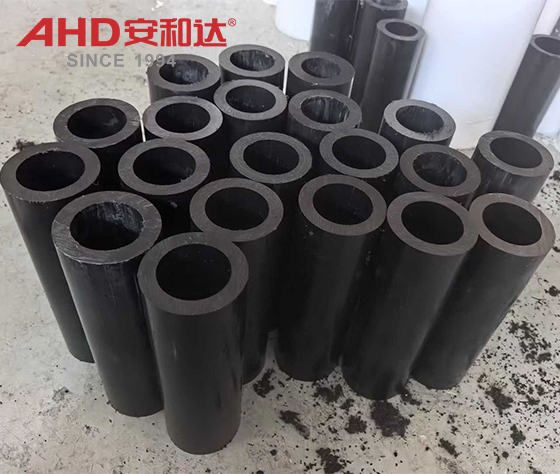
Hollow Polyoxymethylene Rod
III. Secondary Processing of POM Thick-Walled Pipes
POM material is easy to cut and weld. Common secondary processing methods include:
Machining: Turning (precision cutting), milling (grooving/drilling), drilling, tapping (for threaded connections), resulting in a high surface finish.
Heat Treatment: Heating to 120-150℃ allows for bending or flaring (temperature control is necessary to avoid decomposition), but thick-walled pipes require localized heating due to slow heat conduction.
Connection Processing:
Adhesive Bonding: Using POM-specific adhesives (such as epoxy or cyanoacrylate), surface sanding is required to enhance adhesion.
Welding: Hot plate welding (200-220℃), ultrasonic welding (high-frequency vibration heat generation), suitable for butt welding of large-diameter pipes.
Mechanical Connections: Threaded, flanged, or compression fitting connections (pre-processing of interfaces is required).
Surface Treatment: Painting (primer required), laser marking (marking), but POM has low surface energy, requiring pre-treatment (such as corona treatment) to improve adhesion.
IV. Advantages of POM Thick-Walled Tubes
Compared to other engineering plastics (such as PC) or metals, the core advantages of POM thick-walled tubes are:
High Mechanical Properties: Tensile strength (60-70MPa) is close to that of metals; rigidity (elastic modulus 2.5-3.5GPa) is excellent; long-term fatigue resistance (long life under repeated loads).
Low Coefficient of Friction (0.1-0.3): Good self-lubricating properties, reducing friction in sliding scenarios without additional lubrication.
Chemical Resistance: Resistant to organic solvents (such as oils and alcohols) and weak acids and alkalis, superior to the hygroscopic defects of PA (nylon).
Dimensional Stability: Hygroscopicity <0.2%, less affected by temperature and humidity, suitable for precision applications.
Electrical Insulation: Volume resistivity >10¹⁴Ω·cm, suitable for electrical insulation.
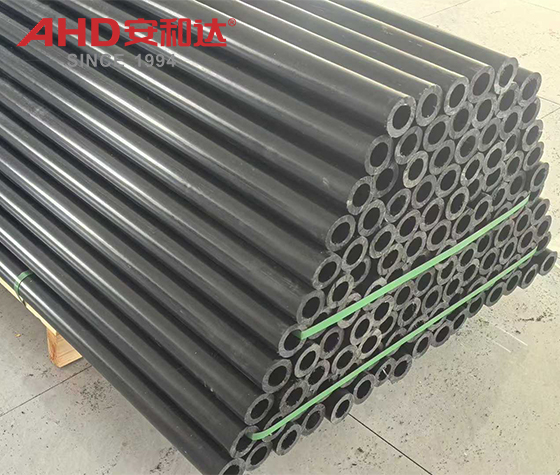
AHD POM Tube
V. Scenarios Where HDPE Thick-Walled Pipes Replace POM Thick-Walled Pipes
HDPE (High-Density Polyethylene) is a semi-crystalline plastic with significantly different performance characteristics from POM. It can be replaced in the following situations:
Cost-Sensitive: HDPE raw material prices are lower than POM, making it suitable for low-cost applications.
Impact/Low-Temperature Resistance: HDPE has an elongation at break >500% (POM approximately 15-30%), offering superior impact resistance (especially at low temperatures), making it suitable for outdoor or dynamic load applications (such as agricultural irrigation pipes and landfill leachate pipes).
Environmental Stress Cracking Resistance: HDPE exhibits better resistance to acids, alkalis, salt solutions, and oils (POM is easily corroded by strong acids and alkalis), making it suitable for chemical liquid transportation.
Large-Diameter/Thick-Walled Light-Load Applications: HDPE has a lower density than POM, making it lighter for the same wall thickness, suitable for large-diameter water supply and drainage pipes.
Note: HDPE has limitations in mechanical strength (tensile strength 20-30MPa), rigidity, and temperature resistance (long-term use temperature ≤60℃) compared to POM. Therefore, it cannot replace POM in applications requiring high load, high precision, or high temperature (>80℃).
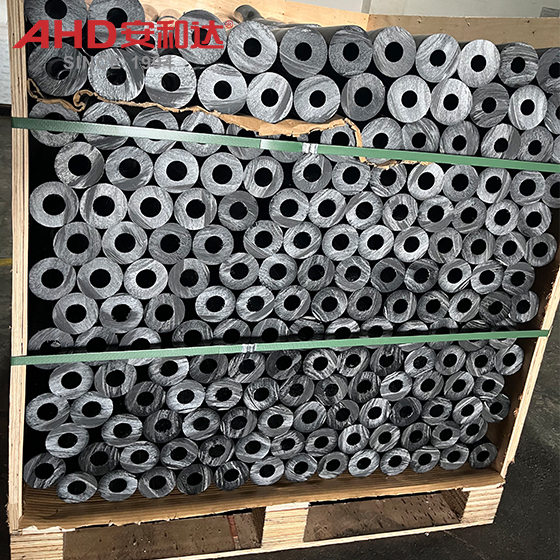
POM Tubes Packing
POM thick-walled pipes dominate precision machinery and structural component applications due to their high rigidity, abrasion resistance, and dimensional stability; HDPE, on the other hand, is more advantageous in light-load, outdoor, or large-diameter pipelines due to its low cost, impact resistance, and chemical resistance. When choosing between these options, a balance between performance and cost-effectiveness must be struck based on specific operating conditions (load, temperature, medium, cost).