

In the industrial processing field, (Ultra High Molecular Weight Polyethylene)UHMWPE sheet has become the preferred material for many industries due to its excellent wear resistance and self-lubricating properties. However, cold flow deformation has always been a core problem for practitioners during UHMWPE sheet processing. Many companies experience dimensional deviations and performance degradation due to cold flow deformation during UHMWPE Sheet production, resulting in cost waste. Today, we will focus on cold flow deformation in UHMWPE processing, comprehensively dissecting the characteristics of the UHMWPE sheet, the nature of cold flow deformation, its causes, preventive measures, and treatment methods. At the same time, we will help you understand the multiple advantages of UHMWPE sheet, assisting practitioners in efficiently avoiding processing problems and selecting high-quality UHMWPE sheets and bars.
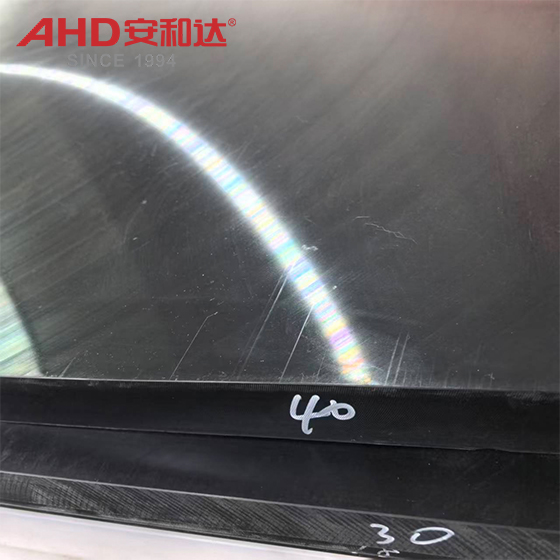
AHD UHMW Polyethylene Sheet
UHMWPE Sheet, short for Ultra-High Molecular Weight Polyethylene Sheet, is a sheet or rod-shaped engineering plastic product made from linear polyethylene with a molecular weight of over 1 million through specific processing techniques. It is one of the most basic and widely used forms of UHMWPE material. Its core characteristic stems from its ultra-long molecular chain structure, which determines its fundamental difference from ordinary polyethylene sheets (such as HDPE).
In terms of core parameters, UHMWPE Sheet has a density of only 0.93-0.95 g/cm³, making it lightweight and easy to install; its operating temperature range covers -269℃ to 100℃, maintaining excellent toughness even at low temperatures without becoming brittle; its coefficient of friction is as low as 0.07-0.11, only slightly higher than polytetrafluoroethylene (PTFE), exhibiting excellent self-lubricating properties; its wear resistance is among the highest of plastics, while also possessing extremely strong impact resistance, chemical stability, and extremely low water absorption (<0.01%). It is non-toxic, odorless, and meets food-grade and medical-grade standards.
In applications, UHMWPE sheets are widely used in various industries, including coal, mining, food, chemical, medical, and logistics. They can be used as silo liners, conveyor rails, equipment linings, and operating table panels. Their core function is to solve industrial pain points such as wear, corrosion, and material blockage, achieving a lightweight, low-maintenance solution that replaces steel with plastic, significantly reducing equipment wear and operating costs for businesses.
It is important to note that due to the extremely high molecular weight and severe molecular chain entanglement of UHMWPE sheets, their extremely high melt viscosity and poor flowability make them far more difficult to process than ordinary plastic sheets. Cold flow deformation is one of the most common quality problems during processing, directly affecting the dimensional accuracy and performance of UHMWPE sheets.

What is cold flow deformation during UHMWPE processing?
Cold flow deformation during UHMWPE processing is essentially an irreversible plastic deformation that occurs when UHMWPE material is subjected to continuous external forces (such as pressure, tension, and cutting forces) at temperatures below its melting point during processing (including molding, cutting, and assembly). The molecular chains slowly slip and rearrange, resulting in this deformation. It can also be understood as the material's "creep" phenomenon—a slow, time-dependent deformation under continuous stress below its yield strength. This is a unique mechanical behavior of polymer materials.
Unlike hot deformation, cold flow deformation occurs at room temperature or lower temperatures, without the need for high-temperature triggering. The deformation process is slow and insidious, and may be difficult to detect initially. However, with the passage of time or continued external force, the deformation gradually accumulates, eventually leading to product failure.

III. Causes of Cold Flow Deformation in UHMWPE Processing
The formation of cold flow deformation in UHMWPE processing is actually the result of the combined effects of the material's inherent properties, processing technology, and environmental conditions.
(I) Material Inherent Properties: The Intrinsic Root Cause of Cold Flow Deformation
The unique molecular structure of UHMWPE sheets is the fundamental reason for its susceptibility to cold flow deformation. UHMWPE has a molecular chain length 10-20 times that of HDPE, an extremely high molecular weight, and extremely strong entanglement between molecular chains. However, the molecular chains are relatively weak in rigidity, and the intermolecular forces are relatively small, lacking sufficient rigid support.
At room temperature, the molecular chains of UHMWPE are in a disordered entangled state. When subjected to continuous external force, the originally entangled molecular chains gradually slip, orient, and rearrange. As the external force continues, the amount of molecular chain slip gradually increases. Once a critical value is exceeded, the molecular chains cannot return to their original entangled state, thus forming irreversible cold flow deformation.
Meanwhile, UHMWPE has a high degree of crystallinity, with tightly packed molecular chains in the crystalline regions but loosely packed molecular chains in the amorphous regions. Under stress, the molecular chains in the amorphous regions are more prone to slippage, leading to localized concentrations of cold flow deformation, such as at the edges of the sheet and in weak areas like holes.
(II) Improper Processing Technology: The Main Cause of Cold Flow Deformation
Processing technology is the most critical external factor affecting cold flow deformation of UHMWPE sheets.
1. Inappropriate Molding Process: UHMWPE sheets are mainly molded using pressing and sintering, and extrusion molding, among which pressing and sintering is a traditional and commonly used process. If the sintering temperature is too high or too low, or the pressure is insufficient or unevenly distributed, it will lead to uneven stress distribution and disordered molecular chain arrangement within the molded sheet. During subsequent processing or use, stress release will trigger cold flow deformation. Furthermore, excessively rapid cooling will result in a large internal temperature gradient within the sheet, generating internal stress and increasing the risk of cold flow deformation. The optimal cooling method is slow cooling to room temperature in the furnace to avoid stress accumulation caused by sudden cooling.
2. Inappropriate cutting parameters: Excessive cutting speed or feed rate can generate excessive heat during cutting, potentially softening the material surface and reducing the stability of molecular chains.
3. Improper drilling process: Excessive drilling speed, dull drill bit, or lack of cooling during drilling can cause the material around the hole to soften due to heat. Simultaneously, the pressure from the drill bit can cause slippage of molecular chains around the hole, resulting in cold flow deformation such as hole displacement, increased hole diameter, and hole wall concavity.
(III) Environmental Conditions: Auxiliary Factors of Cold Flow Deformation
While environmental temperature and other conditions are not the primary cause of cold flow deformation, they can accelerate its occurrence:
Temperature Influence: When the ambient temperature rises (above 40℃), the mobility of molecular chains increases, the slip velocity of molecular chains accelerates, and the rate of cold flow deformation significantly increases. Above 80℃, the mobility of molecular chains is greatly enhanced, and deformation becomes significantly more severe.

Beyond simply avoiding deformation: The multiple advantages of UHMWPE Sheet
With proper scientific prevention, this problem can be effectively avoided, and its numerous superior properties make its application value in the industrial field irreplaceable.
1. Excellent wear resistance: This is the core advantage of UHMWPE Sheet. Under conditions of abrasive wear and adhesive wear, its service life far exceeds that of traditional metal materials, significantly reducing equipment wear and replacement costs. It is especially suitable for use as silo liners, conveyor rails, and other easily worn components.
2. Excellent self-lubricating properties: With a coefficient of friction as low as 0.07-0.11, only slightly higher than PTFE, it can operate smoothly without the need for additional lubricants. This effectively reduces equipment operating resistance and energy consumption, while avoiding lubricant contamination of materials, making it suitable for industries with high hygiene requirements such as food and medical.
3. Exceptional Impact Resistance: UHMWPE Sheet boasts top-tier impact resistance and maintains its toughness even at -196℃ liquid nitrogen temperatures, preventing brittleness and withstanding material impacts, equipment vibrations, and other external forces without easily breaking.
4. Excellent Chemical Stability: It exhibits good corrosion resistance to most acids, alkalis, salts, and organic solvents (except for strong oxidizing acids such as concentrated nitric acid and concentrated sulfuric acid), allowing for long-term use in corrosive environments such as chemical plants and mines.
5. Lightweight and Ease of Processing: With a density of only 0.93-0.95 g/cm³, it is lightweight, facilitating handling, installation, and maintenance. It can be processed into various shapes and sizes using conventional processes such as cutting, drilling, and welding to meet the customized needs of different industries. Although processing is more challenging than with ordinary plastics, efficient production is possible with mastering the techniques.
6. Safe, environmentally friendly and adaptable to multiple scenarios: Non-toxic and odorless, meets FDA standards, and can be used in food processing, medical equipment and other fields; extremely low water absorption (<0.01%), good dimensional stability, and not easily deformed due to moisture.

Cold flow deformation during UHMWPE processing is not an insurmountable problem. UHMWPE sheets, with their diverse advantages such as wear resistance, self-lubrication, and impact resistance, are widely used in various industrial fields, providing strong support for enterprises to reduce costs and improve efficiency.
Whether you need standard-sized UHMWPE sheets or customized UHMWPE plates and bars, AHD can provide you with professional products and technical support to help you achieve efficient production and reduce costs. Welcome to purchase UHMWPE plates and bars from AHD and unlock the core value of UHMWPE material!
