In the industrial processing field, PTFE sheets and rods are widely used for their excellent corrosion and high-temperature resistance. However, the processing of PTFE sheets and rods often causes headaches for practitioners. Many have reported issues such as deformation, burrs, and cold flow during processing. Today, we will focus on the pain points of PTFE Sheet and rod processing, break down the essence of the problems, analyze the causes, and provide practical prevention and treatment solutions to help everyone avoid processing pitfalls.
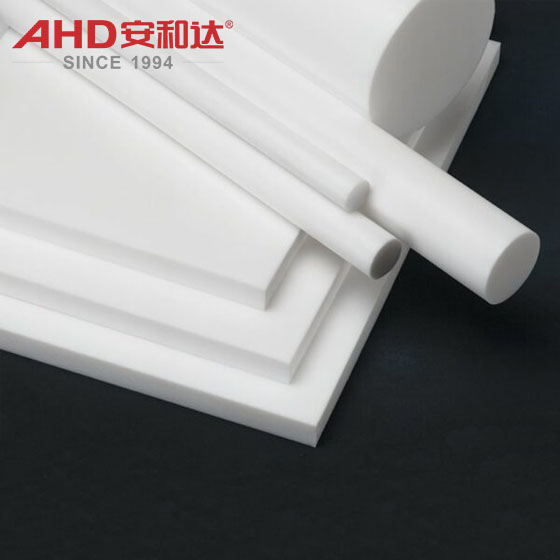
PTFE (polytetrafluoroethylene), commonly known as the "king of plastics," is a fluorinated polymer material. PTFE sheets and rods are commonly used profiles manufactured through molding and sintering or extrusion sintering processes, and are the most basic and commonly used form of PTFE products in industrial applications.
The core characteristics of PTFE sheets and rods are their extremely high chemical stability, virtually unaffected by strong acids, strong alkalis, and organic solvents. They have a wide operating temperature range of -180℃ to 260℃, along with an extremely low coefficient of friction and excellent insulation properties. Therefore, they are widely used in various industries such as chemical, electrical, mechanical, and aerospace. However, these very characteristics also make PTFE sheets and rods difficult to process.
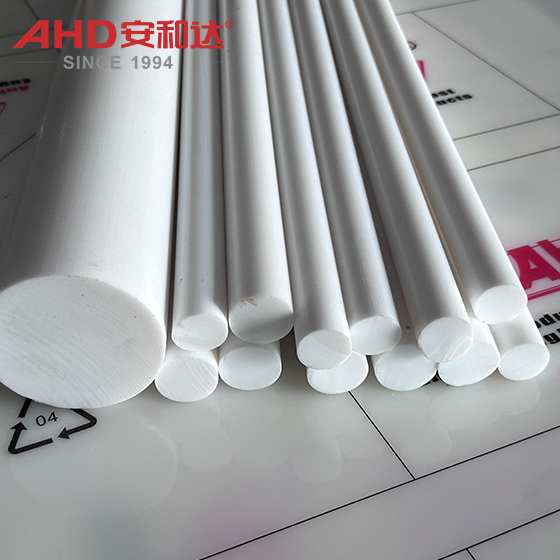
AHD PTFE Rod
Have you encountered these core pain points in PTFE sheet and rod processing?
1. Deformation makes dimensional accuracy difficult to control.
This is the most common pain point in PTFE sheet and rod processing. Whether cutting and milling PTFE sheets, or turning and drilling PTFE rods, deformation is common.
2. Burrs and cold flow easily occur during cutting, resulting in poor surface quality.
PTFE material is relatively soft, but its molecular chains are rigid. During cutting, a "cold flow" phenomenon easily occurs—the material slowly plastically flows under stress, leading to bumps, burrs, and even tool adhesion on the processed surface.
3. Difficult bonding and challenging surface treatment.
PTFE has extremely low surface energy and lacks adhesive properties. Whether bonding with other PTFE products or compounding with metals, rubber, or other materials, it is difficult to form a strong bond.
4. Prone to cracking and delamination during processing.
Some sheets and rods, especially thick-walled PTFE sheets and filled PTFE rods, may develop internal cracks or surface delamination during processing.
5. High coefficient of thermal expansion, processing heat easily causes malfunctions
During processing, the heat generated by cutting causes localized heating of PTFE sheets and bars, resulting in thermal expansion. After cooling, they will contract, leading to dimensional deviations and deformation.
III. Causes of Pain Points: 4 Core Factors from Materials to Processes
The formation of pain points in PTFE Plate and rod processing is not caused by a single factor, but rather by the combined effects of material properties, processing technology, equipment, and operating procedures. Specifically, these can be categorized into four types:
1. Material Characteristics: Inherent "Shortcomings" Leading to High Processing Difficulty
This is the most fundamental reason. PTFE melt has extremely high viscosity and hardly flows in the molten state, making it impossible to mold using conventional thermoplastic injection molding or extrusion methods. It can only be produced into sheet and rod blanks through compression molding and sintering, with subsequent processing relying on mechanical cutting, which inherently increases processing difficulty. Simultaneously, PTFE is soft and has poor thermal conductivity, preventing the rapid dissipation of cutting heat and easily leading to localized overheating; its low surface energy and weak intermolecular forces easily generate cold flow and burrs, and it is also difficult to bond with other materials; its high coefficient of thermal expansion and poor creep resistance further exacerbate deformation and cracking problems. Furthermore, insufficient purity of the PTFE sheet and rod raw materials, batch mixing, or uneven dispersion of fillers (such as glass fiber and bronze powder) also increase the probability of processing pain points. 2. Inappropriate processing technology: Improper parameter settings are the main contributing factor.
3. Poor equipment and tool compatibility: The adage "A skilled craftsman must first sharpen his tools" fails to apply.
4. Non-standard operating procedures: Human factors exacerbate the pain points.
IV. Pain Point Prevention: Proactive Avoidance to Reduce Processing Losses
1. Select High-Quality Raw Materials and Control Quality at the Source
Prioritize the use of high-purity, batch-consistent PTFE raw materials; select reputable manufacturers during procurement to ensure uniform density and absence of internal defects in PTFE sheets and rods, reducing the probability of processing pain points from the source.
2. Optimize Processing Techniques and Precisely Control Parameters
Optimize process parameters based on the size, thickness, and processing method of the PTFE sheets and rods; use compressed air or dedicated coolant for cooling during processing to promptly remove cutting heat and prevent thermal expansion and cold flow; leave a 1-2mm allowance after rough machining, and perform finish machining only after the workpiece has completely cooled and residual stress has been released to ensure dimensional accuracy. During the molding and sintering stage, large-size PTFE sheets and rods require segmented pressurization and slow heating/cooling to ensure uniform compact density and reduce residual stress.
3. Adapt Equipment and Tools to Improve Machining Accuracy
Select high-precision, low-vibration machine tools. Before machining, debug the machine tool to ensure spindle runout and guideway parallelism meet requirements. Select cutting tools suitable for PTFE machining, keep cutting edges sharp, and regularly sharpen or replace tools. Ensure secure clamping to prevent displacement during machining.
4. Standardize Operating Procedures to Reduce Human Error
Establish standardized operating procedures. Operators must undergo professional training before starting work: Clean the cutting tools, worktable, and PTFE sheet/bar surfaces before machining; precisely control the clamping force; promptly remove chips during machining.
5. Perform Pre-treatment to Release Residual Stress
For PTFE sheets/bars requiring high precision, annealing can be performed before machining to reduce deformation and cracking during processing. For filled PTFE sheets/bars, check the filler dispersion before machining to avoid machining problems caused by uneven filling.

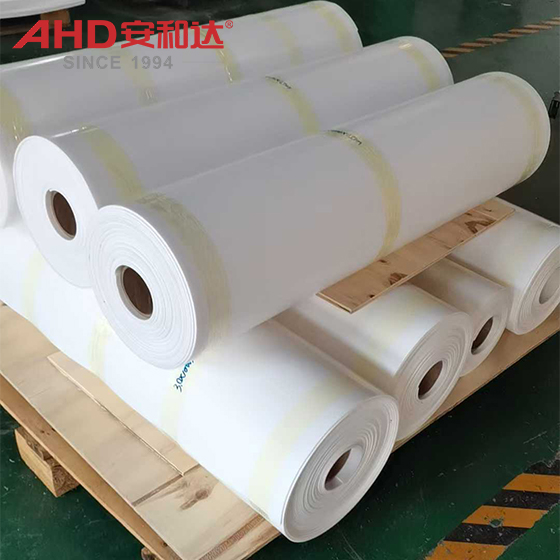
AHD PTFE Roll Sheet
While PTFE sheet and rod processing presents challenges, its superior performance gives it irreplaceable advantages in industrial applications.
Its chemical stability is extremely high, tolerating almost all strong acids, strong alkalis, and organic solvents, allowing for long-term use in harsh chemical environments without concern for corrosion damage.
It exhibits excellent high and low temperature resistance, maintaining stable performance within a temperature range of -180℃ to 260℃, making it suitable for high and low temperature operating conditions.
It has an extremely low coefficient of friction and good self-lubricating properties, making it suitable for manufacturing sliding bearings, guide rails, and seals, reducing mechanical wear and extending equipment lifespan.
It possesses excellent insulation properties, making it suitable for insulating electrical equipment and preventing potential leakage hazards.
It has extremely low water absorption and good moisture resistance, making it suitable for use in humid environments without affecting its performance stability.
It offers flexible molding capabilities, allowing for the production of workpieces of various specifications and shapes through machining, adapting to the needs of different industrial scenarios.
Choose AHD to easily avoid processing pain points.
To reduce the pain points of PTFE sheet and rod processing from the source, choosing high-quality PTFE sheet and rod raw materials is crucial. AHD has many years of experience in plastic sheet and rod production, possessing professional production technology and a comprehensive quality control system. Choose AHD to source high-quality PTFE sheets and rods, making processing easier and more efficient!