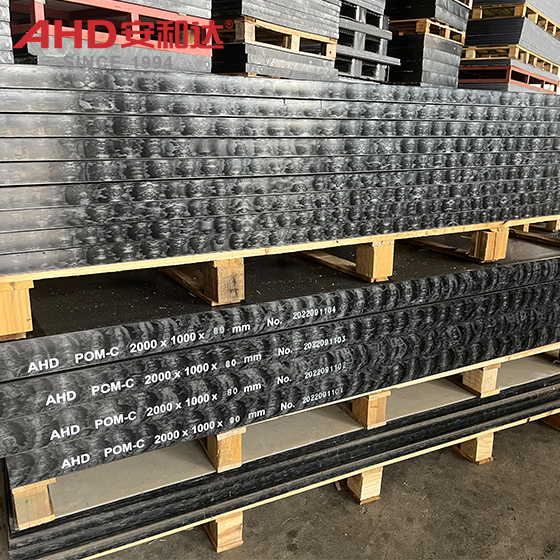
Have you ever encountered these pitfalls when purchasing POM (Polyoxymethylene) sheets: choosing cheap materials only to experience frequent wear and cracking, using the wrong type leading to substandard dimensional accuracy, or rapid aging and failure under high temperature/humidity conditions, ultimately resulting in rework costs far exceeding the material price difference? Improper matching of POM (Polyoxymethylene) homopolymer/copolymer, modification type, and performance parameters can directly impact product lifespan and production efficiency. This article uses professional data and comparisons to teach you how to make accurate selections, ensuring you choose the right material the first time and avoid rework.
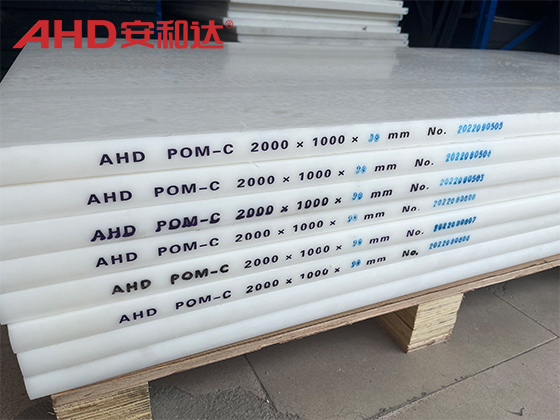 AHD POM Sheet (Polyoxymethylene Sheet)
Ⅰ. distinguish between homopolymer POM sheets and copolymer POM sheets.
POM sheets fall into two main categories, with vastly different performance and applicable scenarios. Choosing the wrong one can lead to problems.
| Performance | Homopolymer POM sheet (POM-H) | Copolymer POM sheet (POM-C) | Key Selection Criteria |
| Tensile strength: | 70–85 MPa | 60–70 MPa | Homopolymer content: 10%–15%, heavy-duty preferred |
| Long-term temperature resistance: | 90–100℃ | 80–90℃ | Homopolymer has a high temperature resistance of 5–10℃, making it ideal for high-temperature applications. |
| Chemical resistance | Sensitive to strong acids/alkalis | Superior resistance to acids, alkalis, and solvents | Copolymer is preferred for moisture/chemical contact |
| Thermal stability | Easy to decompose during processing | More stable molding | Copolymers are recommended for batch processing |
| Cost | Higher | Lower, higher cost-performance ratio | General components prioritize copolymerization |
| Typical Applications | Precision gears, bearings, heavy-duty slides | Valves, bathroom valve cores, electronic structural components | High precision: homopolymer; general purpose: copolymer |
For high strength, high precision, and high temperature resistance, choose homopolymer POM; for chemical resistance, easy processing, and low cost, choose copolymer POM. In 90% of general applications, copolymer is the more reliable choice.

Polyacetal Sheet
Ⅱ. Core Performance Parameters: 5 Key Indicators to Consider When Selecting a Model
1. Mechanical Properties: Determines Load-Bearing Capacity
Tensile Strength: ≥60 MPa (copolymer) / ≥70 MPa (homopolymer); values below this are prone to deformation and breakage.
Flexural Strength: ≥90 MPa, ensuring structural rigidity, suitable for load-bearing components such as sliders and guide rails.
Notched Impact Strength: 6–8 kJ/m² (copolymer), superior impact resistance compared to ordinary plastics, preventing brittle fracture.
Fatigue Resistance: Leading among engineering plastics; no significant attenuation after 10⁶ repeated bending, suitable for dynamic components such as gears.
2. Thermal Properties: Determines the Upper Limit of Operating Temperature
Long-term Operating Temperature: -40℃~100℃; short-term resistance up to 120℃; continuous use above 100℃ will accelerate aging.
Heat Deflection Temperature (0.45 MPa): 110–120℃; for high-temperature applications, choose glass fiber reinforced modified models (up to 140–160℃).
3. Dimensional Stability: A Core Requirement for Precision Components
Water Absorption: ≤0.25% (far lower than 1.5%–3.5% for nylon PA), dimensional change ≤0.1% in humid environments, ensuring precise fit.
Shrinkage: 2.2%–2.5%, high-precision parts require grades with a shrinkage rate ≤2.2% to avoid exceeding assembly clearance limits.
4. Friction and Wear Resistance: Key to Sliding Components
Coefficient of Friction: 0.15–0.25 (excellent self-lubricating properties), suitable for gears and bearings without additional lubrication.
Wear Loss: ≤0.05 cm³/1000 rpm, wear resistance is 3 times that of ABS and 5 times that of ordinary PP, extending component lifespan.
5. Chemical Resistance: Avoid Corrosion Zones
Tolerance: Oils, greases, alcohol, gasoline, weak acids and alkalis
Contraindications: Strong acids (concentrated nitric acid/hydrochloric acid), strong alkalis, strong oxidants, phenols; contact will cause swelling and cracking.
Outdoor Scenarios: UV-resistant modification is required. POM (Polymer Oxide), unmodified version, shows surface brittleness and a strength reduction of over 30% after 3 months of exposure to sunlight.
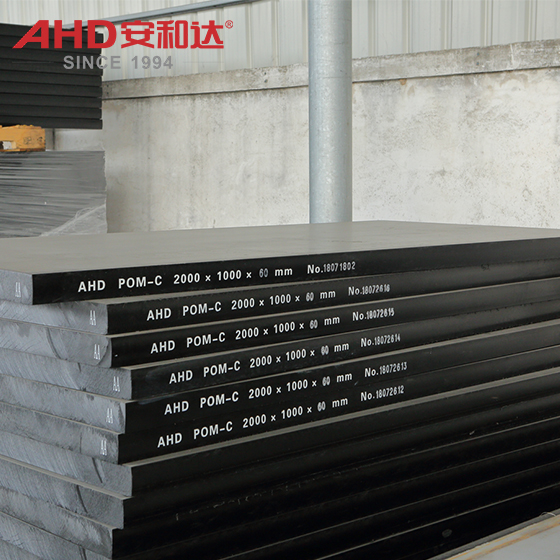
POM Sheet (Delrin Sheet)
Ⅲ. POM Sheet Selection by Scenario: Precise Matching Solutions for Different Industries
1. Machinery/Automation Industry (Gears, Sliders, Guide Rails)
Selection: Homopolymer POM sheet (tensile strength ≥70 MPa, excellent fatigue resistance) or glass fiber reinforced copolymer POM
Data Support: Homopolymer POM gears have a longer lifespan than ordinary copolymers, suitable for 10⁸ cycle loads.
2. Electronics/Electrical Industry (Connectors, Switches, Coil Bodies)
Selection: Low-shrinkage copolymer POM (shrinkage rate ≤2.2%), ensuring precise mating.
Requirements: Insulation resistance ≥10¹⁴ Ω, temperature resistance ≥85℃, avoiding high-temperature deformation leading to poor contact.
3. Automotive Industry (Door Locks, Window Gears, Fuel System Components)
Selection: Oil-resistant copolymer POM or high-temperature resistant modified POM (heat distortion ≥130℃)
Standard: Complies with VW44045 certification, resistant to gasoline/engine oil immersion. No swelling after hours, strength retention ≥95%
4. Bathroom/Daily Necessities Industry (Valve Cores, Zipper Heads, Sprayers)
Selection: Hydrolysis-resistant copolymer POM, no swelling or deformation after long-term water immersion
Advantages: Water absorption rate of only 0.2%, far lower than nylon, avoiding valve core leakage and zipper jamming
5. Medical/Food Industry (Instrument Handles, Food Machinery Parts)
Selection: FDA-certified food-grade POM, odorless, sterilization resistant
Requirements: Meets USP Class VI standards, safe for contact with food/pharmaceuticals, suitable for precision medical components

Ⅳ. POM sheet vs other engineering plastics: Why choose it over others?
| Material | Tensile Strength (MPa) | Water Absorption (%) | Abrasion Resistance | Long-Term Temperature Resistance (°C) | Advantages |
| POM-C (Copolymer) | 60-70 |
0.2-0.25
|
Excellent | 80-100 | Abrasion-resistant + dimensionally stable + self-lubricating |
| Nylon 6 Sheet (PA6 Sheet) | 55-65 | 1.5-3.5 | good | 80-90 | Oil resistant, but absorbs moisture and easily deforms. |
| PC Sheet | 60-70 | 01.-0.3 | General | 120-130 | High impact resistance, poor abrasion resistance |
| ABS Sheet | 40-50 | 0.2-0.4 | Poor | 60-70 | Low cost, low strength |
POM is superior in wear resistance, dimensional stability, and self-lubrication, making it the optimal solution for precision sliding parts such as gears, bearings, and sliders. Replacing metal can reduce weight by 40% and cost by 60%.
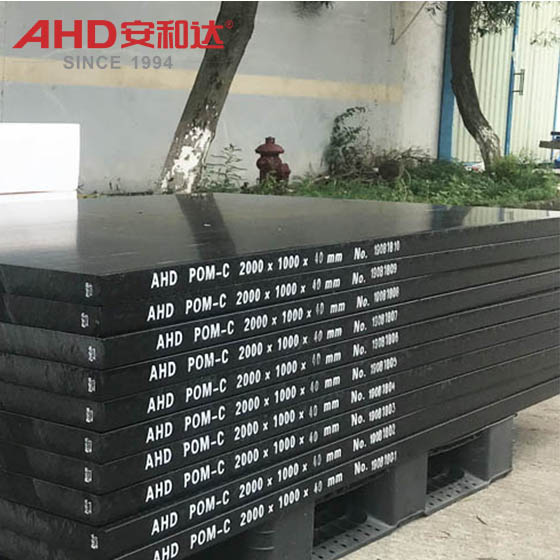
Ⅴ. Selection Pitfalls: 5 Common Mistakes + Solutions
1. Focusing only on price, ignoring performance: Low-priced POM is often made from recycled materials, with tensile strength ≤50 MPa, prone to cracking, and rework costs 3-5 times that of the original material.
2. Confusing homopolymers/copolymers: Using homopolymers in humid environments leads to swelling and leaks after 3 months; using copolymers under heavy loads shortens lifespan by 50%.
3. Ignoring modification requirements: Not using UV-resistant or high-temperature reinforced versions for outdoor applications results in failure within 3-6 months.
4. Ignoring processing compatibility: Choosing low-flow POM (MI<8) for thin-walled parts leads to insufficient adhesive; choosing high-flow POM (MI>15) for thick-walled parts leads to air bubbles.
5. Not conducting compatibility testing: Using ordinary POM directly in chemical environments causes swelling and a sharp drop in strength.
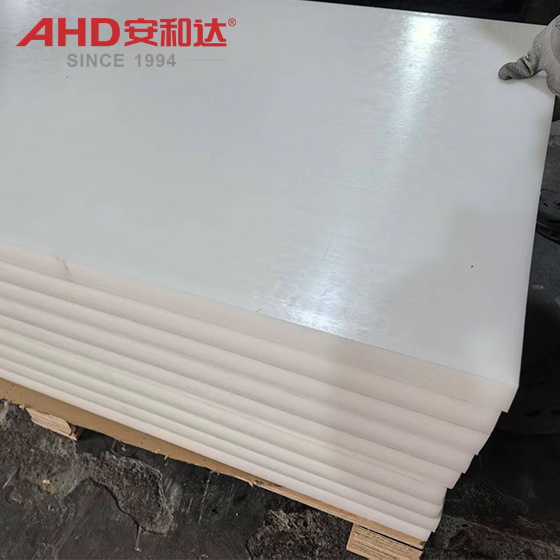
AHD POM Sheets: 30 Years of Professional Manufacturing, Precisely Matched for You
As a manufacturer of plastic sheets and rods for 30 years, AHD specializes in the R&D and production of POM sheets, offering a full range of homopolymer, copolymer, glass fiber reinforced, UV-resistant, and food-grade POM sheets. We rigorously control every performance parameter:
100% tensile strength meets standards; abrasion resistance exceeds industry standards by 15%; dimensional accuracy ±0.05 mm, suitable for precision machining needs; custom thicknesses (1–100 mm) and size cutting are available, supporting small-batch trial production.
If you are struggling to select the right POM sheet or need a customized solution for specific working conditions, contact AHD immediately for a free performance test report and samples. With over 30 years of professional experience, we help you choose the right POM sheet, reducing costs and extending product lifespan!